
Blogging about my Torikae baya manga translation project.
Thoughts from Episode 29: The world beyond the capital, the cast beyond Sara and Suiren
A more typical post today, going over Episode 29 and having a little look at how the cast of the original story expands in Torikae baya.
Suiren, now looking just like Sara used to, is ready to go looking for her brother… except she doesn’t know a lot about going about as a man, riding horses, etc. But with some help from some servants who knew her as a child, she hides away in a palanquin and searches around Heian-kyo. There’s no sign of Sara at Aguri’s home, nor at Saemon’s, but at the latter she spots Tsuwabuki and realises he was Shi no Hime’s secret lover.
A more typical post today, going over Episode 29 and having a little look at how the cast of the original story expands in Torikae baya.
Suiren, now looking just like Sara used to, is ready to go looking for her brother… except she doesn’t know a lot about going about as a man, riding horses, etc. But with some help from some servants who knew her as a child, she hides away in a palanquin and searches around Heian-kyo. There’s no sign of Sara at Aguri’s home, nor at Saemon’s, but at the latter she spots Tsuwabuki and realises he was Shi no Hime’s secret lover.
Meanwhile, Sara is in Uji, encouraging Tsuwabuki to check on the poorly Shi no Hime and generally getting tired of his nonsense. Suiren and her entourage also come to Uji and ask around for a man who looks just like Suiren. Little do they know that Sara is having a stroll nearby with Torako and Toramitsu! Sara gets worked up after seeing a performance involving a tengu, then collapses in pain – but not before making eye contact with Suiren by pure chance. Of course, neither understands what they’ve just seen, and so Suiren departs, believing that Sara is nowhere to be found.
Plenty happens in this chapter, and we get nods to ongoing themes – Suiren’s discomfort in trying to take on a masculine role, Tsuwabuki’s naïve dreams of a happy family with as many wives as he likes, the seemingly mystical connection between Sara and Suiren, even a tengu! – with some striking visuals along the way. I’ll have more to say about these things later, but today, I want to return to an old topic and talk about the cast of Torikae baya.
The source material doesn’t introduce a lot of specific characters, and even fewer by a consistent name or identifier. Most of them appear in the manga too, in some cases being given nicknames in addition to their changing ranks. The most obvious examples are Sarasoju and Suiren, whom we might have some difficulty recognising at this point in the story, with Sara staying at Tsuwabuki’s villa dressing in women’s clothes and Suiren searching for him while dressed in men’s clothes.
But of course, manga is not the same as a (mostly) prose narrative from the Heian period. In totally verbal storytelling, only the plot-significant characters really need to be mentioned, and the reader’s imagination can fill in the blanks with as many background figures as one might expect in the busy palace. But unless you go all closeups all the time, a manga adaptation needs to show the Heian court in action, so a handful of characters just isn’t enough!
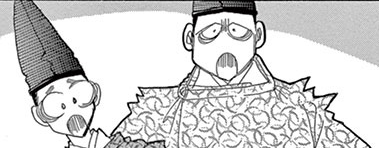
Sara imagines Akimasa and Tadasuke’s reaction.
Panel from volume 4, page 7. ©Chiho Saito/Shogakukan
That means some characters from the original story have new, expanded roles, such as Togu, Umetsubo, and to a lesser extent, people like Aguri and Saemon. In addition to those, though, are many, many more. Some character designs reappear, suggesting they are meant to be the same person showing up again and again. I asked Saito about whether she had names or titles in mind for any of the unidentified background characters, and she indicated that she avoided doing that as she didn’t feel confident enough about the time period to get it right when going beyond the source material. But she does name new characters sometimes. The danger of getting details wrong is often mitigated by having the identified characters be true one-offs whom we never hear from again, but there are quite a few who are recurring characters.
The most prominent of these so far are probably Tachibana no Akimasa and Minamoto no Tadasuke, the Lenny and Carl of Sara and Tsuwabuki’s work lives. Their purpose in the story is to demonstrate that Sara is well-liked at court and has friends who aren’t Tsuwabuki: they show up at social events, and theirs are the faces Sara pictures in Episode 16 when he worries about people’s reactions if they were to learn of his secret. They appear several times, and Akimasa is also integrated a bit more into the goings-on of the Heian court, turning out to have a job as a high steward (式部 の 大輔 – shikibu no taifu) under Shikibu-kyo no Miya.
A few named minor characters appear in Episode 29. Torako and Toramitsu arguably appear in the original story – there are brief mentions of children of the siblings’ wetnurses – but otherwise they’re pretty much new characters. Torako in particular plays a fairly substantial role, continuing to serve Sara even long past this point in the story.
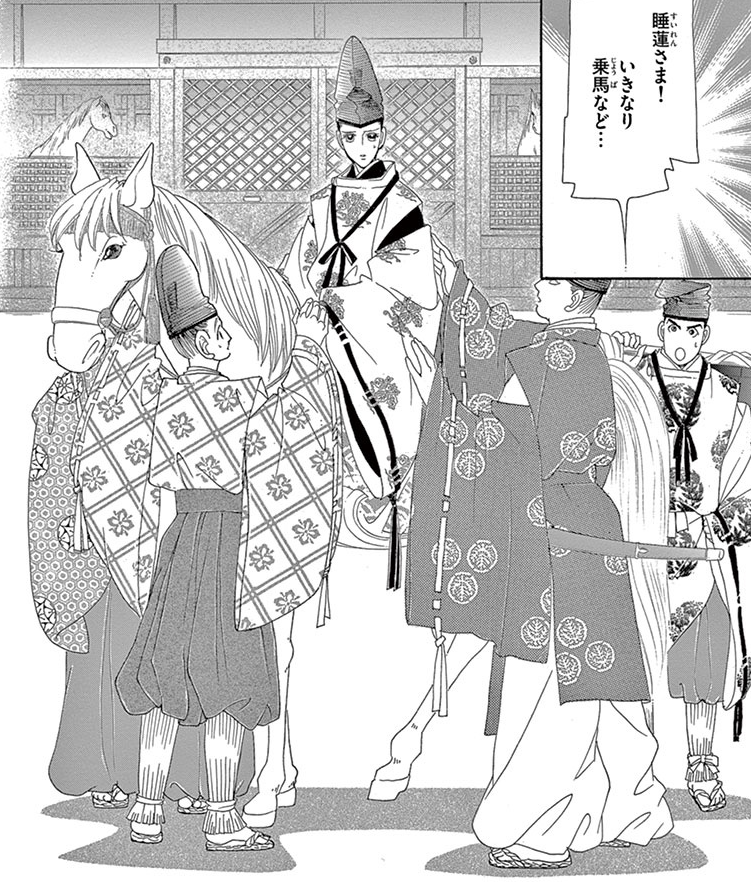
Pictured: Suiren (dressed as Sara), Gyuomaru, Jiroemon, Hayabusamaru, another guy.
Panels from volume 6, page 118. ©Chiho Saito/Shogakukan
We’re introduced to Suiren’s male servants too. One is apparently Sara’s former stable hand, and he introduces himself as Gyuomaru, while another is called Jiroemon. Suiren’s mother picked out these two and three other unnamed guys specifically because they knew Suiren as a child, and it’s possible these also correspond to the vague “wetnurse’s children” from Torikaebaya monogatari, but they’re effectively new characters. And besides them, this chapter mentions other people in passing, like Kakumitsu’s wife/Shi no Hime’s mother – who later makes a brief appearance – and Jiroemon’s aunt, a maid named Hiiragi. We even learn that Sara’s old horse is called Hayabusamaru!
While not every chapter has quite so many recurring or named characters, it’s fair to say that Saito does expand on the core cast more than she thought she dared to. And I think it’s for the best! It just wouldn’t be very interesting if an adaptation in a visual medium like manga didn’t show a bit more life in Heian-kyo, so adding these supporting characters is arguably just as important as showing all the historical architecture and beautiful clothes.
I’ve been meaning to put together a chart of the characters and their relationships at some point, a bit like the ones that already exist in the manga volumes. Of course, including everyone would make it much more complicated than the existing charts, and that’s what’s stopped me so far… but I still want to do it one of these days!