
Blogging about my Torikae baya manga translation project.
Summary and observations on Volume 8: New relationship drama for Sara and Suiren
This is the first of five posts summarising the volumes of Torikae baya that cover the period after the siblings’ big switch and before the manga’s conclusion. Something to bear in mind as we go on is that although I’ll continue to refer to Sara and Suiren as the characters we know, most people at court think that each sibling is the other – making everything a bit confusing!
At the end of Volume 7, Sara was working as Togu’s naishi no kami alongside San no Hime, and getting the first inklings that he might have a thing for the Emperor. That situation and its ongoing developments take centre stage in Volume 8.
This is the first of five posts summarising the volumes of Torikae baya that cover the period after the siblings’ big switch and before the manga’s conclusion. Something to bear in mind as we go on is that although I’ll continue to refer to Sara and Suiren as the characters we know, most people at court think that each sibling is the other – making everything a bit confusing!
At the end of Volume 7, Sara was working as Togu’s naishi no kami alongside San no Hime, and getting the first inklings that he might have a thing for the Emperor. That situation and its ongoing developments take centre stage in Volume 8.
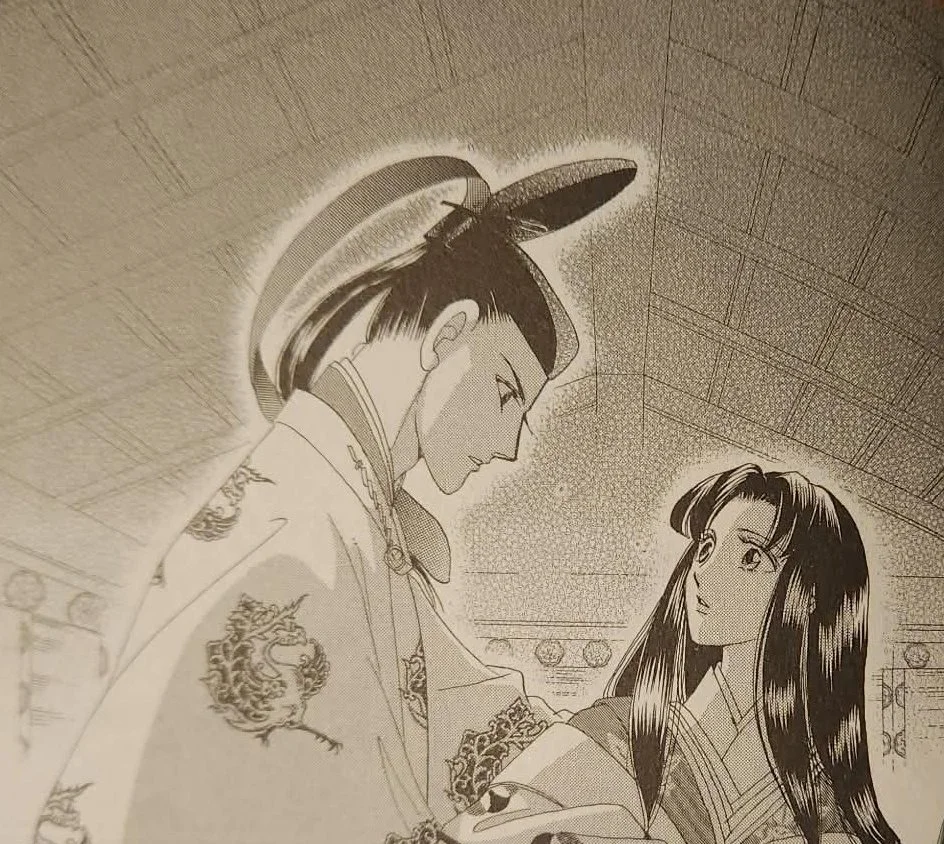
Cropped panel from volume 8, page 79.
©Chiho Saito/Shogakukan
Ahead of a party for the Tookanya festival (on the 10th day of the 10th month), Togu suggests that Sara could perform the koto for the Emperor at the event. In spite of Suiren’s best efforts to teach Sara previously, Sara isn’t much good at it, and sadly plays the flute by himself; the Emperor overhears this, remembers how Sara used to play, and turns his thoughts towards “Suiren”. His interest only increases following the party, where he catches Sara in his arms after a convenient gust of wind.
Despite this, Sara continues to deny having any romantic feelings towards the Emperor. He and San no Hime – who thinks the two naishi no kami are friendly rivals – prepare to dance to celebrate the Niinamesai ceremony, despite being older than the usual performers. Sara feigns illness to let San no Hime get the attention instead, but the Emperor is undeterred. The situation gets thornier, with Sara attempting to put him off by claiming to be unable to bear children, then avoiding him, which results in the Emperor declaring that he won’t allow any other man to marry “Suiren” – if he can’t have Sara, nobody can. To cap it off, the Emperor later sends Sara a gift of red maple leaves just after their time had passed, a gesture that reminds Sara of the unseasonally blooming cherry branch he once sent, and makes Sara realise he really does love the Emperor after all.
Meanwhile, the real Suiren just wants to be with Togu, but is in no position to make this happen. Kakumitsu convinces Suiren to meet again with Shi no Hime, who has now had enough of Tsuwabuki and his shenanigans, and is suddenly eager to have a “real” relationship with her husband. Suiren fights off her advances by admitting to having feelings for somebody inaccessible, but agrees to superficially maintain their marriage.
Of course, Togu hears about this and so that relationship becomes awkward too. And after Togu falls ill and goes to convalesce at her father’s home, Sara decides that a proper meeting between Togu and Suiren would cheer them both up. He organises an opportunity for a night-time visit at the end of the volume, but unfortunately an unwitting San no Hime once again demonstrates her security skills by catching Suiren and alerting the guards.
Some other details and stray observations:
I noted once before that Saito expressed a preference for avoiding giving explicit names or job titles to original characters, but still ended up doing it a bit anyway. At this point in the manga, there is much more original material altogether, as it departs quite significantly from the post-switch story beats of Torikaebaya monogatari. With that seems to come a greater willingness to have a bit of fun, even with the aspects that Saito felt unqualified for. I feel the use of archaic vocabulary and historical spelling rules increases in this volume, especially in chapter titles (for example Episode 36 is titled 相逢, with the furigana あひあふ and read as あいあう), and it seems like dialogue also features older conjugation rules more frequently than before.
The Niinamesai is an event connected to the rice harvest, and one where the gosechi dance is performed the next day. San no Hime is so eager to be one of the dancers because it offers a chance to catch the Emperor’s eye, and her strategy is so obvious that other women bring up Fujiwara no Takaiko, who performed the dance and later became Empress.
San no Hime’s blatant attempts to get close to the Emperor also invite remarks that she should just be his naishi no kami instead – remember that explanations about the naishi no kami’s job usually assume that she serves the Emperor rather than the crown prince!
One more point about San no Hime is that she aids in my efforts to track the timeline by saying in Episode 38 that she is 23 years old. Incidentally, she also suggests that this makes her a Christmas cake by the standards of the time.
Her sister Shi no Hime sends Tsuwabuki away with his tail between his legs early in the volume. He is, of course, the father of both of her children, and he refers to the newest child as Sakuyahime. However, when Shi no Hime meets Suiren (believing she is being reunited with Sara), she calls the child Tamakohime, and says she alone named her – another (frankly deserved) punch in the gut for Tsuwabuki!
Sara is inspired to offer Togu and Suiren a meeting together after stumbling upon Suiren’s writings and realising that they show the strength of Suiren’s feelings towards Togu. Not for the first time, it sounds like Suiren is basically writing the same story we’re reading, or something very similar.