Thoughts from Episode 35: Naishi no kami
I’m back for the final chapter before the volumes I’m skipping over! (I explain that plan a bit more here) At this point in the story, Sara and Suiren are settling into their new roles as each other, but there’s a catch: their personalities seem to have changed since before they went missing. Men at court think that “Sara” is no longer as bright and fun as he was, and suspect it is because of Shi no Hime and Tsuwabuki’s affair; meanwhile, the returning “Suiren” doesn’t seem like the modest, ladylike individual San no Hime has heard about. Now fearful of raising suspicious, both Sara and Suiren take extra care about how they come across as they deal with the drama of this chapter.
And what is that drama? In Episode 32, there was an intruder in Togu’s quarters, resulting in San no Hime coming in as a new naishi no kami, and this time, they get a lead on who the intruder could be. Sara first seeks Suiren’s help, before revealing the investigation to San no Hime, and in the end, the two naishi no kami work together to catch the perpetrator.
During a party to celebrate their success, San no Hime gets lightly wasted on Fushimi’s finest* and tells her new friend Sara about her childhood and how she only came to live with her father in Heian-kyo after her mother died. She also reveals that she dreams of marrying the Emperor and finally providing him with a male heir – and though Sara is nice about it, he begins to have conflicted feelings.
Since returning to the palace, Sara has had to contend with the fact that another naishi no kami is already there. In Episode 34, his strategy for dealing with the Amatsukitsune – with assistance from Suiren and Yoshino no Miya – helped him get accepted by Togu, and this time his working relationship with San no Hime improved. At the end of it all, both Sara and San no Hime remain in post as Togu’s naishi no kami.
So what is a naishi no kami? I haven’t really said much about this, other than that the naishi no kami (尚侍) is an attendant that Willig called the “Maid of Honour” in her translation**. The naishi no kami obviously plays a big part in Torikaebaya monogatari, being the job of both main characters one after the other, and later in the manga, Saito even has Sara become the naishi no kami to somebody else. It’s an important role, and not one that Saito would’ve expected readers to know much about, so she uses the manga volume afterwords to provide some extra information.
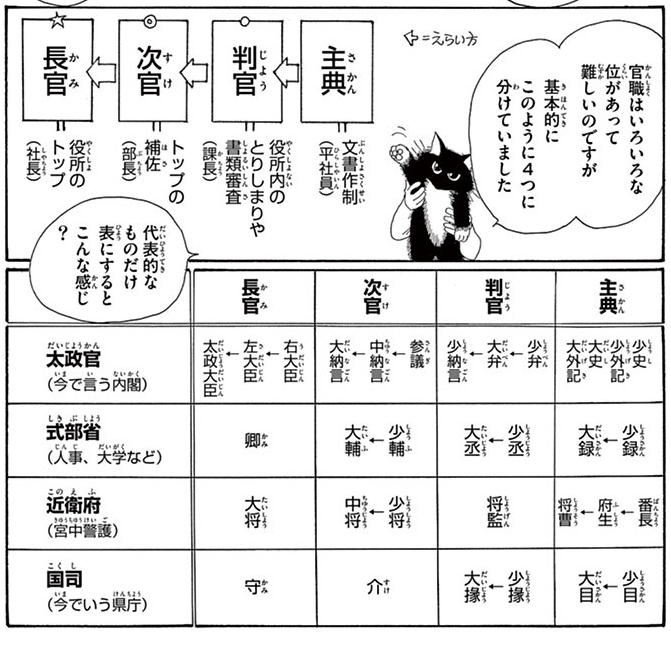
Chart from volume 4, page 184.
©Chiho Saito/Shogakukan
First, in the Volume 4 afterword, we see a chart broadly dividing court positions into different ministries and ranks. Kami (長官, but also spelt with other kanji depending on government ministry) refers to those people in the highest positions in each section. And on the next page, Saito goes on to clarify that the naishi no kami is the kami of an office called the naishi no tsukasa. They were between the junior fifth rank and junior third rank at court, and there could be up to two of them. They had responsibility for relaying the Emperor’s messages, and with time, the position became nearly as important as the Emperor’s consorts, often being a pathway for young women of influential families to become consorts themselves.
The Volume 10 afterword, coming just after Sara’s new appointment which I hinted at earlier, offers more detail about what the job entails. A bit like a senji, the naishi no kami was like a private secretary to the Emperor. She would present him with proposals from ministers, then record his decisions, and she would inform others of his requests. But she also had other responsibilities like helping him with eating and bathing, and as kami of the naishi no tsukasa, she kept the other palace ladies in check.
Much of this matches what happens in Torikae baya. Though Suiren (and then Sara) is employed as naishi no kami not to the Emperor but to his planned successor, we see a lot of these other details, and they often impact the story. For example, Suiren’s early anxieties relate to the expectations of the job and the ideas people have about it. She worries about being able to take responsibility within Togu’s staff and is embarrassed about the prospect of providing more intimate assistance. She becomes a target of Umetsubo’s jealousy, and the Emperor does eventually seek to make her one of his ladies. As Sara takes over the job and then moves to another similar post, these same kinds of challenges rear their heads again. And even that throwaway point from the Volume 4 afterword about the number of positions available turns out to be significant when he runs into the other naishi no kami San no Hime!
As Volume 7 comes to an end, everything is basically in place for the latter parts of the story. Suiren is now “Sara”, working as a court official, and Sara is now “Suiren”, established as one of Togu’s two naishi no kami. There is an ongoing movement to unseat the current Togu – taking power away from somebody ill-equipped for it in the eyes of her opponents, or relieving her of a great burden in the eyes of her allies – but still no real alternative. And finally, Sara is starting to wonder whether his admiration for the Emperor is really just respect for his former employer.
But I will not be translating volumes 8-12, at least not for this project. With that in mind, rather than doing generally one blog post per chapter, I’ll write a few posts covering the plotlines of one volume at a time, with some observations along the way. And hopefully, I’ll soon fit in a chance to put up the big character chart I’ve been threatening to make!
*I do realise that sake production in Fushimi came later, but just let me have this one!
**Interestingly (and surprisingly!) Willig’s translation was recently republished, this time without the previous title of The Changelings. The old one was out of print for quite a while, so this is a good chance to read it.