
Blogging about my Torikae baya manga translation project.
Thoughts from Episode 63: Context is everything
As the end of the story nears, this chapter sees the plot begin aligning once more with the plot of the original Torikaebaya monogatari, but as we’ve seen before, the differences in how those story beats are reached have an impact on how it all comes across. And on that note, I’ll get a bit into how poems from the original story are recontextualised in the manga.
In the aftermath of the palace fire, Sara and the Emperor are now an item (finally! a successful workplace romance for Sara!) and Marumitsu’s residence is to be used as a temporary palace. While Sara shows the Emperor around, Suiren tells Marumitsu, Nishi and Higashi that the Emperor knows the truth about the siblings; Nishi then prepares Sara for his private audience with the Emperor.
As the end of the story nears, this chapter sees the plot begin aligning once more with the plot of the original Torikaebaya monogatari, but as we’ve seen before, the differences in how those story beats are reached have an impact on how it all comes across. And on that note, I’ll get a bit into how poems from the original story are recontextualised in the manga.
In the aftermath of the palace fire, Sara and the Emperor are now an item (finally! a successful workplace romance for Sara!) and Marumitsu’s residence is to be used as a temporary palace. While Sara shows the Emperor around, Suiren tells Marumitsu, Nishi and Higashi that the Emperor knows the truth about the siblings; Nishi then prepares Sara for his private audience with the Emperor.
For much of the rest of the chapter, Sara frets over how the Emperor might react if he were to learn that not only did Sara have a previous sexual partner despite living as a man since the age of 14, but that this resulted in pregnancy and stillbirth. He decides to take the chance, and after they spend the night together, the Emperor realises the first of these secrets. When Sara tells him the rest of the story (omitting quite how it happened and who with), the Emperor is shocked but sympathetic, and in the end, Sara agrees to be his wife.
There are references in Episode 63 to the Tanabata legend, as the Milky Way (Amanogawa, 天の川) is visible in the night’s sky. I don’t think that’s because it is Tanabata, because it appears to me that it’s probably winter at this point in the story. However, it links the events to the time that Tanabata did take place in Episode 54: that time, Sara and the Emperor’s relationship very nearly kicked off, and perhaps more importantly, the missing Suiren was reunited with Mitsuko. That connection gives the current situation a bit of a “true love” vibe.
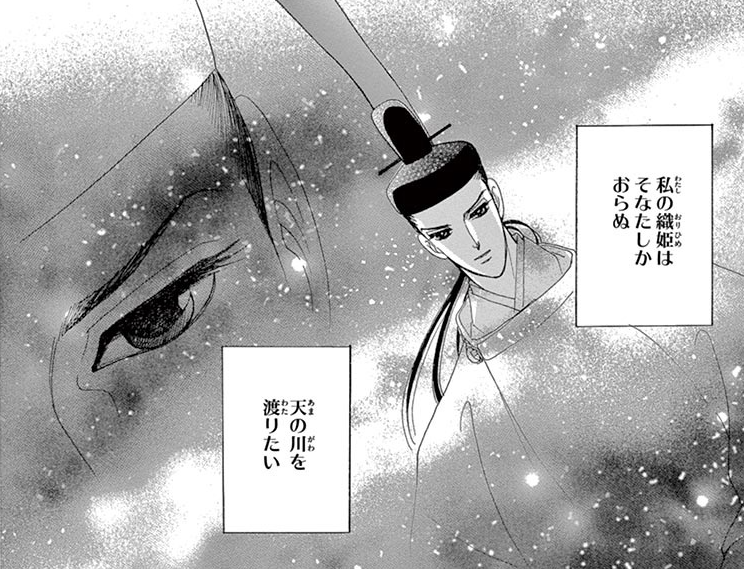
Sara sees the Emperor in a dream.
Panel from volume 13, page 102. ©Chiho Saito/Shogakukan
All that talk of the Amanogawa also sets the Emperor up to write Sara a poem that invokes another legendary river, the Mitsusegawa (三瀬川 – more commonly known today as Sanzunokawa, 三途川), which people must cross when they die. Here it is:
三瀬川 のちの逢瀬は 知らねども 来ん世をかねて 契りつるかな
Both the classical Japanese original and a modern Japanese gloss are included, and as usual, I use this as an opportunity to follow up a shorter, more direct translation with a more explicatory version. Here’s how I handled this poem:
Though I know not whether we will meet at the Mitsusegawa, let us pledge to meet again in lives to come.
(They say a woman is borne across the Sanzunokawa by the first man she loves. I may be unable to cross the river with you at the end of this life, but let us promise that we will cross together in a future life.)
This is not the first time that a poem in Torikae baya has made reference to this legend. After Tsuwabuki initiates his affair with Shi no Hime, he recites a poem to express the depth of his feelings for her, saying that he will carry her across the Mitsusegawa and that the two must be bound together by fate. The contrast is obvious: whereas Tsuwabuki’s poem tries to put an optimistic spin on pressuring Shi no Hime into doing what she’d rather be doing with her husband (and kind of ruining her life in the process), the Emperor’s poem reassures Sara that their relationship is more meaningful than whatever might have happened in the past.
But remember what I said about poems being recontextualised in Torikae baya? Well, in the original story, the Emperor’s poem doesn’t seem quite so sweet. Having seen very little of the naishi no kami – and unaware that they are the former chunagon – he sneaks into their room at night and gets down to business without feeling the need to ask. The naishi no kami doesn’t even realise who he is until halfway through! In the original context, that poem serves much the same purpose as Tsuwabuki’s. He even gets a response, a poem from the naishi no kami downplaying the value of making a promise for future lives, which reminds me of the incredulous replies the chunagon gives to the saisho no chujo (and Sara to Tsuwabuki) when the latter melodramatically suggests he will die of worry. The romance between the Emperor and the naishi no kami isn’t really so different from those more disastrous affairs.
Needless to say, Saito doesn’t portray Sara’s relationship with the Emperor like that. As I’ve talked about before, she often shows characters’ feelings and imbues them with more agency by changing the way that major events in the story take place. In the final “Atogaki baya” afterword, she specifically highlights how the former chunagon marrying the Emperor didn’t really strike her as a happy ending, and I’d say that same approach really helps take the somewhat depressing edge off the final outcome. The extended post-switch section of the manga demonstrates how Sara and the Emperor become gradually more interested in each other, and crucially, when they sleep together in Episode 63, Sara is actually into it.
The new context could have made the original poem feel out-of-place, but instead it changes the tone to be more readily interpretable as romantic. Saito’s use of poems from Torikaebaya monogatari is quite selective, with plenty being omitted, but it’s interesting to see this kind of repurposing. Another instance can be seen in Episode 56. Shortly before Suiren’s return from exile, she sends a heartfelt poem to Mitsuko; the same poem appears in the original story, but in the context of the former naishi no kami returning from Yoshino, checking up on various women and weighing up how to fit all these potential wives into a nice big house. Suiren in the manga is quite a different character, but the poem still serves a purpose. As is so often the case, these little changes and additions don’t reshape the plot as a whole, but they go a long way in advancing the “positive” version of the story that Saito wants to tell.