Thoughts from Episode 34: The sky is falling
The cliffhanger last time saw Sara, now ready to take over Suiren’s old position as naishi no kami, coming face to face with San no Hime (daughter of Kakumitsu and sister of Sara’s former wife Shi no Hime). It soon emerges that in the wake of the invasion of Togu’s quarters, Kakumitsu had most of her existing staff dismissed in favour of San no Hime and her attendants, leaving Togu isolated and distrustful. When Sara finally gets to see her in private, she quickly confirms that he is not the Suiren she knows, and San no Hime takes him away.
Just as Sara and Suiren are scrambling for a solution, an ominous falling star appears in the night sky. Suiren seeks advice from Yoshino no Miya, who writes back telling them that it will recur for three nights. The siblings then devise a plan. On the third night, Sara advises Togu to copy sutras in the Daigokuden, where priests are doing the same; Suiren appears and they convince Togu by discreetly confirming her suspicion that they have switched places. When the meteor is gone the following night – just as Yoshino predicted – this happy outcome is attributed to Togu’s efforts. As a consequence, Sara cements his position as (one of) Togu’s trusted naishi no kami, and the Emperor resolves to continue backing Togu.
Among the interesting little details in Episode 34 is the casual identification of a now-former member of Togu’s staff as “Senji no kimi” (宣旨の君). Senji here refers to a high-ranking female servant of an emperor, crown prince, regent, etc, who was something like a chief secretary. This character worked alongside Suiren throughout her time as naishi no kami, making appearances in more than ten chapters by my count – so why did it take until now for her to be referred to by rank? Well, that’s because the same thing happens in the source material! When the siblings return to court after their switch, there’s an abrupt mention of a “senji no kimi”, and then one more reference later adding that she is the daughter of Togu’s late mother’s wetnurse (that is, she was to Togu’s mother as Torako and Toramitsu are to Sara). I don’t know whether this version of Senji is that accurate to the original, but I do have a feeling that Saito discovered late on that this character existed and probably corresponded to the one she’d already included up to this point. Anyway, this all means that Suiren’s former colleague is actually one of the very few characters specifically identified in the original Torikaebaya monogatari!
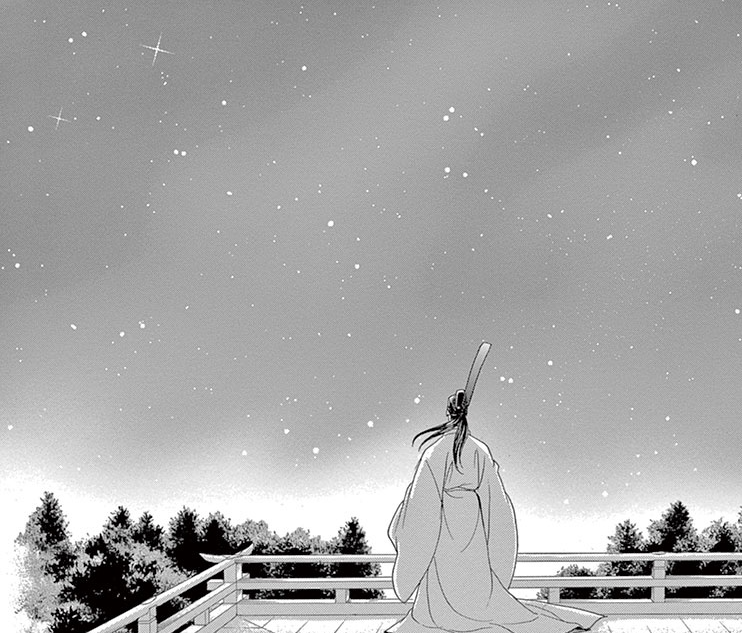
Panel from volume 7, page 146.
©Chiho Saito/Shogakukan
This chapter also returns us to the Daigokuden, an important palace building atop which Sara, Tsuwabuki and the then-Togu confronted another astronomical phenomenon all the way back in Episode 3. The now Emperor even points out the significance of warding off two bad omens in the same building, bringing memories flooding back for Sara.
But the similarities between these events don’t stop there. While the eclipse was tied to Sara’s frightening visions of a tengu threatening to devour the sun/Emperor, the falling star in Episode 34 has a name that is also connected to tengu myths: Amatsukitsune (written 天津狐 in Torikae baya), meaning “heavenly fox”. When I wrote about the eclipse the first time, I mentioned the tiangou, a Chinese mythical dog said to eat the sun. The earliest appearance of the word 天狗 (which we read as “tengu”, at least now) in Japan is in the Nihon shoki, an important history book of the 8th century CE, where it refers to an ominous star crossing the sky from east to west, its naming clearly influenced by those earlier Chinese legends.
With time, what was once imagined as a dog far up in the sky became a birdlike entity a bit closer to earth. But more importantly, glosses used to guide readers in how to understand the Classical Chinese of the Nihon shoki in the local language give us the pronunciation “amatsukitsune”. That means that the meteor that appears in this chapter of Torikae baya is a specific phenomenon recorded in the earliest Japanese histories, which is closely tied to the developing legends of the tengu. And considering Yoshino’s apparent connection to the tengu in the story, it might not just be his scientific knowledge that allows him to give such convenient advice about the Amatsukitsune.
We’re now very close to the point where my translation skips ahead to the final volume, but I’m afraid I’ll have to make you wait a bit longer! I’m taking a break next week, so my post about Episode 35 will probably come in two weeks’ time. See you then! 👋