
Blogging about my Torikae baya manga translation project.
Digression: Who’s who in Torikae baya? Part 2
I’m stepping away briefly from my summaries of volumes 8-12 to unveil a new addition to the Extras page! The new page is for a kind of character relationship chart (something I realise I first hinted at doing over a year ago…) and you can find it here.
I’m stepping away briefly from my summaries of volumes 8-12 to unveil a new addition to the Extras page! The new page is for a kind of character relationship chart (something I realise I first hinted at doing over a year ago…) and you can find it here.
Each tankobon volume of Torikae baya, beginning with the second, kicks off with a diagram of the most important characters in the story and their relationships to one another, with short introductions of each character and a plot synopsis to bring readers up to speed. These are very handy, but there are a couple of downsides: they only include certain characters at one time, thereby leaving out some of the relationships, and there are plenty of characters who are never deemed important enough to appear. And so I thought that for followers of this project, it would be nice to have a bigger version of one of these.
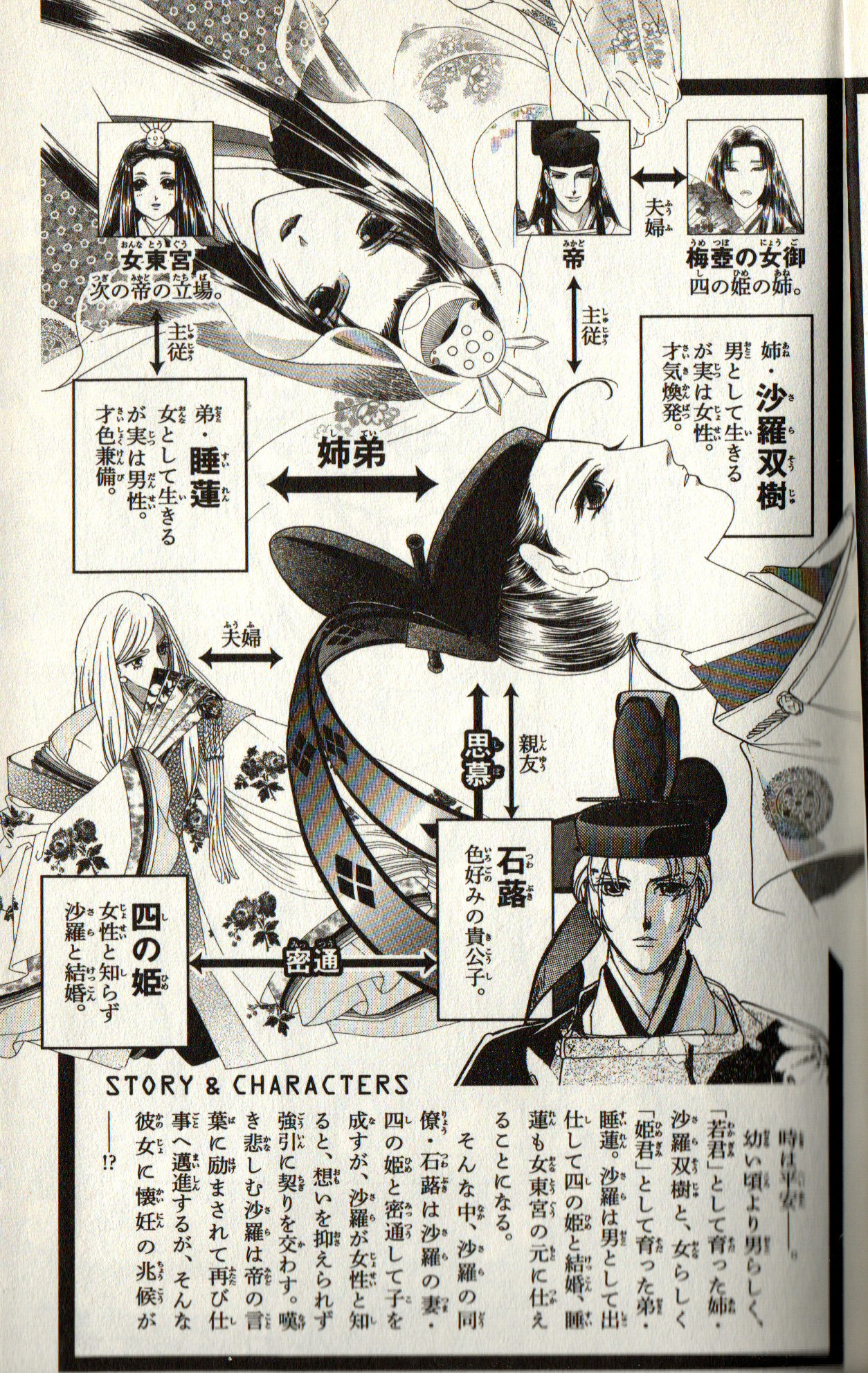
The character relationship chart included at the beginning of the fifth volume.
From volume 5, page 3. ©Chiho Saito/Shogakukan
I fantasised about showing off the true madness of Torikae baya’s web of relationships via a big, unwieldy chart in the same format as those ones, like mapping out a wild conspiracy theory. In the end, I just didn’t have the technical skills (or the patience to gain the technical skills) to assemble something like that and have it actually work, so I settled on a different format. In my chart, each character has a profile card with their name, picture and introduction noting their main relationships, and you can click on the related characters to jump to their card. It even works reasonably well on mobile!
Here, I want to just say a bit more about some aspects of the chart. First, it doesn’t include absolutely everyone. 31 characters are included at this point in time, which covers just about every recurring character referred to by a name or title. There are others I might include later, like Suiren’s male attendants. The problem with them is that only two (maybe three?) are clearly referred to by name. To make things easier to follow in the translation, I have plans to assign nicknames to nameless recurring characters – this will probably also happen with “Umetsubo’s maid” – so perhaps those guys will be included on the list once I’ve done that. On the other hand, two past emperors are mentioned in the manga, and their connections to known characters are obviously important in the story, but we never see their faces – should they be added too?
There is a system of icons for easy indication of common relationship types. Some types of relationship (for example “political supporter”) just don’t come up often enough to get an icon, so those go in the little introduction instead. Meanwhile, some relationships are one-way, which is why Sara is “🤝💖” in Tsuwabuki’s eyes and Tsuwabuki is “🤝” in Sara’s (awkward). Also, characters like Sara, who have some kind of connection to just about everyone, don’t have every single one of those relationships listed in their profile. Kakumitsu is just as closely related to Suiren as to Sara, but Kakumitsu and Suiren don’t have very much to do with each other, so I left out that link.
Similarly, I don’t get too much into the nitty gritty of how relationships change and when. The “>” shows that it doesn’t happen right when the character first appears, but what is “late” in one character’s story could be early in another’s. And even though there are some spoilers in there, I omit some of the final developments, especially if the general direction of change is already indicated.
Anyway, I hope this new addition is a useful resource! In other news, I’ve also made a few updates to the map (with a few more yet to come) and brought the timeline up to date as of the end of Volume 8. And actually, I spotted a mistake in the timeline while I was working on this: the kidnapping incident doesn’t take place six years into the story, but six years after Sara and Suiren first meet. I now estimate that they’re probably about ten years old when they go to Kurama. This might not matter an awful lot, but who knows?
Thoughts from Episode 14: Location, location, location
Thanks to a bright idea from Suiren, Sara and Tsuwabuki are sent off on a months-long expedition to get regional governors to release their hoarded rice. It turns out their strategy is to dazzle the governors with a performance based on the legend of Yamato Takeru, before pulling out their swords and threatening them.
Thanks to a bright idea from Suiren, Sara and Tsuwabuki are sent off on a months-long expedition to get regional governors to release their hoarded rice. It turns out their strategy is to dazzle the governors with a performance based on the legend of Yamato Takeru, before pulling out their swords and threatening them.
One night later in the trip, Shikibu-kyo no Miya is awaiting the two of them. He flirts aggressively with Sara, leading Tsuwabuki to step in to take one for the team, but just as things start to heat up, Sara returns the favour and saves Tsuwabuki from an inevitable gay awakening. Sara tells Tsuwabuki he’s a great friend he never should’ve doubted, but when he returns to Heian-kyo just after Shi no Hime gives birth, he realises his newborn daughter looks a lot like his loyal buddy.
There’s a lot that could be said about this chapter, but the thing I want to focus on today is locations! After a long period where nearly all the action takes place in the capital, Episodes 13 and 14 both see the protagonists go further afield. In Episode 13, they visit Yoshino, and in this chapter, Sara and Tsuwabuki travel around quite a bit.
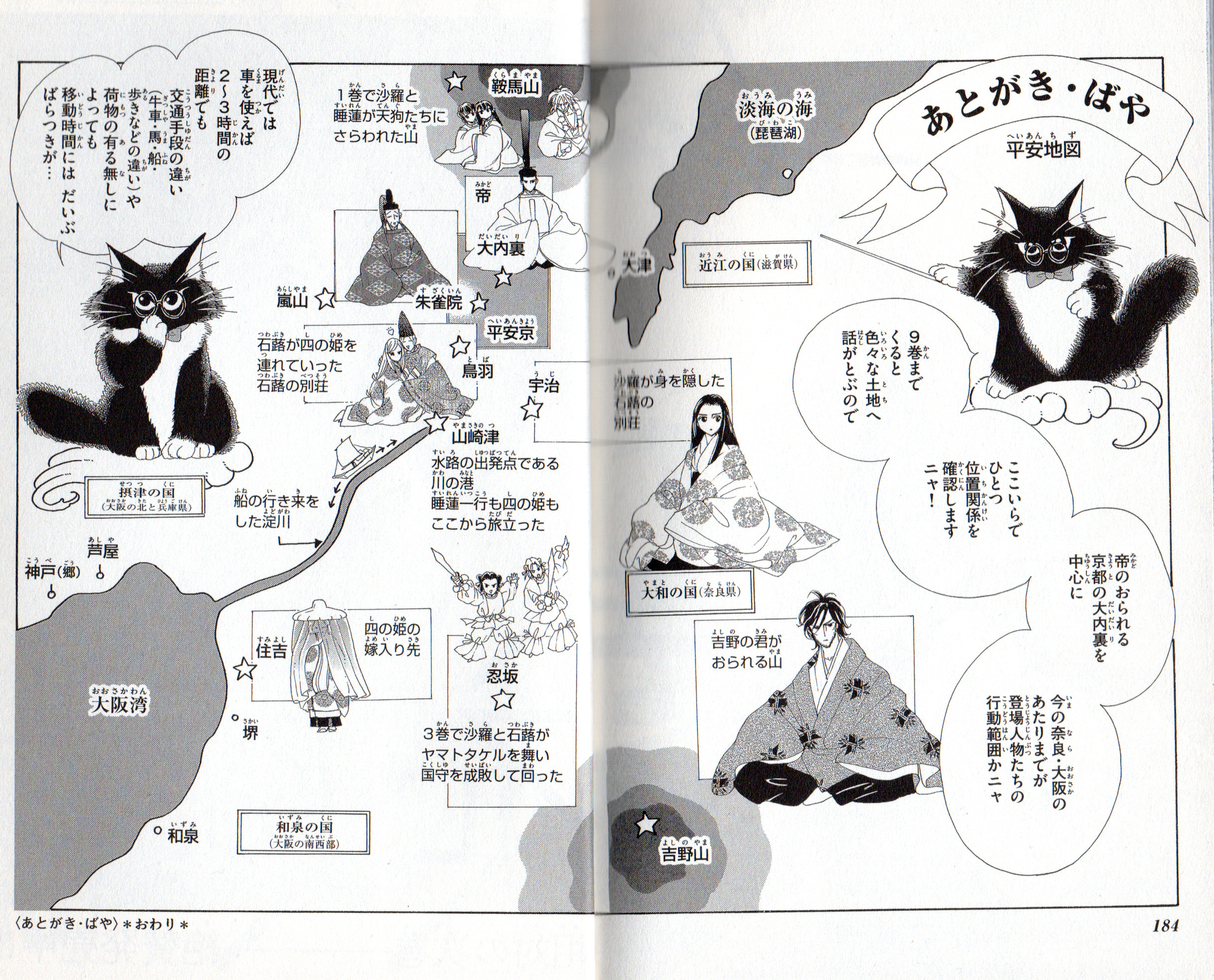
Map from volume 9, pages 184 and 185.
©Chiho Saito/Shogakukan
The only named place they visit in Episode 14 is Osaka – that’s 忍坂 with a short “o”, not the more famous 大阪 with a long “o”. The place that appears in Torikae baya is in modern-day Nara Prefecture, whereas the big city of Osaka we know today didn’t exist with that name until a few hundred years later. Incidentally, another more famous “Osaka” in the Heian period was 逢坂 (also a long “o”), an important barrier on the route from Heian-kyo to the eastern provinces, which appears in a number of poems.
Now, as you may have gleaned from my previous post where I talked about checking out locations from the manga in person, places in Torikae baya are often portrayed in quite specific detail. Places like palace buildings are clearly drawn based on real-life counterparts, and Saito uses some of the afterwords in each volume to provide plans of Heian-kyo and the palace. For the latter, she points out that she made a few adjustments to the exact layout compared with what the real Heian court was like, but just having it drawn up is really helpful for understanding how everything comes together.
One afterword also features a map of the whole relevant area, showing locations like Kurama and Yoshino – and since it’s in volume 9, there are also other places from much later in the story. A nice thing about this map is that Saito gives a little explanation of how people got around the area and how long it took. Typical means of transport included boat, horse, ox-drawn cart or walking, and even using the fastest of these, a trip that would take a few hours today might have required a day’s travel or more at the time of Torikae baya.
A couple of months ago, I added the Extras page as a place for the series timeline (which is still getting semi-regular updates!), and now I’ve added a map there too. You can then click through to a Google map where you can see where these historical locations line up with modern-day geography. I’ve tried to include all specified locations from the manga, but as there are probably some later ones that I can’t remember right now, you might see some updates to this as well. Please check it out!
Digression: Keeping track of time in Torikae baya
Something I’ve been doing as I’ve worked through the translation is noting indications of the passage of time in Torikae baya. The story takes place over several years, and while some of the jumps forward are made quite clear, there are other subtler indications too, and I want to make sure there’s nothing I’m missing! I’ll say a bit today about how much time has passed in the series so far and what kind of details I’ve looked at, but if you just want the basics, you can also take a look at the new timeline page I put together!
Something I’ve been doing as I’ve worked through the translation is noting indications of the passage of time in Torikae baya. The story takes place over several years, and while some of the jumps forward are made quite clear, there are other subtler indications too, and I want to make sure there’s nothing I’m missing! I’ll say a bit today about how much time has passed in the series so far and what kind of details I’ve looked at, but if you just want the basics, you can also take a look at the new timeline page I put together!
First, when does this take place? The original Torikaebaya monogatari was probably written in the late Heian or early Kamakura period, and the setting for the story is definitely some point in the Heian period. There have been a couple of times where I got into rabbit holes trying to work out exactly when the manga could be set based on things like dates of historical eclipses. I even concluded at one point that it wasn’t chronologically possible, because there are references to Yoshino no Miya having been on a mission to Tang China, but it’s also made clear that The Tale of Genji already exists.
The end result of all this is that I don’t really know! Maybe the Tang reference is just outdated terminology for the time period, or maybe the timing really isn’t intended to be very specific.
But at least on a closer level, we can work out some details about the timeline! Early on, it’s made quite clear how much time passes: the story starts with Sara and Suiren being born, the major kidnapping incident takes place six years later, and the discussions about Fujiwara no Marumitsu’s son taking a job at court begin when the siblings are almost 14 – time for becoming an adult, as far as everyone in this setting is concerned. The next clear indication of characters’ ages comes in Episode 6, when we hear that Shi no Hime – 19 years old – is three years Sara’s senior. Otherwise, we generally have to rely on other clues.
I want to come back to the point about coming of age though. It’s worth noting that Sara and Suiren are pretty young, at least by the standards a lot of us would expect. This also applies to other characters. Tsuwabuki mentions once that he is 18, and soon afterwards he says that Sara is still 16 at that point, so they’re just two years apart. We don’t know Nanten no Togu’s age, but she’s noted as seeming like a child despite her astuteness, so it’s probably fair to assume she isn’t too far away from Sara and Suiren’s age.
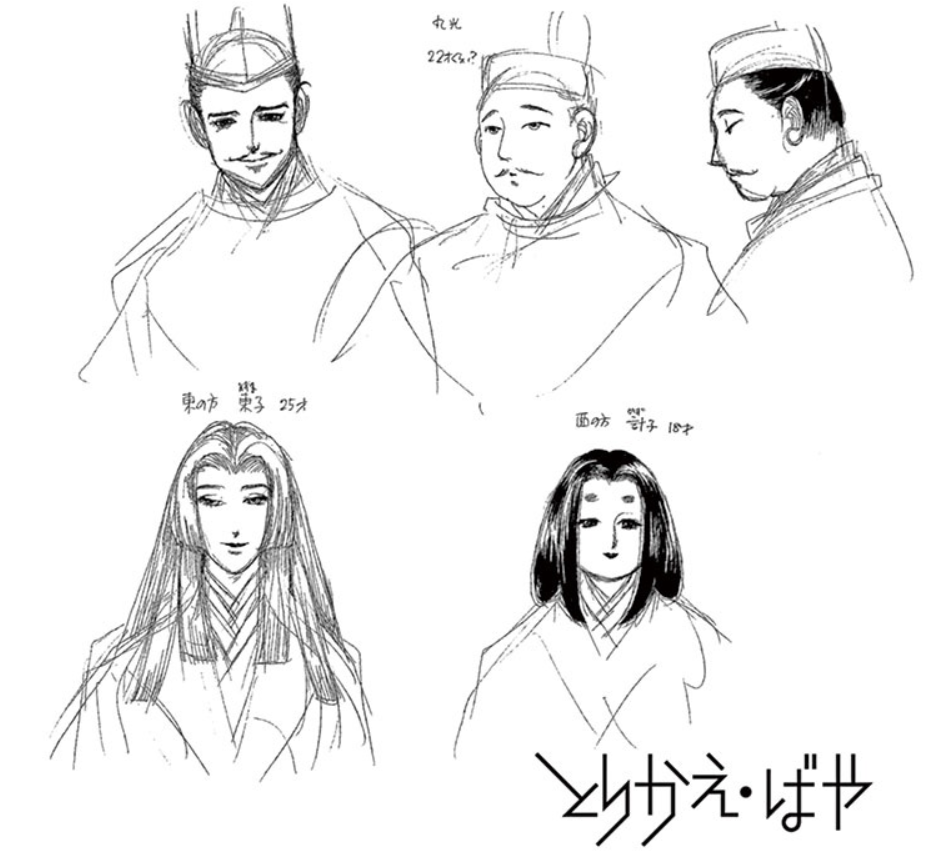
Production sketches of characters from volume 1, page 150.
©Chiho Saito/Shogakukan
There are no in-text references to the age of Sara and Suiren’s parents, but there are some sketches included between chapters in Volume 1 that can help. There’s a sketch of Marumitsu, supposedly around 22 years old, and I think it’s fair to assume that’s as of when the siblings are born. There are also drawings of his wives, with Higashi no Ue (Suiren’s mother) at 25 years old and Nishi no Ue (Sara’s mother) at 18. This aligns quite well with the ages at which Sara and Suiren are entering adult life: if they can start working at 14 and get married at 16, it’s not so bizarre that they’d be having children somewhere around 20.
And as for other signs of the passage of time, we can look at details like seasonal events. The komahiki that takes place in Episode 2 is supposed to have been an August event, so it must be within the first few months of Sara entering the work force. The fact that the changing of the Emperors is specified to take place at New Year also helps set up the chronology of some of what follows.
After that, another thing I found myself looking at obsessively was flowers. Around the time of Sara’s marriage to Shi no Hime and Suiren starting her job as naishi no kami, we know that not much time has passed since New Year, because we see snow and because there’s a plum blossom party at the palace with the appearance of a notably unseasonable butterfly. In the next couple of chapters, there are frequent mentions of the cherry blossoms – showing that spring has come – and even more specific points like how far into the season it is, and the appearance of wisteria which typically comes just after.
I won’t write out everything that I’ve considered with respect to the timeline, but I promise there’s a lot! Again, please do check out the timeline page if you want to get a quick idea of what happens when – and I’ll be keeping it updated too!