
Blogging about my Torikae baya manga translation project.
Back to school
At the University of Edinburgh, where I’m working on my PhD (and where I also do part-time teaching!), staff are currently on strike as the latest part of a long-running dispute to avoid redundancies which are ostensibly required despite the university’s notable wealth. There’s also been quite a bit of noise about the university’s plans to put an end to dozens of programmes by the end of the 2026-2027 academic year. This has been met with public backlash, which the senior management in their infinite wisdom appear not to have anticipated. It isn’t the ideal backdrop when I’m expecting to complete my degree within the next year and somehow make some professional use of it afterwards…
Because of all this, I write today’s post with the subject of education very much on my mind. And while I’ve written a couple of times lately about the educational angle of Torikae baya, I realise I’ve said very little about education in the manga. So what was education like for the people of the Heian court?
At the University of Edinburgh, where I’m working on my PhD (and where I also do part-time teaching!), staff are currently on strike as the latest part of a long-running dispute to avoid redundancies which are ostensibly required despite the university’s notable wealth. There’s also been quite a bit of noise about the university’s plans to put an end to dozens of programmes by the end of the 2026-2027 academic year. This has been met with public backlash, which the senior management in their infinite wisdom appear not to have anticipated. It isn’t the ideal backdrop when I’m expecting to complete my degree within the next year and somehow make some professional use of it afterwards…
Because of all this, I write today’s post with the subject of education very much on my mind. And while I’ve written a couple of times lately about the educational angle of Torikae baya, I realise I’ve said very little about education in the manga. So what was education like for the people of the Heian court?
The word for “university” in modern Japanese is daigaku (大学), which originally referred to the Confucian book of Great Learning. This is reflected in the name of an educational institution active in Heian-kyo, the daigaku-ryo (大学寮 – roughly “Bureau of Great Learning”). There, noblemen were trained and tested in subjects including history, (Chinese) literature, law and of course Confucianism, under the tutelage of the hakase (博士).
A few hakase appear in Torikae baya, where I’ve been translating their title as “Master”. All the way back in Episode 3, the Masters of Astronomy, Chronometry and Divination showed up to deliver ominous news to the Emperor (later Suzakuin). I think these guys don’t have quite the same professorial role as the hakase of the daigaku-ryo though: while they come from the on’yoryo (Bureau of Yin and Yang), which was part of the Nakatsukasa-sho, the daigaku-ryo was under the umbrella of the shikibu-sho, where Shikibu-kyo no Miya and Akimasa do their jobs. However, a hakase from the daigaku-ryo is specifically mentioned in Episode 16, when the Master of Letters (monjo hakase, 文章博士) sets the theme at the poetry party. (Incidentally, a famous holder of the position of monjo hakase was Sugawara no Michizane, to whom students now pray for academic success.) And similarly, at the flower viewing party where Sara takes his leave from the court, a hakase – probably the monjo hakase again – provides themes for the poetry recital.
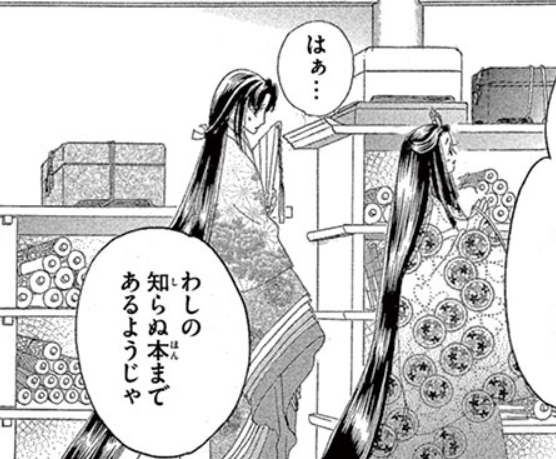
Suiren moves into the Nashitsubo with shelvesworth of books from home.
Cropped panel from volume 2, page 62. ©Chiho Saito/Shogakukan
But although these teachers make cameos, there is no actual mention of the daigaku-ryo in Torikae baya. In practice, it wasn’t necessarily where everybody went to study, even though the government sometimes wanted them to; realistically, children of the nobility were typically home-schooled. This form of education is hinted at in one of the manga afterwords, where Saito notes that training in the classics, calligraphy, diary writing and religion was part of boys’ preparation to enter the palace workforce. They would then continue to learn from their seniors and from their predecessors’ meticulous work diaries.
It’s worth pointing out that I said boys there intentionally. This kind of formal education was only for boys and men (and, as you may imagine, only those of the upper stratum of society). Girls of noble birth were also educated, but the subjects might vary depending on their circumstances. Murasaki Shikibu is well known for having been proficient in Chinese thanks to having a father who was a published writer of Chinese poetry. The study of Chinese by women was evidently not as forbidden as some suggest, but it apparently had pros and cons: intelligence was much admired, but the diaries of Murasaki and her contemporary Sei Shonagon indicate that there was something gauche about flaunting one’s academic gifts.
The difference between boys’ and girls’ education comes across in Episode 32 of Torikae baya, when Sara and Suiren learn how to take on each other’s roles. Yoshino is surprised to discover that Suiren is so adept at Chinese, having been raised as a girl – it turns out this is because of her bookish proclivities – and then offers to teach her other traditionally masculine subjects like Confucianism and formal writing. And in the final chapter, Suiren alludes to the different expectations for men’s and women’s writing when she reassures Sara that nobody would believe the story she wrote (implied to be Torikaebaya monogatari) could be a man’s work.
So there you have it! Education never really takes centre stage in the narrative of Torikae baya, but it’s bound up in so much of the society and culture of the setting that there’s actually quite a bit that you can say about it. It’s almost as if, contrary to what some would have you believe, education has… value?
Torikae baya as… yuri?
After explaining what makes Torikae baya a shōjo manga and suggesting some benefits of looking at it as a gakushū manga, I want to discuss Torikae baya in terms of genre just a little bit more. First, I should admit that while Saito Chiho’s manga career and available information about Flowers magazine definitely point towards the shōjo category and there are at least some people vouching for Torikae baya as gakushū manga, the basis for categorising it as yuri (百合) is more dubious. Basically, this idea comes from a fairly throwaway remark Saito made in a joint interview with Revolutionary Girl Utena director Ikuhara Kunihiko, saying that there might be “relatively yuri-esque” (割と百合っぽい) aspects in Torikae baya. As such, I’m not being entirely serious about defining it in this way, but let’s see where this takes us!
After explaining what makes Torikae baya a shōjo manga and suggesting some benefits of looking at it as a gakushū manga, I want to discuss Torikae baya in terms of genre just a little bit more. First, I should admit that while Saito Chiho’s manga career and available information about Flowers magazine definitely point towards the shōjo category and there are at least some people vouching for Torikae baya as gakushū manga, the basis for categorising it as yuri (百合) is more dubious. Basically, this idea comes from a fairly throwaway remark Saito made in a joint interview with Revolutionary Girl Utena director Ikuhara Kunihiko, saying that there might be “relatively yuri-esque” (割と百合っぽい) aspects in Torikae baya. As such, I’m not being entirely serious about defining it in this way, but let’s see where this takes us!
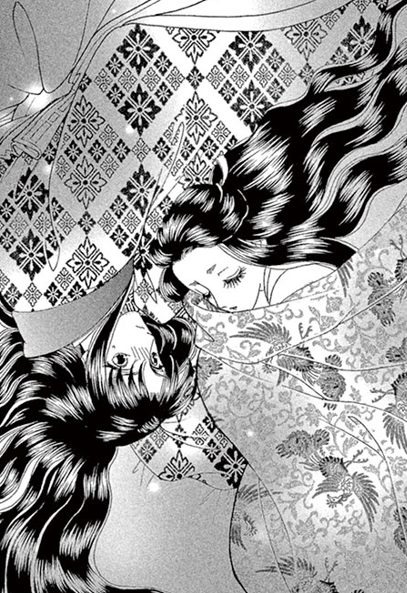
This might remind you of something.
Cropped panel from volume 2, page 88. ©Chiho Saito/Shogakukan
What is yuri? I’m quite happy with this definition: it is “any anime or manga series [etc]… that shows intense emotional connection, romantic love or physical desire between women” as determined “by the *perception* of the audience.” It has its roots in early shōjo magazines, which featured serialised novels depicting “S” relationships (エス関係 – also called “Class S”), that is, very strong friendship and romantic (?) admiration between girls. Associated tropes like all-girls schools and sad endings form part of the background for yuri as a genre.
The relationship between Suiren and Togu fits this mould pretty well. Suiren admires Togu from the moment they first meet, and when Tsuwabuki tries it on with Suiren, it occurs to her that his definition of “love” matches her feelings for Togu. Their connection then develops through awkward moments and Togu’s jealousy when she believes that Suiren is to become one of the Emperor’s women. They aren’t in a school, but their workplace of the Nashitsubo is basically a girls-only environment. Whether they have the same kind of senpai/kohai dynamic of some “S” relationships is complicated a bit by the fact that, as first in line to the throne, Togu is obviously in a senior position, but Suiren is probably a few years older – but with yuri being in the eye of the beholder, isn’t that extra tension just a bit more fun for the beholder? ;) Another point that might be a coincidence is the possibility of some bilingual wordplay: although “suiren” (睡蓮) is literally something like “sleeping lotus” in Japanese, its English name is water lily, and the Japanese name for lily is, of course, yuri (百合).
Obviously, Suiren and Togu’s relationship looks a lot less like yuri once Suiren is known to the world as “General Sarasoju”. This point makes me think of another aspect of older narratives: those relationships weren’t supposed to last. Either the girls were expected to grow out of it and later find husbands, or – as became common for a time in yuri stories – it ended in disaster. If we think of Suiren/Togu as an example of an “S” relationship, then its obligatory ending comes when, just as things are getting serious, Suiren vanishes and returns in a form that makes the relationship no longer one between two girls.
One more benefit of thinking about Torikae baya in relation to yuri is that it makes us question which relationships would count. Depending on how you interpret Suiren and Sara’s respective situations, you might argue that Suiren/Togu was never a lesbian relationship. But if that were the case, then Sara’s marriage to Shi no Hime would have to count instead! Similar issues apply to other romantic situations too: if Tsuwabuki is attracted to Sara, Suiren and Shi no Hime, those can’t all be heterosexual at the same time.
Ultimately, with all the other stuff going on in the story, maybe yuri isn’t really the best way to categorise Torikae baya. But still, just considering that possibility raises questions that make it clear that no matter how you look at it, some aspect of the story (most aspects, let’s be honest!) is undeniably queer.
Torikae baya as shojo manga
This post looks a bit at genre/publishing format and why this information might be useful when thinking about Torikae baya. I’ve referred to this series as “shōjo manga” in a few places – conferences, the about page of this site – but this isn’t necessarily a straightforward assertion, and it also carries some implications with it.
This post looks a bit at genre/publishing format and why this information might be useful when thinking about Torikae baya. I’ve referred to this series as “shōjo manga” in a few places – conferences, the about page of this site – but this isn’t necessarily a straightforward assertion, and it also carries some implications with it.
If you’ve made your way here, chances are you already have an idea of what shōjo manga is. Manga is traditionally categorised according to the broad target demographic of the magazine it was originally published in (with exceptions such as manga that isn’t in a magazine in the first place), with the main such categories being shōjo (girls), shōnen (boys), josei (women) and seinen (men). Not all readers of each magazine fit the supposed target demographic based on age/gender; in fact, I think it’s fair to say many don’t, especially among the fan communities for individual series, where you find fans who identify as, for example, fujoshi or otaku. Even so, the categories matter because as a result of their historical development – especially in the case of shōjo and shōnen – certain aesthetic and narrative tendencies dominate in each one. They are therefore often described as genres rather than just publishing formats.
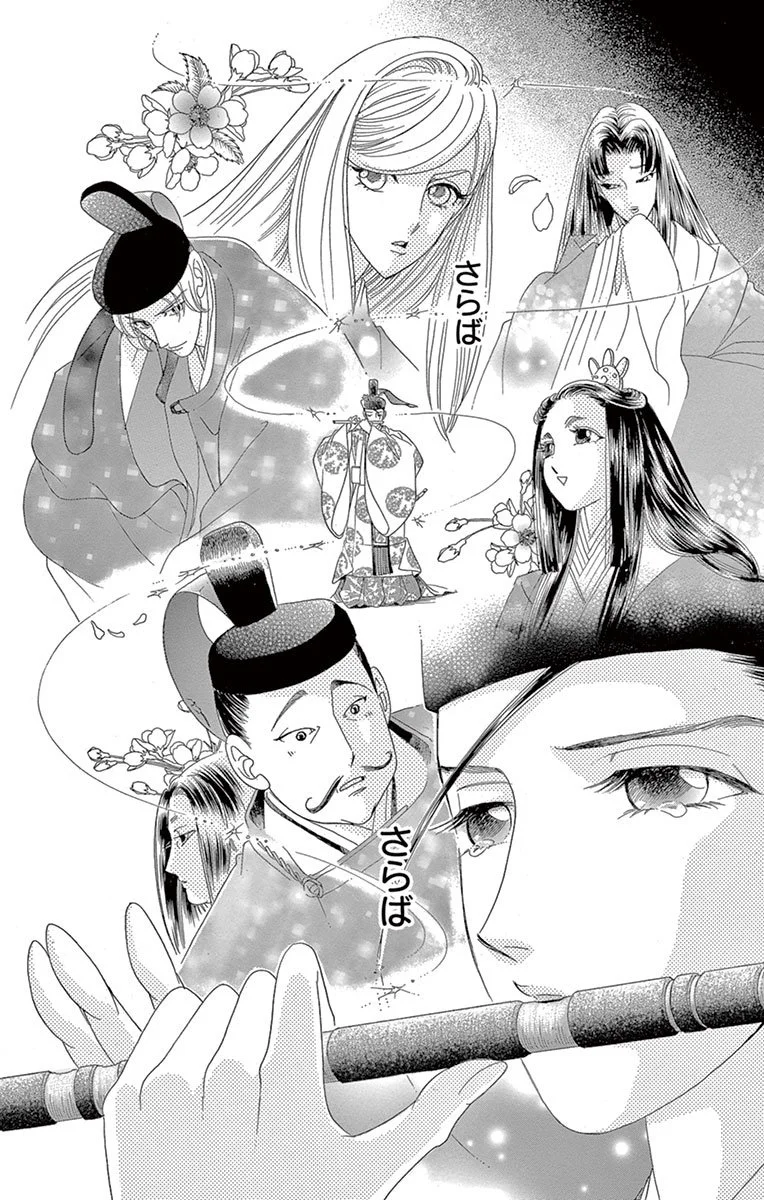
An example of shōjo-style page layout in Torikae baya.
From volume 5, page 100. ©Chiho Saito/Shogakukan
So, Torikae baya must be a shōjo manga, right? Well… that isn’t quite so clear. I’ve seen it described as both shōjo and josei, and not always with an acknowledged point of reference. What about Flowers, the magazine where it was published? Also ambiguous. Sites for reading manga online like cmoa and Renta! sort magazines under the traditional categories, but they’re inconsistent on whether Flowers is a shōjo or josei magazine, and confusingly they sometimes don’t label Torikae baya the same as the magazine itself. Fascinatingly, the English and Japanese Wikipedia pages for Flowers cite the very same source for the magazine’s category… and somehow reach opposite conclusions.
If we look at that source, a page where Shogakukan promotes the magazine to potential advertisers, we can see how this has come about. It refers to the target readers as “thirty-plus female manga lovers” (30代以上の漫画好き女性), which seems to align with the josei category, but also portrays the featured manga writers as “legends” who were involved with shōjo manga specifically since the formative years of the genre. But even though this does open up the potential for confusion, it does suggest at least that there is a distinct vision for the magazine. And elsewhere, this vision becomes clearer: another Shogakukan page for the magazine again emphasises the involvement of “veteran” authors, while describing its content as “an evolved form of shōjo manga” (少女まんが進化形) with the “soul” of shōjo; the Flowers Twitter account, meanwhile, straightforwardly calls it a shōjo manga magazine.
In the same way, Saito’s emphasis is always on shōjo manga, regardless of how the magazine might be categorised. For example, in the final afterword, she mentions wanting to make the story work as shōjo manga. After all, that’s the environment she’s always worked in – she is the kind of “veteran” writer that Flowers revolves around.
This means that the original readers of Torikae baya are people who picked up Flowers and decided to read a Saito Chiho manga, and this affects their expectations. The series is therefore situated in the context of classic shōjo manga conventions. Common aesthetic elements include floral decoration and enlarged eyes, originating in the illustrations common in shōjo magazines before manga became a significant part of what they published. Some argue that this style, with regular closeups on characters’ faces and text outside of speech balloons acting as a kind of inner monologue or voiceover, evokes empathy in readers, drawing them into the fictional character’s interior world. Shōjo manga also originated elaborate page layouts with techniques like overlapping panels and full-body views of characters taking up most of the page, which later expanded into other manga categories.
Why does it matter that Torikae baya is shōjo manga? In terms of its thematic content, it continues a long shōjo tradition of portraying gender non-conforming characters going back to influential 1970s series like The Rose of Versailles (Versailles no bara) and continuing through the decades, including several of Saito’s own works. Maybe you know one of them! Shōjo series based on Heian period literature are also not uncommon.
We can recognise plenty of aesthetic features of shōjo manga in Torikae baya too, sometimes employed in quite clever ways. With the simplified style of shōjo manga, it’s common for characters’ faces to be difficult to differentiate, with details like hair (style and colour) and clothes doing that job instead. You might have heard of this phenomenon by light-hearted, somewhat pejorative terms like “same face syndrome”, but in this context at least, it can also be seen as an aspect of an “aesthetic of sameness” where matching is preferred over contrast. In Torikae baya, this preference is arguably an advantage: rather than emphasising Sara and Suiren’s differences, Saito can lean on genre conventions and draw them pretty much identically, making it believable that their secret can go undetected and highlighting their special connection.
There are of course other ways in which Torikae baya operates within shōjo conventions, but there are also times when the challenges of adaptation require solutions from outside of those established methods. But that’s a topic I’ll save for another day!
How do we talk about Sara and Suiren?
A challenge that inevitably comes up when discussing any version of Torikaebaya monogatari is working out how best to refer to the two central characters. In the story itself, people are generally known by their job titles, but those change over the course of the narrative, and significantly, the siblings take on each other’s former roles partway through. This is tricky for readers in both Japanese and English (and presumably other languages too).
A challenge that inevitably comes up when discussing any version of Torikaebaya monogatari is working out how best to refer to the two central characters. In the story itself, people are generally known by their job titles, but those change over the course of the narrative, and significantly, the siblings take on each other’s former roles partway through. This is tricky for readers in both Japanese and English (and presumably other languages too).
Some modern Japanese translations and adaptations opt to give them personal names/nicknames to help keep us on track, which is how we get “Sarasoju” and “Suiren” as well as “Tsuwabuki”, “Marumitsu” and others. Willig’s 1978 translation of Torikaebaya monogatari includes translated job titles and sticks to those, but in the 1983 published version (and the recent reprint) she opted to use each character’s longest-lasting job title, untranslated, as if it were a name. For example, Sara’s counterpart goes through several promotions, but the narration calls him “Chunagon” even before he takes on that job.
A related issue is which gendered pronouns are suitable for each of the siblings. Third-person pronouns in Japanese were not gendered at the time of Torikaebaya monogatari’s writing, and even now are rarely grammatically necessary. Across the entirety of the Torikae baya manga, the words 彼 (he) and 彼女 (she) are only used a handful of times. Also, in manga – or this one at least – the verbal text is nearly all dialogue spoken diegetically, or first-person thoughts of major characters, with very little third-person narration. As a result, a formally published translation of the manga would be able to dodge the issue entirely, because the referents for Sara and Suiren would depend on how the speaker views them at that point in the story.
Of course, that’s not all I’m doing in this project! There is commentary in addition to the translation, but besides that, the translation itself includes descriptions of what is happening visually. That means that outside of characters’ speech and thoughts, I actually talk about Sara and Suiren in the third person quite often. As you’ll have noticed if you’ve been reading many of these blog posts, I continue to refer to the original Sara as Sara and the original Suiren as Suiren even after the siblings trade places, and I keep calling them “he” and “she” respectively. As I mentioned here, this is at odds with how other characters refer to them (except each other) later in the story, but after spending time with these two for the first seven volumes – and then breezing through most of the post-switch volumes – it doesn’t personally feel jarring to keep calling them what I always called them.
But how should we refer to Sara and Suiren? Maybe it’s worth taking a look at those first-person thoughts for an idea of how they see themselves. You’ll probably be unsurprised at this point to learn that… it’s complicated. Early on, Sara describes his situation as 男の成りをした女子 (otoko no nari o shita onago) – that is, a girl who has become, or taken on the form or role of, a man. His inner thoughts generally reflect a similar position, regarding himself as being secretly a woman.
However, the expressions he uses change somewhat. When he realises Shi no Hime is having an affair, he thinks of her partner as “another man”, and after his own disastrous encounter with Tsuwabuki, he thinks about the impact on his life. He tends to think in terms like 男としての自分 (otoko toshite no jibun) and 男として生きる (otoko toshite ikiru) – his self, or his life, “as a man”. Similar to “nari” in that earlier phrase, the “toshite” adds a bit of distance, but occasionally, he drops in something like 男のまま (otoko no mama) – “still a man” – or 男であり続ける (otoko de ari tsuzukeru) – “continue being a man” – that suggest that living as a man is no different from being one.
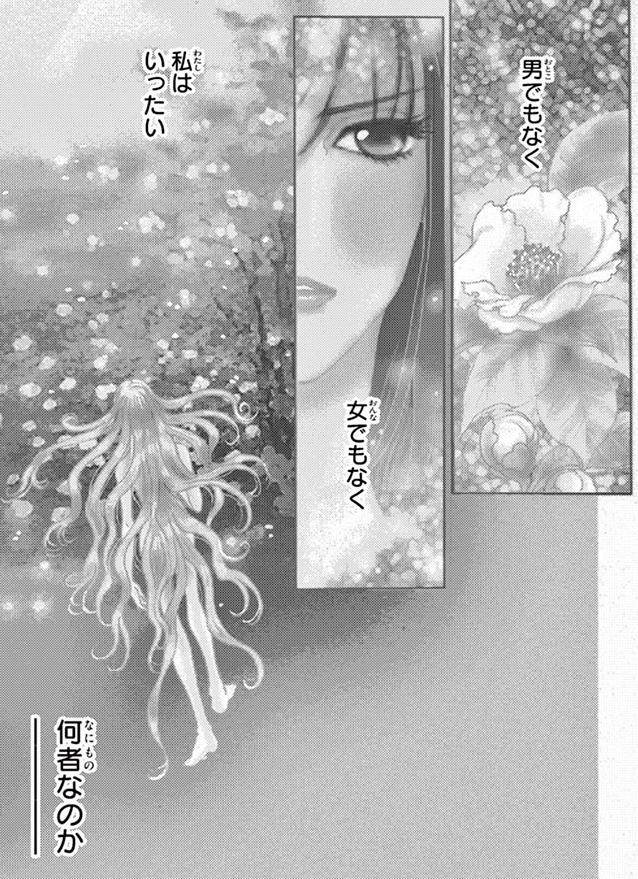
Episode 1 opens with Sara questioning what he could be if he is neither man nor woman.
Panels from volume 1, page 3. ©Chiho Saito/Shogakukan
Suiren, on the other hand, takes until Episode 24 to even consider such issues. When Sara disappears, she’s taken aback by the realisation that she could be the man to go in search of Sara. And as I mentioned in an earlier post, Suiren – who has been known to fear/dislike men since early chapters – is scared of the idea that that’s what she is deep down. She also happens to use the same “otoko toshite” expression as Sara, thinking about how she “held Togu-sama as a man would” and feeling incapable of “living as a man”. This is, incidentally, the same kind of phrasing Tsuwabuki uses when he laments his struggles in his pursuit of Suiren. Being a man is no more or less of an act for Suiren or Tsuwabuki than it is for Sara.
Finally, one other thing that comes up in Sara’s thoughts is the idea of being “neither” man nor woman, or “halfway” both. This comes up at times when things are going badly wrong, and is evidently a source of anxiety: Sara’s fear is that being unable to fit into either category means there is nowhere he belongs. And at the very beginning of Episode 1, the same kind of phrasing appears in a flash-forward featuring Sara’s first-person thoughts. It’s also important that when other characters like Yoshino no Miya, Marumitsu and the Emperor use similar expressions to describe Sara and/or Suiren, it’s a sign of how actually, this quality of neitherness/bothness is a good and admirable thing.
This all adds up to a sense of genderfluidity for the two siblings. We can say they generally are as they appear to be at a given time, even if they have their doubts both before and after their decision to change places. I would therefore say it’s justifiable to refer to them accordingly: Sara is “he” earlier in the story” and “she” later in the story, and Suiren “she” then “he”. But when do we make that change? The point when each leaves Heian-kyo, now appearing like the other? The moment in Yoshino when they make the choice to switch? Or maybe, as in Willig’s translation, when they return to the capital? And should that change again at times like Episode 62, when the original Sara temporarily takes on the appearance of the current “Sara”? What about before they take up their court roles?
As reasonable as that choice would be, it would cause difficulty when discussing the manga, especially from a wider perspective, because whether to call each sibling “he” or “she” would always be dependent on the particular part, or parts, of the story being discussed. They could of course both be “they”, but I’m not keen on this for the image descriptions, as it would require more context (and more words!) to provide clarity, when I’d rather be succinct.
And so, in the interest of consistency, I plan on sticking to what I’ve done all along! If both “he” and “she” are correct at different points, then it shouldn’t matter which one we decide to use as a consistent referent. And if it doesn’t matter, then why default to their presumed genders in childhood (which is what tends to happen)? Thematically, the narrative suggests that how Sara and Suiren live is much more important than how they were born, and with that in mind, I’d prefer to challenge that existing tendency.
The blog will be a bit quieter for a while! No new post next week, and we’ll see about the following week. I’m anticipating having quite a lot going on all at once, so it may be that posts go up only every other week, or something like that. Anyway, see you in 2-3 weeks!
Thoughts from Episode 65: NEARLY the end
Here we are, at the last chapter of Torikae baya – officially not titled “episode 65” but “final episode”. There are a few different plot threads that get their conclusions here, and for that reason, I’ll only write about the first half or so today, with another post to cover the remaining pages.
We’ve been firmly in coda territory for a few chapters, but to give Episode 65 at least some sense of climactic drama, a cliffhanger was set up last time, with the pregnant Sara suddenly falling unconscious. As the Emperor prays, he encounters Sara in a dream, held underwater by some mysterious beads. Sara fights off the beads, the Emperor helps him out, and when he awakens, it turns out the child has been born!
Here we are, at the last chapter of Torikae baya – officially not titled “episode 65” but “final episode”. There are a few different plot threads that get their conclusions here, and for that reason, I’ll only write about the first half or so today, with another post to cover the remaining pages.
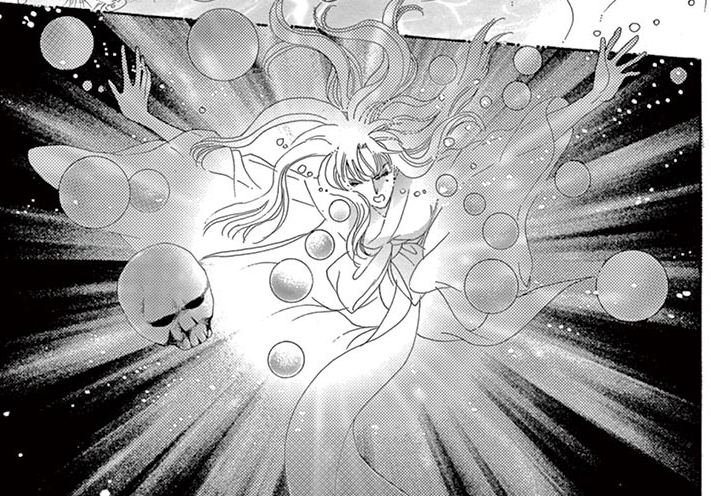
Sara struggles with the rosary beads.
Panel from volume 13, page 151. ©Chiho Saito/Shogakukan
We’ve been firmly in coda territory for a few chapters, but to give Episode 65 at least some sense of climactic drama, a cliffhanger was set up last time, with the pregnant Sara suddenly falling unconscious. As the Emperor prays, he encounters Sara in a dream, held underwater by some mysterious beads. Sara fights off the beads, the Emperor helps him out, and when he awakens, it turns out the child has been born!
After this incident, Umetsubo comes to the Emperor to declare her intention to take religious vows. She reveals that she received cursed rosary beads from Genkaku, but had them exorcised – an act that may have helped Sara survive. Later, the Emperor visits Marumitsu’s residence to mark 50 days since the baby’s birth, and it appears that Sara and the Emperor both had the dream about the river and the beads. The Emperor says the baby will be the new Togu and Sara will be Empress, and hands out some more promotions while he’s at it. Finally (for now), he visits the newly anointed nun Umetsubo with her father Kakumitsu, and asks her to act as a mother to Yuzuru so he can take up a new role helping the infant Togu.
The drama that opens this chapter is of course very short-lived – was there ever any serious doubt that Sara would make it out safely this late in the game? – but it does link up nicely with other things that have been going on. When he dreams of being in the river at the end of Episode 64, he identifies it as the Sanzunokawa, where people go when they die and which Tsuwabuki invoked in a poem to Shi no Hime. The Emperor, though, interprets it as the Amanogawa, further emphasising the connection to his remarks in Episode 63, and dashingly helps Sara across.
But apart from the specific links to those two legendary rivers, this incident fits into recurring references to drowning more broadly. In Episode 17, Sara has a nightmare in which he is drowning, and when he goes to seek Yoshino’s advice in Episode 21, he gazes into the river and imagines himself floating in the water. Similar visuals appear elsewhere, including the title pages for both Episodes 28 and 29, ramping up the foreshadowing before Sara wades out into the Ujigawa in despair. We could even look out for every occasion Sara and Suiren are reflected in the water’s surface, and it may well also be meaningful that Sara once helps save a man from drowning during his river rerouting work.
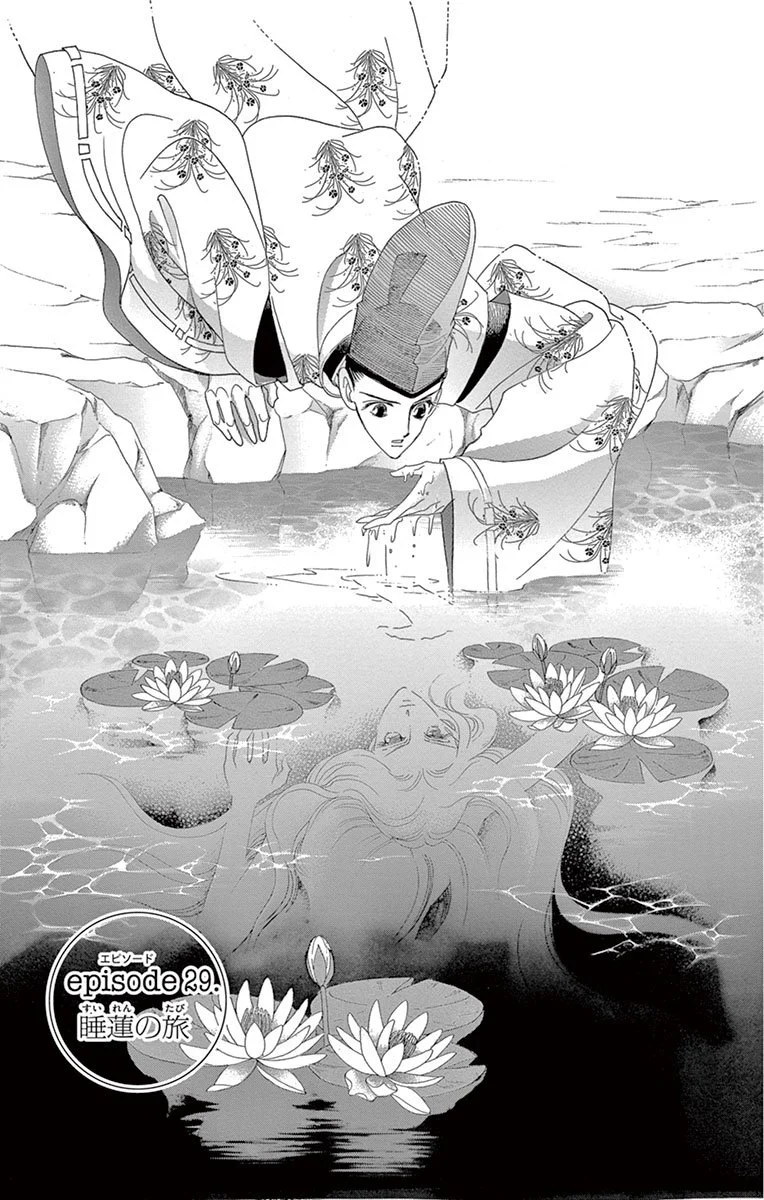
Suiren sees Sara reflected in the water.
Episode 29 title page from volume 6, page 117. ©Chiho Saito/Shogakukan
I’m not going to argue that Torikae baya is the first artistic work to use “drowning” as a motif, but I do think it’s interesting to see it keep coming up, and particularly the way that it returns at the end. The two points where Sara is at risk of drowning are clearly different: in the first, he attempts to take his own life after losing a baby, and is rescued only thanks to his eerily similar sibling, but this time, he fights back against a targeted attack, then returns to his happy new relationship and safely gives birth. Basically, while he wanted to die halfway through the story, he wants to live by the end.
I’ve mentioned before that there are plenty of references to The Tale of Genji in this manga, notably during the portion set in Uji, and these drowning references feel like a big one. When Sara opts for suicide by drowning in the Ujigawa to escape a life governed by the whims of a fickle man, he echoes the plight of Ukifune, one of the main characters of Genji’s so-called Uji chapters, who does the same thing when she is caught in the middle of a love triangle. To really drive home the comparison, when Suiren begins to fear that it may be impossible to find Sara again in Episode 29, she pictures an empty floating boat (literally “ukifune” 浮舟).
But the thing is, there’s already a more standard way of comparing the main characters of Torikaebaya monogatari to the main characters of Genji. The other two sides of Ukifune’s love triangle are Kaoru and Niou, famous for their contrasting personalities: Kaoru is the melancholic overthinker while Niou is libidinous and impulsive. Do you see where this is going? In a post-Genji tale like Torikaebaya monogatari, Kaoru and Niou seem like obvious reference points for the characters we know respectively as Sara and Tsuwabuki.
It’s interesting enough that a character apparently merely posing as a man should be inspired by Kaoru, but adding the Ukifune comparison in the manga adds another dimension. It fits in very well with Yoshino’s claim that the siblings’ unusual “combined knowledge and experience of both man and woman” makes them special. Sara experiences life as a popular but brooding young man and as a mistreated woman, and maybe in the end, the understanding that comes from this is what gives him a strong will to live after all.
Thoughts from Episode 61: Heavy clothes to fill
For the first time in two months, today’s post concentrates on just one chapter, with the thirteenth volume being one of the eight included in my translation. Plenty has happened in the story since Episode 35, covering about a year of in-story time by my estimation. I did summarise volumes 8-12 in the last few posts, but let’s begin with a brief reminder of where we are right now.
Sara took over Suiren’s position and worked as Togu’s naishi no kami together with San no Hime. Togu, who later stepped down, is now known as Ichi no Himemiya (or Mitsuko). Sara is now the Emperor’s naishi no kami, working closely with people like the imperial archive keeper. Suiren, in turn, took over Sara’s position and now works as a general in the Imperial Guards, though she left the capital for a while after a thwarted attempt to visit Mitsuko. The Emperor has worked out that Sara is not really Suiren, but hasn’t truly confronted him. Tsuwabuki is now married to Shi no Hime, and has zero understanding of what has happened with Sara and Suiren. And finally, during the search for a new Togu, two monks have arrived to cause problems: one, Ginkaku, was banished but continued to cast curses from far away, and his disciple, Genkaku, is now ready to carry out Ginkaku’s evil plans.
For the first time in two months, today’s post concentrates on just one chapter, with the thirteenth volume being one of the eight included in my translation. Plenty has happened in the story since Episode 35, covering about a year of in-story time by my estimation. I did summarise volumes 8-12 in the last few posts, but let’s begin with a brief reminder of where we are right now.
Sara took over Suiren’s position and worked as Togu’s naishi no kami together with San no Hime. Togu, who later stepped down, is now known as Ichi no Himemiya (or Mitsuko). Sara is now the Emperor’s naishi no kami, working closely with people like the imperial archive keeper. Suiren, in turn, took over Sara’s position and now works as a general in the Imperial Guards, though she left the capital for a while after a thwarted attempt to visit Mitsuko. The Emperor has worked out that Sara is not really Suiren, but hasn’t truly confronted him. Tsuwabuki is now married to Shi no Hime, and has zero understanding of what has happened with Sara and Suiren. And finally, during the search for a new Togu, two monks have arrived to cause problems: one, Ginkaku, was banished but continued to cast curses from far away, and his disciple, Genkaku, is now ready to carry out Ginkaku’s evil plans.
Yoshino no Miya’s counter-curse against Ginkaku appears to have succeeded, but at a cost. Suiren informs the Emperor and Sara that Yoshino is in some sort of coma, and is instructed to patrol the palace. Meanwhile, Genkaku, who has been staying at Kakumitsu’s residence, sets the house on fire before catching Umetsubo and her maid as they try to escape.
Suiren gets dressed for action, speaks with Tsuwabuki, and leaves her regular uniform with Sara. She then runs into Mitsuko and advises her to return to the Suzakuin. Mitsuko acquiesces, but sends San no Hime to visit Yoshino on her behalf, and points out that although the fire has died down, there are now signs of a disturbance approaching the palace proper.
When Sara returns to the oddly quiet palace, he encounters Umetsubo’s maid. He sees Genkaku (remembering him from Kurama and immediately linking him to the snake incident from volume 12), who has taken Umetsubo and the maid there. Genkaku attempts to strangle Sara, but Sara manages to stab him and attack him with the crystal ball he received from the Emperor. Though Sara escapes, he has his kamoji of Suiren’s hair yanked off in the process and witnesses Genkaku starting a new fire. The chapter ends with somebody closely resembling Suiren running to deliver news to the Emperor.
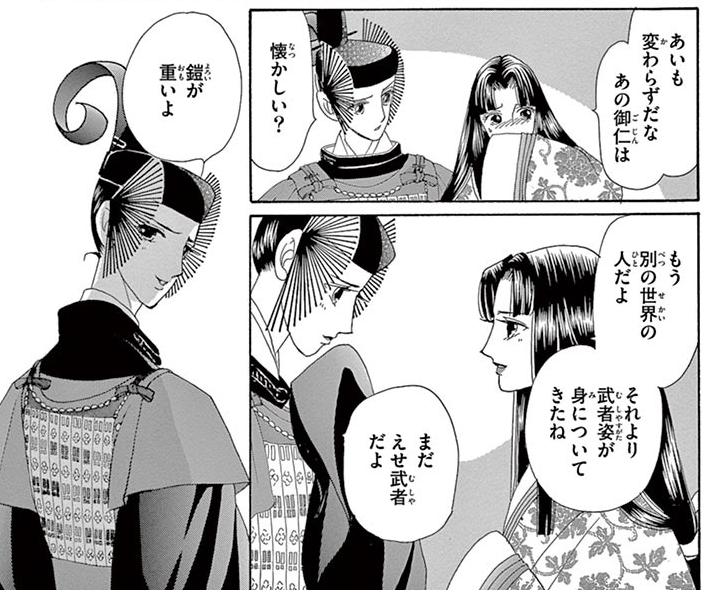
Panels from volume 13, page 18.
©Chiho Saito/Shogakukan
A lot of time has gone by since Sara and Suiren made the dramatic decision to switch places and go back to Heian-kyo. As I touched on at that time, this change isn’t presented as a return to their true natures, but as going against their usual instincts. And even this late in the story, there are still indications that they haven’t settled comfortably into their new roles.
When Tsuwabuki appears in this chapter, Sara avoids him, then remarks to Suiren about how his former colleague behaves the same way he always did. Suiren asks if he misses his time as a court gentleman and Sara suggests that he is over it by now, but when Sara responds that Suiren now looks the part of a soldier, Suiren disagrees. After all this time, Suiren still regards herself as an えせ武者 (a false soldier – “a pale imitation” in my translation). She leaves with a wry smile and says, “The armour is heavy” (鎧が重いよ).
Suiren’s comment on the weight of her new clothes reminds me of a moment from much earlier, shortly after the siblings return to the capital. In Episode 34, Sara is exhausted after a tough first day as Togu’s naishi no kami, and tells Torako, “Women’s clothes are so heavy” (女の装束は重い). Obviously, we can read both lines literally – yes, armour is likely to be heavy, and yes, the many layers of Heian court women’s dress add up – but it’s hard not to see a figurative meaning too. Wearing clothes that they don’t feel at ease wearing is a challenge for Sara and Suiren; it’s a heavy burden, and so is the responsibility attached to them.
Speaking of responsibility, there is another moment in this chapter that calls back to the time when Sara and Suiren return to Heian-kyo. To persuade Mitsuko to go somewhere safer, Suiren insists that as somebody who could still end up ruling the country if things went horribly wrong, Mitsuko’s life is not only her own. Sara’s mother Nishi says something very similar in Episode 33, admonishing him for disappearing and causing his loved ones such heartache.
I’ve mentioned before that although the topic of fate comes up a lot, the narrative of the manga strongly suggests that the siblings are free to shape their own destiny. Still, it isn’t as simple as them getting to do whatever they like at all times. They originally leave their positions in the capital when everything starts to crumble, but when they consider the power they have to help the people they care about, they make a choice to go against what feels easiest and take on new roles. The responsibility they ultimately feel may be a heavy burden to bear, but it comes along with their active choice to keep on living.
Thoughts from Episode 32: Trading places
The manga reaches a key turning point in the story now, as Sara and Suiren plan their return to the capital to fill each other’s former roles. They teach one another how to look and behave to avoid suspicion, and Yoshino no Miya helps Suiren overcome her anxiety around men.
But what Episode 32 concentrates on mostly is events in Heian-kyo. In an effort to alleviate Marumitsu’s stress, the Emperor declares that he is rescinding his request for Suiren’s hand in marriage – much to the jealous Umetsubo’s delight. Meanwhile, Kakumitsu tries to have his as-yet unseen daughter San no Hime installed as Togu’s naishi no kami, but Togu rejects him, wanting to wait until Suiren recovers from her alleged ailment.
The manga reaches a key turning point in the story now, as Sara and Suiren plan their return to the capital to fill each other’s former roles. They teach one another how to look and behave to avoid suspicion, and Yoshino no Miya helps Suiren overcome her anxiety around men.
But what Episode 32 concentrates on mostly is events in Heian-kyo. In an effort to alleviate Marumitsu’s stress, the Emperor declares that he is rescinding his request for Suiren’s hand in marriage – much to the jealous Umetsubo’s delight. Meanwhile, Kakumitsu tries to have his as-yet unseen daughter San no Hime installed as Togu’s naishi no kami, but Togu rejects him, wanting to wait until Suiren recovers from her alleged ailment. As Kakumitsu abandons decorum and complains openly about Togu, a shady bunch of vice ministers plot to get rid of her, ideally in favour of Shikibu-kyo no Miya. By the end of the chapter, they put their plan into action, with a man showing up in Togu’s bedchamber, thus exposing lax security in the Nashitsubo pavilion, stirring up gossip about Togu, and making Kakumitsu even more determined to restructure Togu’s staff.
Something we see quite a bit of at this stage in the manga, roughly between Episodes 31 and 34, is use of the verb とりかえる (to exchange, trade, substitute, etc). As that is indeed the verb used in the title of the story, you might think that isn’t so strange, but until now it’s been used sparingly. It appeared back in Episode 1, first when Marumitsu laments that things would be so much simpler if his children’s personalities were the other way around, and then a few times specifically in reference to the siblings trading outfits in order to escape the tengu bandits. That chapter ends with this scene:
SARA and SUIREN, both looking the same in their nightclothes and with their hair down, examine the clothes together.
SUIREN I never liked these boys' clothes,
but now that I know I'll never put my arms through those sleeves again,
I felt the desire to see the genpuku outfit...
SARA I feel the same way.
I wanted to properly say goodbye to my life as a girl...
...
Shall we switch clothes one last time?
Your mogi outfit,
and my genpuku outfit.
And aptly, we also say goodbye to the word とりかえる. The only time it is used again between Episode 1 and Episode 31 is when Marumitsu repeats his opening line in the new context of marriage discussions surrounding both Sara and Suiren.
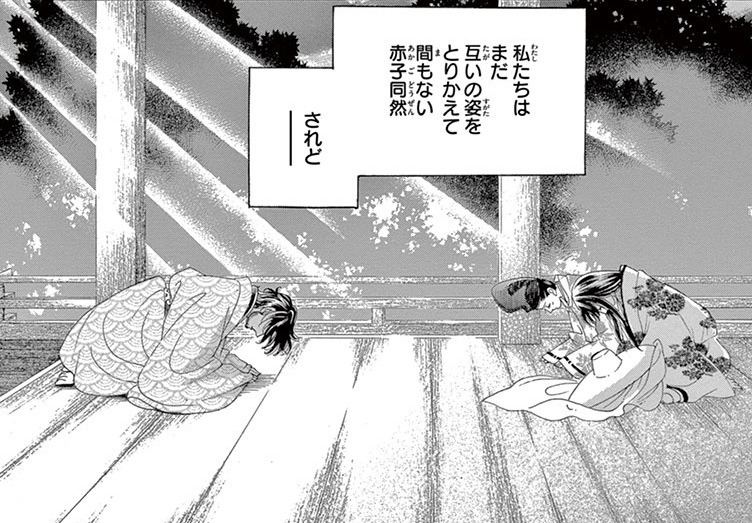
Panel from volume 7, page 74.
©Chiho Saito/Shogakukan
I find it very interesting that it takes so long for とりかえる to re-emerge, and that this is the first time Sara and Suiren talk about switching their positions or appearances, rather than just their clothes as in Episode 1. While readers might be tempted to think of the early decision to give Sara a genpuku (boys’ coming-of-age ceremony) and Suiren a mogi (girls’ coming-of-age ceremony) as the central “switch” of the title, the way the siblings describe their situation shows that to them, this is the moment where they change and take on roles that don’t suit them. And sure enough, this chapter basically gives us a montage where they learn how to live as one another, which requires them to really push back against their natural instincts.
But even though there’s basically no discussion of とりかえる for large portions of the story, there are actually several occasions where one sibling stands in for the other. They are, after all, similar enough in appearance to seem like two parts of one person. Obviously, they put on each other’s clothes to outwit the bandits in Episode 1, but then there’s also the incident where Sara suddenly has to impersonate Suiren while speaking to the Emperor from behind a blind.
Another situation where Sara dresses in women’s clothes – though not with the goal of appearing like Suiren – is in Episode 14. I didn’t say very much about it in my earlier blog post about that chapter, but to lull some greedy regional officials into a false sense of security, Sara and Tsuwabuki put on a show wearing women’s clothes. They perform a song from the legend of Yamato Takeru, impressing the spectators who seem to conveniently forget that in the legend, Yamato Takeru disguises himself as a woman to gain access to his enemies, maybe a stone’s throw away from where they’re sitting.
And there’s another important occasion much later, where the siblings’ situation is very different, but Sara has a reason to take on Suiren’s appearance again (and I would say “for the last time”, but there is a bonus chapter that suggests they’re not entirely done switching places). I won’t go into detail about it here, since we’re still nowhere near that point in the story, but it’s another moment that fits in with a pattern that these earlier scenes establish.
One aspect of these “trading places” incidents is of course to play around with the central conceit of the story, but more importantly, they present the siblings’ irregularity as something of a superpower. Yoshino addresses this directly in this chapter, telling them that very few others share “the combined knowledge and experience of both man and woman” (男と女の二倍の知識と経験). Living with a secret causes both Sara and Suiren a great deal of heartache, and Sara especially suffers a lot, but it also enables them to do things that most others can’t. And ultimately, what pushes them to switch positions and return to Heian-kyo isn’t some idea that they should “go back” to how they “should” be; it’s the realisation that they have a unique opportunity to help their loved ones, and that they can still do good in the world even after the unravelling of their lives so far.
As an aside, it’s now been a year since I started the blog! A few weeks ago I wrote about how far the project has come since then, but I just wanted to say once again, thank you for reading! Hopefully I’ll be able to keep this going even as I get closer to the end of the project!
Thoughts from Episode 28: Suiren makes up her mind
Following the previous chapter’s visit to Uji to check in on Sara’s depressing storyline, we get the conclusion to Suiren’s dilemma in Heian-kyo. Everyone at court now knows that the Emperor has requested Suiren as a wife, so Suiren returns from her brief absence to give Togu an explanation. Togu assumes she has accepted the Emperor’s proposal and offers congratulations, having made an effort to get over her previous jealousy.
Following the previous chapter’s visit to Uji to check in on Sara’s depressing storyline, we get the conclusion to Suiren’s dilemma in Heian-kyo. Everyone at court now knows that the Emperor has requested Suiren as a wife, so Suiren returns from her brief absence to give Togu an explanation. Togu assumes she has accepted the Emperor’s proposal and offers congratulations, having made an effort to get over her previous jealousy.
But that isn’t really why Suiren has come! They have a conversation in private, while a dramatic storm conveniently shields them from eavesdroppers. After a roundabout conversation during which Suiren says she wants to leave and go looking for Sara, she finally reveals her biggest secret, even opening her robes to prove it to the disbelieving Togu. Togu faints, and when she wakes up she thinks Suiren is already gone – but she’s actually hung around to formally announce her departure. Leaving Togu distraught, Suiren finally makes her big exit, then goes to her parents to have her hair cut and put on Sara’s clothes, ready to begin the search for her missing brother.
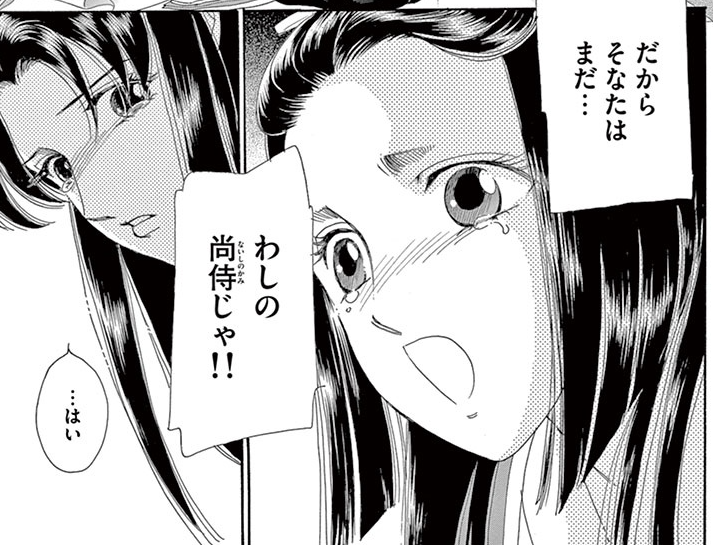
Panels from volume 6, page 107.
©Chiho Saito/Shogakukan
It says a lot about Torikae baya that the complex relationship between Suiren, a young woman harbouring a big secret about her personal background, and the adolescent Togu – who is also importantly her boss – is the healthiest romantic pairing in the story by a pretty big margin! Crucially, this is also a point where the manga diverges from the source material – not in the fact that it happens at all, but in how the characters and their relationship are portrayed.
Rosette F Willig, the translator of the original Torikaebaya monogatari into English, makes the case that the story effectively has just one main character, the chunagon, who is “played” by the two siblings one after another. The “sister” takes on the role until the situation becomes untenable, then the pair decide in Yoshino to switch places, so the “brother” then takes over. One impact of this is that the naishi no kami’s storyline is not explored in much detail. The “brother” simply becomes the naishi no kami, is smitten by the female Togu, and then can no longer continue in the position on account of having almost immediately impregnated her. Switching places to become the new chunagon is an easy decision for this version of the character, who takes quickly to life as a man, and isn’t even that devoted to Togu once other charming ladies become available!
Torikae baya’s Suiren is quite different, and plenty of time is devoted to showing that. Her shyness isn’t just a phase that she quickly grows out of, though her confidence does grow through her work as naishi no kami. And whereas her 12th-century (or thereabouts) counterpart’s attraction to Togu appears as some kind of masculine “instinct” coming to the surface, Suiren is instead shown to be scared that that could be the case. For example, in Episode 26, she panics after kissing Togu and says to herself: “I held Togu-sama as a man would.” It isn’t taken for granted here that she would want to live a man’s life given the choice, and she only takes Sara’s place when she feels she must.
When I wrote about Tsuwabuki finding out about Sara’s secret, I explained that Saito took what happens pretty quickly in Torikaebaya monogatari and expanded on it, with the effect of exploring characters’ emotions and changing how it all comes across to readers. The same thing basically happens in this case: instead of Togu finding out everything at once, her relationship with Suiren slowly develops, until Suiren reveals her secret and leaves, apparently never to return. This makes the characters more interesting, their storyline more romantic, and the overall plot less focused on how great it is to be a Heian gentleman.
Thoughts from Episode 16: Tsuwabuki, NO!!
The plot developments in Torikae baya – especially in recent chapters – have a bit of a trainwreck quality to them. Not just in the sense that you can’t look away from the ongoing disaster, but also in the sense that as each carriage derails one by one, the situation just keeps getting worse. And if you thought everything was going wrong in Episode 15, you ain’t seen nothing yet!
Last time, Tsuwabuki accidentally discovered that the colleague he’s obsessed with is a bit bustier than he expected – but he’s still not quite sure what that means. In the meantime, Sara avoids him, but wisteria-loving matchmaker Shikibu-kyo no Miya hears that they’ve fallen out and so invites them both to a poetry party on a hot summer’s night. Sara wants to just make a quick appearance and then leave, especially after Tsuwabuki’s awkwardly emotional recitation, but Shikibu-kyo insists that he perform next. The heat and stress cause Sara to faint, so Tsuwabuki rushes in to take him away before anybody investigates him too closely.
The plot developments in Torikae baya – especially in recent chapters – have a bit of a trainwreck quality to them. Not just in the sense that you can’t look away from the ongoing disaster, but also in the sense that as each carriage derails one by one, the situation just keeps getting worse. And if you thought everything was going wrong in Episode 15, you ain’t seen nothing yet!
Last time, Tsuwabuki accidentally discovered that the colleague he’s obsessed with is a bit bustier than he expected – but he’s still not quite sure what that means. In the meantime, Sara avoids him, but wisteria-loving matchmaker Shikibu-kyo no Miya hears that they’ve fallen out and so invites them both to a poetry party on a hot summer’s night. Sara wants to just make a quick appearance and then leave, especially after Tsuwabuki’s awkwardly emotional recitation, but Shikibu-kyo insists that he perform next. The heat and stress cause Sara to faint, so Tsuwabuki rushes in to take him away before anybody investigates him too closely.
Once they’re alone (with Shikibu-kyo’s encouragement), Tsuwabuki decides he needs to know what’s going on. And when Sara awakens in a fresh change of clothes, he realises the secret is now truly out. After the two have another intense exchange, Tsuwabuki promises to keep Sara’s secret. Seconds later, though, he “can’t control his feelings”, so he does what Tsuwabuki tends to do in these situations.
Now that Sara and Tsuwabuki’s relationship has taken a terrible new turn, it seems like a good time to look at how the two compare. In particular, I’m interested in how they both relate to masculinity.
Tsuwabuki can be seen as a typical, even exaggeratedly typical, Heian romantic hero. He’s emotional and passionate, and he’s constantly thinking about romance. One of the first times he and Sara interact, he’s already trying to get closer to Sara’s sister he’s been hearing about. And he openly weeps when Sara tells him to give it a rest.
Sara, on the other hand, isn’t a typical Heian man, despite all his celebrated personal qualities. As early as Episode 4, we hear that people are gossiping about Sara’s apparent disinterest in chasing girls, and when he gets married, he just lies perfectly still next to his new wife. For that matter, he even learns about the birds and the bees from Tsuwabuki (wild foreshadowing in hindsight)!
But despite this, Sara doesn’t seem all that desperate to be more of a man. He’s willing to make an effort to fit in, but notably, when he has a vision of the tengu during the eclipse, he only wishes “to be a real man” to make life a bit less complicated. When the incident is over, he even feels relieved that his wish didn’t come true. He is who he is, and he’s more concerned about being able to continue living his existing life at court. And so, during this chapter’s disastrous sexual encounter with Tsuwabuki, he thinks:
SARA [thinking] There's nothing "lucky" about this.
What will become of my life as a man?
What will happen to me now?
Ironically, Tsuwabuki seems much more anxious about being a man than Sara is. To readers, it’s clear early on that he’s infatuated with Sara, but he keeps trying to find other explanations for his feelings. First, he assumes he must really be interested in Sara’s identical sister, and then he decides it’s actually just lingering affection for Shi no Hime. As time goes on, he gradually recognises that it really is Sara who he wants, but he fears that this would mean that he isn’t the ladies’ man he desperately wants to be. And as a sign of how important that identity is to Tsuwabuki, here’s what he thinks to himself in Episode 9, after discovering that he wasn’t really that into Suiren once he saw her in person:


Panel from volume 2, page 129.
©Chiho Saito/Shogakukan
TSUWABUKI [thinking] At the age of 18, am I already an old man?
Could I be sick?
I must get to the bottom of this.
As he and his men cross a bridge, he looks up wistfully at the moon.
TSUWABUKI [thinking] If I don't,
my life as a man will be over!!
As always, Tsuwabuki is being terribly dramatic here, but he describes these feelings in almost the very same way Sara describes his own feelings later – and this goes to show how important Tsuwabuki’s “life as a man” is to him. Tsuwabuki causes a lot of problems in this story, and it all basically comes back to his anxiety over living up to this masculine ideal.
There might be a bit of a delay before the next post, as I’ll be presenting at the BAJS conference later this week, but once I get to it, you can see what happens next in this wild ride!