How do we talk about Sara and Suiren?
A challenge that inevitably comes up when discussing any version of Torikaebaya monogatari is working out how best to refer to the two central characters. In the story itself, people are generally known by their job titles, but those change over the course of the narrative, and significantly, the siblings take on each other’s former roles partway through. This is tricky for readers in both Japanese and English (and presumably other languages too).
Some modern Japanese translations and adaptations opt to give them personal names/nicknames to help keep us on track, which is how we get “Sarasoju” and “Suiren” as well as “Tsuwabuki”, “Marumitsu” and others. Willig’s 1978 translation of Torikaebaya monogatari includes translated job titles and sticks to those, but in the 1983 published version (and the recent reprint) she opted to use each character’s longest-lasting job title, untranslated, as if it were a name. For example, Sara’s counterpart goes through several promotions, but the narration calls him “Chunagon” even before he takes on that job.
A related issue is which gendered pronouns are suitable for each of the siblings. Third-person pronouns in Japanese were not gendered at the time of Torikaebaya monogatari’s writing, and even now are rarely grammatically necessary. Across the entirety of the Torikae baya manga, the words 彼 (he) and 彼女 (she) are only used a handful of times. Also, in manga – or this one at least – the verbal text is nearly all dialogue spoken diegetically, or first-person thoughts of major characters, with very little third-person narration. As a result, a formally published translation of the manga would be able to dodge the issue entirely, because the referents for Sara and Suiren would depend on how the speaker views them at that point in the story.
Of course, that’s not all I’m doing in this project! There is commentary in addition to the translation, but besides that, the translation itself includes descriptions of what is happening visually. That means that outside of characters’ speech and thoughts, I actually talk about Sara and Suiren in the third person quite often. As you’ll have noticed if you’ve been reading many of these blog posts, I continue to refer to the original Sara as Sara and the original Suiren as Suiren even after the siblings trade places, and I keep calling them “he” and “she” respectively. As I mentioned here, this is at odds with how other characters refer to them (except each other) later in the story, but after spending time with these two for the first seven volumes – and then breezing through most of the post-switch volumes – it doesn’t personally feel jarring to keep calling them what I always called them.
But how should we refer to Sara and Suiren? Maybe it’s worth taking a look at those first-person thoughts for an idea of how they see themselves. You’ll probably be unsurprised at this point to learn that… it’s complicated. Early on, Sara describes his situation as 男の成りをした女子 (otoko no nari o shita onago) – that is, a girl who has become, or taken on the form or role of, a man. His inner thoughts generally reflect a similar position, regarding himself as being secretly a woman.
However, the expressions he uses change somewhat. When he realises Shi no Hime is having an affair, he thinks of her partner as “another man”, and after his own disastrous encounter with Tsuwabuki, he thinks about the impact on his life. He tends to think in terms like 男としての自分 (otoko toshite no jibun) and 男として生きる (otoko toshite ikiru) – his self, or his life, “as a man”. Similar to “nari” in that earlier phrase, the “toshite” adds a bit of distance, but occasionally, he drops in something like 男のまま (otoko no mama) – “still a man” – or 男であり続ける (otoko de ari tsuzukeru) – “continue being a man” – that suggest that living as a man is no different from being one.
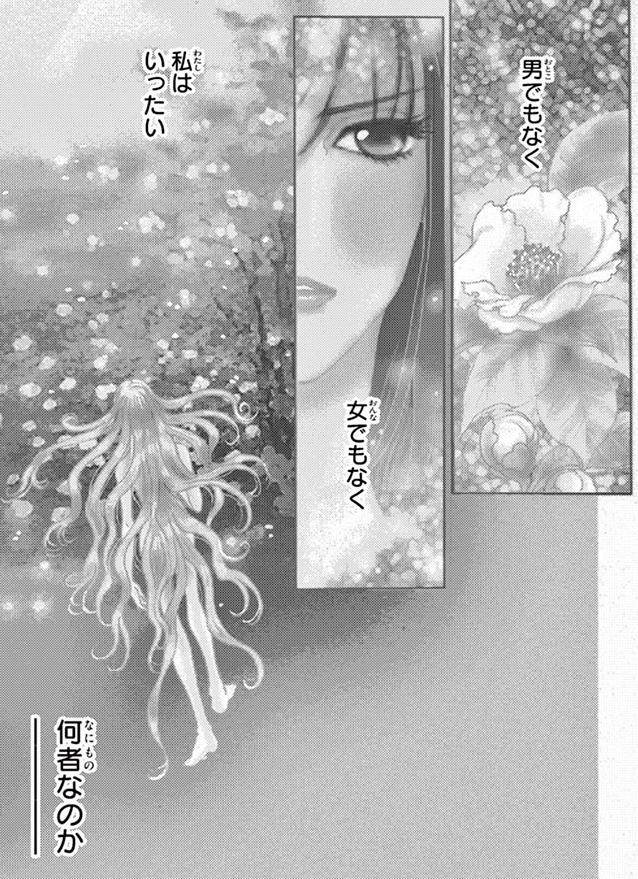
Episode 1 opens with Sara questioning what he could be if he is neither man nor woman.
Panels from volume 1, page 3. ©Chiho Saito/Shogakukan
Suiren, on the other hand, takes until Episode 24 to even consider such issues. When Sara disappears, she’s taken aback by the realisation that she could be the man to go in search of Sara. And as I mentioned in an earlier post, Suiren – who has been known to fear/dislike men since early chapters – is scared of the idea that that’s what she is deep down. She also happens to use the same “otoko toshite” expression as Sara, thinking about how she “held Togu-sama as a man would” and feeling incapable of “living as a man”. This is, incidentally, the same kind of phrasing Tsuwabuki uses when he laments his struggles in his pursuit of Suiren. Being a man is no more or less of an act for Suiren or Tsuwabuki than it is for Sara.
Finally, one other thing that comes up in Sara’s thoughts is the idea of being “neither” man nor woman, or “halfway” both. This comes up at times when things are going badly wrong, and is evidently a source of anxiety: Sara’s fear is that being unable to fit into either category means there is nowhere he belongs. And at the very beginning of Episode 1, the same kind of phrasing appears in a flash-forward featuring Sara’s first-person thoughts. It’s also important that when other characters like Yoshino no Miya, Marumitsu and the Emperor use similar expressions to describe Sara and/or Suiren, it’s a sign of how actually, this quality of neitherness/bothness is a good and admirable thing.
This all adds up to a sense of genderfluidity for the two siblings. We can say they generally are as they appear to be at a given time, even if they have their doubts both before and after their decision to change places. I would therefore say it’s justifiable to refer to them accordingly: Sara is “he” earlier in the story” and “she” later in the story, and Suiren “she” then “he”. But when do we make that change? The point when each leaves Heian-kyo, now appearing like the other? The moment in Yoshino when they make the choice to switch? Or maybe, as in Willig’s translation, when they return to the capital? And should that change again at times like Episode 62, when the original Sara temporarily takes on the appearance of the current “Sara”? What about before they take up their court roles?
As reasonable as that choice would be, it would cause difficulty when discussing the manga, especially from a wider perspective, because whether to call each sibling “he” or “she” would always be dependent on the particular part, or parts, of the story being discussed. They could of course both be “they”, but I’m not keen on this for the image descriptions, as it would require more context (and more words!) to provide clarity, when I’d rather be succinct.
And so, in the interest of consistency, I plan on sticking to what I’ve done all along! If both “he” and “she” are correct at different points, then it shouldn’t matter which one we decide to use as a consistent referent. And if it doesn’t matter, then why default to their presumed genders in childhood (which is what tends to happen)? Thematically, the narrative suggests that how Sara and Suiren live is much more important than how they were born, and with that in mind, I’d prefer to challenge that existing tendency.
The blog will be a bit quieter for a while! No new post next week, and we’ll see about the following week. I’m anticipating having quite a lot going on all at once, so it may be that posts go up only every other week, or something like that. Anyway, see you in 2-3 weeks!