Afterword: The Afterwords
Now that I’ve got through talking about each chapter of Torikae baya one by one, this seems like a good time to say a bit more about the afterwords that appear in every volume! I’ve previously mentioned these “Atogaki baya” sections in passing, but what exactly are they?
At the end of each published volume, where most manga would have some kind of short bonus material (you may know this as omake), there is a 2-4 page section, generally still in manga form, where Saito directly addresses the reader and provides some additional context that you wouldn’t get from reading the monthly chapters in Flowers magazine. And naturally, when it comes to translating and studying the series, the information they provide can be very useful! Here’s a rundown of what each afterword covers:
Volume 1 – A brief explanation of how Saito ended up adapting Torikaebaya monogatari.
Volume 2 – An overview of the daily lives of Heian government officials.
Volume 3 – The connections between Heian court events and some modern-day public holidays in Japan.
Volume 4 – An explanation of court positions and ranks, and how these apply to major characters in the story. I referred to this in this post and this one.
Volume 5 – How working on Torikae baya helped Saito understand what the different dolls in a Hina matsuri display represent.
Volume 6 – Types of marriage in the Heian period. I referred to this in this post.
Volume 7 – An explanation of Heian women’s clothing, specifically the junihitoe (twelve-layered robes).
Volume 8 – An explanation of male court officials’ clothing, noting the great detail of variation based on rank and position.
Volume 9 – A map of the Kinai region at the time of the story. I referred to this in this post and used it as a basis for my map.
Volume 10 – An explanation of the duties of the naishi no kami. I referred to this in this post.
Volume 11 – Plans of the greater palace area (daidairi), the palace complex (dairi) and the Seiryoden. I referred to this in this post.
Volume 12 – Details of the emperor’s harem and the ranks available for his women.
Volume 13 – A discussion of some of the alterations made to the source text throughout the manga.
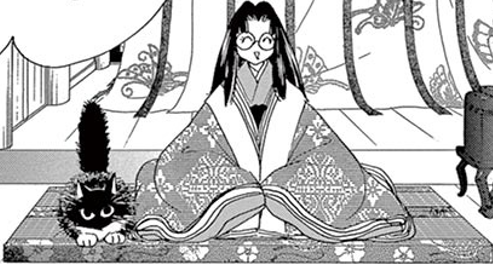
Saito in Heian period clothes with her cat in the final afterword.
Panel from volume 13, page 131. ©Chiho Saito/Shogakukan
For readers, these afterwords offer clarity on aspects of the story and its setting that may be hard for non-specialists to imagine, and especially in the first and last volumes, they provide insight into Saito’s process. And this last point is important because there just aren’t that many places where Saito speaks about how she approached the adaptation. Apart from these, there are a handful of magazine/online interviews where Torikae baya comes up (these two for example), and a small artbook sold as part of the volume 13 limited edition.
Details in the afterwords have helped me understand the world of the story and given me a sense of Saito’s intentions* for the adaptation. For example, the volume 1 afterword uses the intriguing term “melancholic moe” (メランコリックな萌え) to describe elements of the source material that might speak to today’s readers; and the volume 13 afterword mentions writing the manga to emphasise the story’s “positive entertainment value” (かなーり前向きなエンタテイメント性) and work specifically as shojo manga.
But the afterwords aren’t perfect. As I’ve already mentioned, they’re short, there’s only thirteen of them, and yet they represent the lion’s share of sources that reveal Saito’s thoughts on the adaptation. Also, even though some of them deal with quite specialist topics, they’re not really meant to be academic writing, and as such, they usually don’t cite specific sources. And so, they are very useful for me, but limited.
This all means that it was extremely valuable to get the chance to speak to Saito myself last summer. I found out where some of this information came from, saw what books Saito used as reference for Heian period clothing, architecture, etc, and found out more about what inspired her to write Torikae baya in the first place and in the specific way that she did. One particular takeaway was that writing the series required all sorts of background research and, rather than let that go to waste, she wanted to share with the readers as much as possible of what she herself had learnt. We can see this in the afterwords themselves: most of them feature an illustration of Saito (and/or her cat) explaining or showing off the matter at hand, like a teacher. This all leads me to add education to the list of motivating factors behind Saito’s adaptation – and that’s something I’ll say more about another day!
As for what I’ll do with the afterwords… I’ve obviously used them for reference, and I have written rudimentary translations for a few of them, but they’re supplemental paratexts rather than fundamental parts of the manga. That means they probably won’t make it into the thesis itself, but I may include at least some translated afterwords in an appendix. We’ll see!
*I don’t want to hype up the idea of “authorial intent” too much – especially when we consider that writing a serialised manga involves delegating tasks to assistants and not necessarily knowing how long it’ll go on for – so to be clear, when I say “intention”, I don’t mean a perfectly articulated manifesto by The Author that must be taken at face value. What I mean is something less concrete, a loose set of principles guiding decision-making (perhaps not consciously) during the process of adaptation.