
Blogging about my Torikae baya manga translation project.
Changes and ‘Za Chenji!’
If you’ve read any of my previous blog posts, you’ll have realised that the original Torikaebaya monogatari is quite old – definitely old enough for a few versions of the tale to have made the rounds. In the last few weeks, I’ve mostly been reading/rereading some of the different translations and adaptations that exist. So on that note, let’s take a look at the other manga adaptation of Torikaebaya monogatari: Yamauchi Naomi’s Za Chenji!
If you’ve read any of my previous blog posts, you’ll have realised that the original Torikaebaya monogatari is quite old – definitely old enough for a few versions of the tale to have made the rounds. In the last few weeks, I’ve mostly been reading/rereading some of the different translations and adaptations that exist. So on that note, let’s take a look at the other manga adaptation of Torikaebaya monogatari: Yamauchi Naomi’s Za Chenji!
Za Chenji! (a transliteration of “The Change”) was published in Hana Yume EPO magazine between 1986 and 1988. Rather than being a direct adaptation of Torikaebaya monogatari, it’s based on an early-80s novel adaptation, also titled Za Chenji!, by celebrated shōjo novel author Himuro Saeko (probably best known outside Japan for Ocean Waves). Still, it does basically follow the story we know. Another manga, Torikaebaya ibun by Kihara Toshie, actually predates Yamauchi’s manga by a few years, but as it takes the basic concept of the gender switch and then runs with it in quite a different direction (it isn’t even set in the Heian period!!) I just don’t think it’s directly comparable with Za Chenji! and Torikae baya.
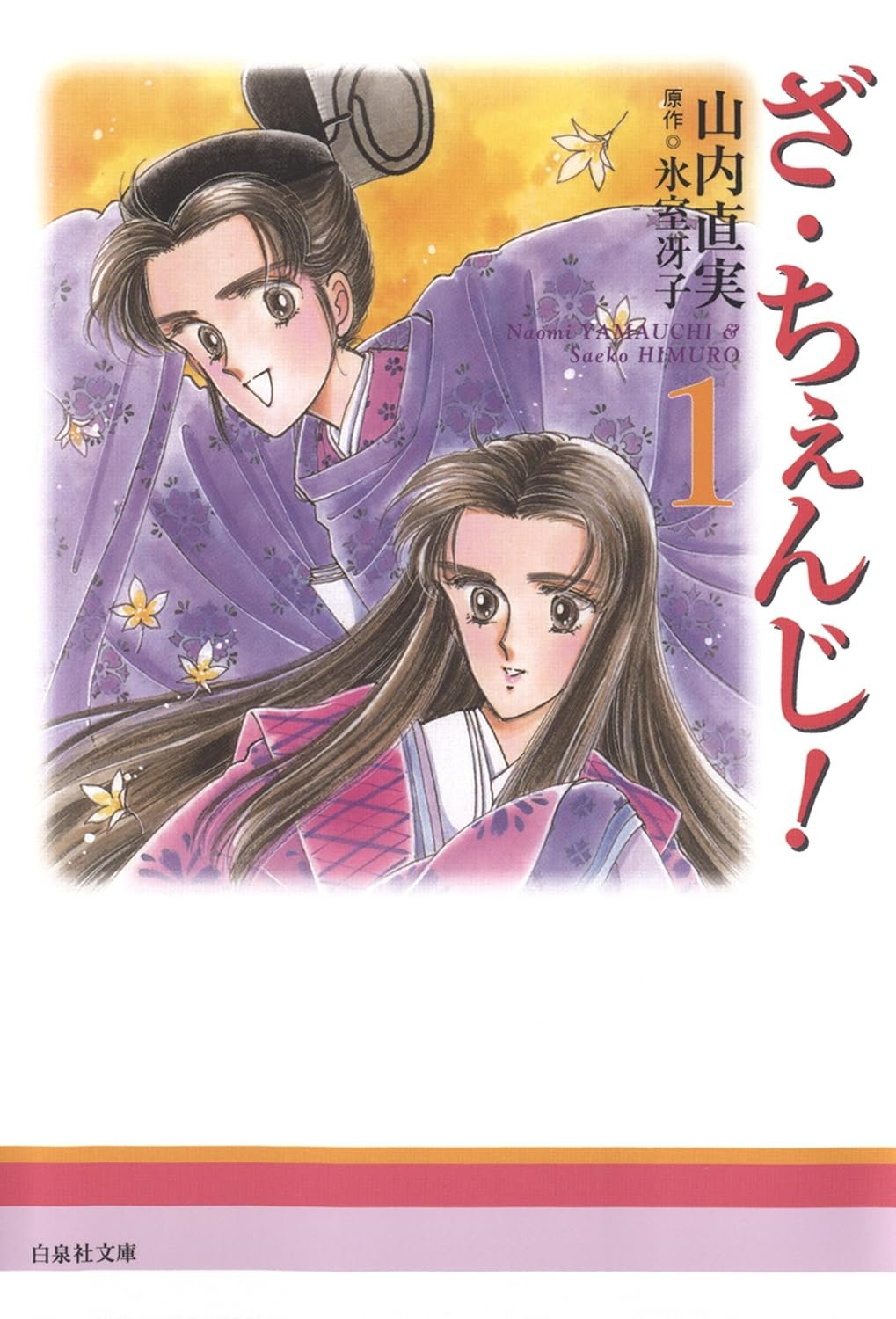
The cover of Za Chenji! volume 1.
I’ve written before about how Torikae baya diverges in minor and major ways from its source material, and this is true for Za Chenji! as well. One of the most obvious differences is that it only tells part of the story, with the fourth and final volume ending as Sara’s counterpart Kira takes over the role of naishi no kami from Suiren’s counterpart (also called Kira) and ponders what will happen next. The tone is quite different too: although the sibling in the Sara role does have moments of self-doubt and melancholy, for the most part it’s more of a romantic comedy full of hijinks and awkward misunderstandings. As an example of the latter, Sara’s counterpart doesn’t get pregnant, instead naively getting the impression that kissing makes babies. Some changes, like changing the udaijin’s fourth daughter (the chunagon’s wife) to his third daughter, seem pretty arbitrary.
There are cases where alterations to the original story in Torikae baya align with ones that already appeared in Za Chenji! For example, the Shikibu-kyo no Miya character, though named for an individual mentioned in passing in the original text, has a lot in common with a character in Za Chenji! named Hyobu-kyo no Miya, who does not appear in Torikaebaya monogatari. Meanwhile, the storm that provides Suiren with the opportunity to reveal the truth to Togu must have been influenced by a similar scene in Za Chenji!, even if Saito’s version adopts a more serious tone.
On the other hand, there are many ways in which Torikae baya clearly goes back to the source. When I was looking again recently at the earlier portions of Torikaebaya monogatari for the first time in a while, I was struck by how much of it is actually portrayed without changes in Torikae baya. There were even several points where I realised that some apparently original scenes were probably repurposed from moments that were otherwise skipped over. Importantly, Saito reinstates elements that don’t show up at all in Yamauchi and Himuro’s adaptation, like the characters of Suzakuin and Yoshino no Miya and the father’s dream about the tengu. It seems to some extent like a deliberate choice to bring this newer version closer to the source material.
But having said that, it’s not like Torikae baya reflects the narrative of Torikaebaya monogatari without any alterations or interpretations – and certainly not that any of this makes it somehow a “better” adaptation than Za Chenji! I’ve spoken before about a few motivating factors that appear to guide Saito’s decision-making in the process of adapting the tale, and we’ve already seen that her manga is not purely telling the original Heian period story but also the story she wants to tell. The same can be said for Za Chenji! too. It uses the plot of Torikaebaya monogatari basically to tell a story about a girl who wants to live the exciting, meaningful life afforded to men, but Himuro – and then Yamauchi – isn’t all that interested in exploring the complexity of the siblings’ genders. That complexity is absolutely central to Torikae baya though. Their differences compared to Torikaebaya monogatari and each other reflect those distinct angles.
Each new adaptation plays with the potential in the source material, but each one also becomes a kind of source for future versions. Sometimes, Torikae baya is different from Za Chenji! because it’s closer to the original text, but sometimes it’s different even because it does take inspiration from the earlier manga and shines a new light on it. And obviously, both of them have elements entirely specific to that one version of the story. Wouldn’t it be boring if they were all just the same?
By the way, if you want to read the Za Chenji! manga in English and see how different (or similar!) it is compared to other versions, there is actually a fan translation out there. I won’t link it here, but look it up and give it a read if you’re interested!
Torikae baya as gakushu manga
Last week, I wrote about the importance of the shōjo genre/format as context for Torikae baya, and in the process, I spent a bit of time justifying my decision to define Torikae baya as a shōjo manga at all. This time, I don’t exactly throw all that in the bin, but I do want to say a bit about how else we might categorise this series.
Last week, I wrote about the importance of the shōjo genre/format as context for Torikae baya, and in the process, I spent a bit of time justifying my decision to define Torikae baya as a shōjo manga at all. This time, I don’t exactly throw all that in the bin, but I do want to say a bit about how else we might categorise this series.
As I mentioned before, there are four main categories for manga based on what kind of magazine it is first published in: shōjo (girls), shōnen (boys), josei (women) and seinen (men). Besides these, there are some other magazine categories, like ones aimed at little kids – sometimes gendered and sometimes not – and ones decidedly not aimed at kids. Others concentrate on particular themes or styles, like BL or 4-koma. Or manga might not appear in specialist magazines at all. Miyazaki Hayao, for example, has written several manga over his career, but not one in any of the big four categories: instead, they were published in places like an anime magazine, a scale model hobbyist magazine and a Communist Party newspaper for children.
One other category is gakushū manga – basically, educational manga – which is often published in book form rather than in magazines. When I worked in Japanese primary schools, I remember classroom bookshelves full of manga biographies of famous historical figures. Gakushū manga can cover any school subject, and they’re not even necessarily targeted at children – manga can teach you about boring grown-up subjects like statistics and economics too.
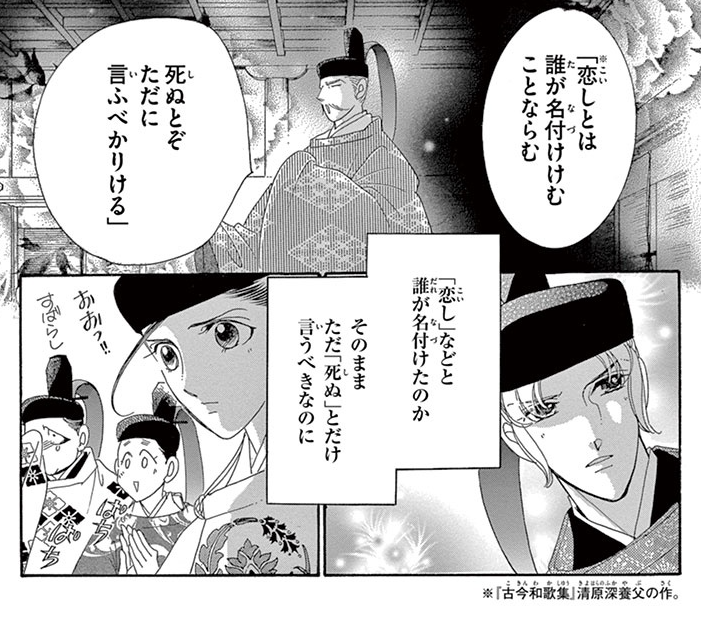
A poem from the Kokin wakashu, with a modern Japanese translation and a footnote citation.
Panels from volume 4, page 12. ©Chiho Saito/Shogakukan
A broader definition of gakushū manga is also possible, as we can see in the Nippon Foundation’s “Manga Edutainment” project: this site explicitly uses the label of gakushū manga not in the sense I just spoke about, but as an umbrella term for a variety of manga in all sorts of genres with educational value, handpicked by manga writers, academics, etc. And in the “literature” section is – you guessed it! – Torikae baya, selected by shōjo manga scholar Fujimoto Yukari.
What’s helpful about thinking about Torikae baya as a gakushū manga? For one, it aligns with my idea that aside from things like entertainment and a “positive” outlook, one of Saito’s motivations in adapting Torikaebaya monogatari is education. In our interview, she talked about the amount of background research involved in the adaptation and how she wanted to put it to good use. This comes across in elements like the volume afterwords and the inclusion of a range of Heian court events.
It also helps to answer the question of how to adapt a work like Torikaebaya monogatari in the medium of shōjo manga. Classic shōjo conventions allow for techniques like organising panels and pages in ways that are more complicated than was the norm in early serialised manga, which is handy for depicting the Heian court as full of life. When it comes to textual aspects, word balloons contain speech, while outside of balloons there are (broadly defined) sound effects and plenty of internal monologue, treated a bit like a voiceover. This is all well and good for showing readers what’s happening and how characters feel, but it doesn’t offer an easy solution for teaching them about the setting. To do that, Saito adds things like chunks of third-person explicatory narration, footnotes and modern Japanese translations of poetry alongside the original – features one might expect to encounter in gakushū manga adaptations of Heian period literature.
Of course, the point of this isn’t to say that the boundaries of shōjo manga are so strict that a single footnote changes the genre! If anything, I want to stress the opposite: there is such variety in possible modes of expression in manga that even if a writer is working within a particular genre, they can pull from a much wider toolbox depending on what they want to do. To some extent, just about any manga adaptation of a lesser-known 800-year-old text is going to have at least some educational motive – even if it’s only to the extent of “hey check this out!” – so it shouldn’t come as a great surprise that in Torikae baya, Saito supplements her usual shōjo style with elements common in more overtly educational material.
Afterword: The Afterwords
Now that I’ve got through talking about each chapter of Torikae baya one by one, this seems like a good time to say a bit more about the afterwords that appear in every volume! I’ve previously mentioned these “Atogaki baya” sections in passing, but what exactly are they?
Now that I’ve got through talking about each chapter of Torikae baya one by one, this seems like a good time to say a bit more about the afterwords that appear in every volume! I’ve previously mentioned these “Atogaki baya” sections in passing, but what exactly are they?
At the end of each published volume, where most manga would have some kind of short bonus material (you may know this as omake), there is a 2-4 page section, generally still in manga form, where Saito directly addresses the reader and provides some additional context that you wouldn’t get from reading the monthly chapters in Flowers magazine. And naturally, when it comes to translating and studying the series, the information they provide can be very useful! Here’s a rundown of what each afterword covers:
Volume 1 – A brief explanation of how Saito ended up adapting Torikaebaya monogatari.
Volume 2 – An overview of the daily lives of Heian government officials.
Volume 3 – The connections between Heian court events and some modern-day public holidays in Japan.
Volume 4 – An explanation of court positions and ranks, and how these apply to major characters in the story. I referred to this in this post and this one.
Volume 5 – How working on Torikae baya helped Saito understand what the different dolls in a Hina matsuri display represent.
Volume 6 – Types of marriage in the Heian period. I referred to this in this post.
Volume 7 – An explanation of Heian women’s clothing, specifically the junihitoe (twelve-layered robes).
Volume 8 – An explanation of male court officials’ clothing, noting the great detail of variation based on rank and position.
Volume 9 – A map of the Kinai region at the time of the story. I referred to this in this post and used it as a basis for my map.
Volume 10 – An explanation of the duties of the naishi no kami. I referred to this in this post.
Volume 11 – Plans of the greater palace area (daidairi), the palace complex (dairi) and the Seiryoden. I referred to this in this post.
Volume 12 – Details of the emperor’s harem and the ranks available for his women.
Volume 13 – A discussion of some of the alterations made to the source text throughout the manga.
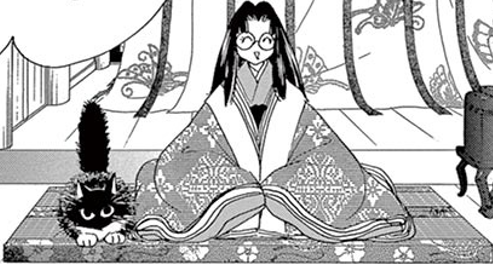
Saito in Heian period clothes with her cat in the final afterword.
Panel from volume 13, page 131. ©Chiho Saito/Shogakukan
For readers, these afterwords offer clarity on aspects of the story and its setting that may be hard for non-specialists to imagine, and especially in the first and last volumes, they provide insight into Saito’s process. And this last point is important because there just aren’t that many places where Saito speaks about how she approached the adaptation. Apart from these, there are a handful of magazine/online interviews where Torikae baya comes up (these two for example), and a small artbook sold as part of the volume 13 limited edition.
Details in the afterwords have helped me understand the world of the story and given me a sense of Saito’s intentions* for the adaptation. For example, the volume 1 afterword uses the intriguing term “melancholic moe” (メランコリックな萌え) to describe elements of the source material that might speak to today’s readers; and the volume 13 afterword mentions writing the manga to emphasise the story’s “positive entertainment value” (かなーり前向きなエンタテイメント性) and work specifically as shojo manga.
But the afterwords aren’t perfect. As I’ve already mentioned, they’re short, there’s only thirteen of them, and yet they represent the lion’s share of sources that reveal Saito’s thoughts on the adaptation. Also, even though some of them deal with quite specialist topics, they’re not really meant to be academic writing, and as such, they usually don’t cite specific sources. And so, they are very useful for me, but limited.
This all means that it was extremely valuable to get the chance to speak to Saito myself last summer. I found out where some of this information came from, saw what books Saito used as reference for Heian period clothing, architecture, etc, and found out more about what inspired her to write Torikae baya in the first place and in the specific way that she did. One particular takeaway was that writing the series required all sorts of background research and, rather than let that go to waste, she wanted to share with the readers as much as possible of what she herself had learnt. We can see this in the afterwords themselves: most of them feature an illustration of Saito (and/or her cat) explaining or showing off the matter at hand, like a teacher. This all leads me to add education to the list of motivating factors behind Saito’s adaptation – and that’s something I’ll say more about another day!
As for what I’ll do with the afterwords… I’ve obviously used them for reference, and I have written rudimentary translations for a few of them, but they’re supplemental paratexts rather than fundamental parts of the manga. That means they probably won’t make it into the thesis itself, but I may include at least some translated afterwords in an appendix. We’ll see!
*I don’t want to hype up the idea of “authorial intent” too much – especially when we consider that writing a serialised manga involves delegating tasks to assistants and not necessarily knowing how long it’ll go on for – so to be clear, when I say “intention”, I don’t mean a perfectly articulated manifesto by The Author that must be taken at face value. What I mean is something less concrete, a loose set of principles guiding decision-making (perhaps not consciously) during the process of adaptation.
More thoughts from Episode 65: The End
The time has come! As promised last week, this post goes over the second half of the 65th (and final) chapter, with a bit of commentary on where we’ve ended, why it’s interesting and what comes next for this project.
The time has come! As promised last week, this post goes over the second half of the 65th (and final) chapter, with a bit of commentary on where we’ve ended, why it’s interesting and what comes next for this project.
Following the previous events, Sara is formally crowned as Empress, while the Emperor and Suzakuin watch on and discuss the situation with Ichi no Himemiya (Mitsuko; the now former Togu) and General “Sarasoju” (Suiren). Suiren later visits Mitsuko, the two having both learnt that they have been granted permission to get married. However, having overheard the Emperor and Suzakuin’s conversation, Tsuwabuki thinks this would lead to disaster, believing it to be a situation like the earlier marriage between Sara and Shi no Hime. He therefore waits for Suiren to emerge in the morning after visiting Mitsuko, and confronts her. Suiren says nothing, but places Tsuwabuki’s hand on her chest and leaves, laughing. Tsuwabuki is utterly perplexed – for a moment he seems to think Heian surgeons must’ve had techniques lost to history – and aptly, that’s the last we see of him.
The narrative then jumps ahead… let’s say some years later. At Marumitsu’s residence, Mitsuko and San no Hime try to resolve a dispute between a tearful boy and a boisterous girl (clues identify the boy as Suiren and Mitsuko’s child and the girl as Sara and the Emperor’s). Sara catches Suiren nearby, writing a story based on the siblings’ experiences. While they reminisce, Marumitsu and his wives watch the squabbling children, a sight that reminds Marumitsu of a certain other boy and girl.
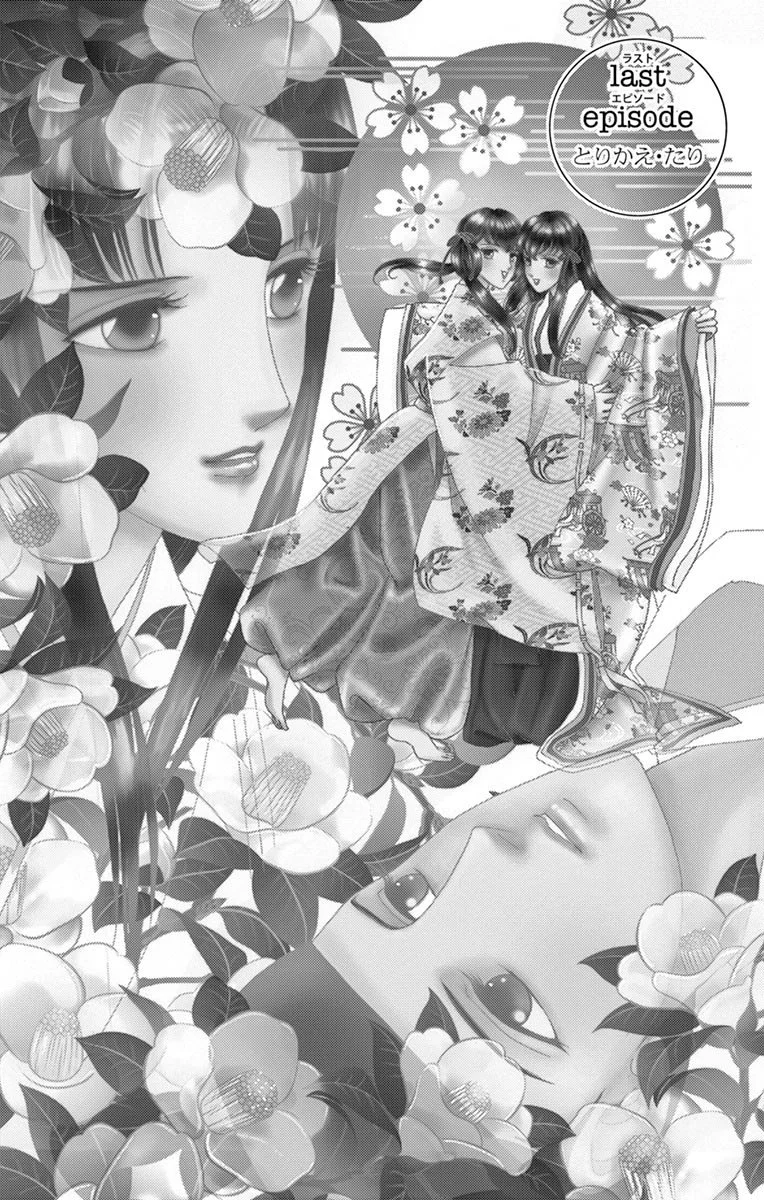
Episode 65 title page from volume 13, page 148.
©Chiho Saito/Shogakukan
And that’s it! After everything that’s happened over the 65 chapters, Sara and Suiren are living their post-switch lives comfortably, remembering the past and looking to the future. And despite the various tweaks along the way, the ending reached in the manga is still fundamentally the same as in the original Torikaebaya monogatari. Whether that ending is satisfying depends on how you look at it, but as suggested a few weeks ago, I find that by taking more time with the second half of the story and conveying each step of the way as down to the protagonists’ choices (at least partly), it puts a new spin on the same ending that makes it happier than it might’ve felt otherwise.
I briefly noted last time that this chapter is officially called the “final episode” rather than “episode 65”. Now I’d like to take a look at the title, “Torikae tari”: this is, of course, a twist on the title of the manga, and as it stands, my translation leaves it in Japanese just as I’ve left the manga’s title in Japanese. The new phrase replaces the desiderative suffix baya (think “if only…”) with the perfective or resultative auxiliary verb tari (think “has happened”), turning Marumitsu’s old line “I wish I could switch them” to “they have been switched” – or, if you like, “the change is complete”.
Something I’ve thought about a bit is the significance of the fact that “torikau” (取り替ふ) is a transitive verb, meaning that it acts upon a grammatical object. With no other words present, the phrase torikaebaya implies a subject and object, and in the tale, the subject is the father. It struck me as quite sad to think that the siblings don’t even get to be (grammatically) the subjects of their own story. They are truly at the mercy of fate: things happen to them, and they just go along for the ride.
Fate is obviously a recurring theme in Saito’s manga version, and we get a reminder of it in this chapter. During the ceremony where Sara becomes Empress, he remembers that Yoshino no Miya – knower of things and (figuratively??) a tengu – said this would happen one day. And in a sense, it really was all destined to happen, because it’s a fictional story based on an existing story with a particular premise and particular plot points that remain the same in the manga. Attention is brought to this too, with Suiren continuing to write a story that has come up a couple of times already, and which is implied to be Torikaebaya monogatari or something a lot like it. Interestingly, she reassures that nobody will trace it back to her (or rather, “Sarasoju”) because she writes using hiragana – then considered a women’s style.
The last point is also interesting because we don’t know who really wrote Torikaebaya monogatari. In Rosette F Willig’s thesis, where she translates the original story, she summarises existing discussion over whether the author was a man or a woman. She then considers two other possibilities: that as there were at least two versions, a woman may have rewritten a man’s work, or even that the author was somebody whose own life was something like the chunagon’s.
But really, there’s no way of knowing who actually wrote the story in its two versions, or whether there might have even been more than two. For that matter, since distributing literature at the time would’ve meant borrowing manuscripts and/or hand-copying them, the version we ended up with could have contained errors or changes of its own.
In contrast, we know exactly who wrote modern adaptations like Torikae baya. To return to the earlier point about transitive verbs, I realised at one point that I’d been thinking of “adapt” in too much of an intransitive sense, wondering what had changed between different adaptations as if it were some kind of natural process. But while “adapt” can be used either way, I think it’s actually more interesting to see it as transitive: this version of the story was written by a known individual with ideas to bring to the table. Whoever wrote Torikaebaya monogatari, Saito wrote Torikae baya, and did so in a way that gives the siblings a more active role in the story. Even in Saito’s version, their father still gets the final word, but notably, it’s to say this:
HIGASHI I suppose
you're thinking ‘if only I could change those two’?
MARUMITSU No.
MARUMITSU is shown in profile, looking thoughtful.
MARUMITSU The children are fine
just as they are.
It's not for me to decide.
They will be what they want to be.
Though Sara and Suiren didn’t get to change certain details of their predestined story, they did make some choices of their own along the way, and perhaps the next generation will fare better.
You might notice something of a parallel between the in-story “fate” that the characters push against on the one hand, and another “fate” determined by the source material which Saito then had to contend with on the other. And this is exactly what I’m interested in tying together in my thesis! Since completing a first draft of the translation back in December, I’ve been slowly working on making the translation more consistent and good, and working out a shortlist of translated chapters to go into the thesis. Recently, I’ve also been doing some more reading to determine what should go into the commentary and how. I have about a year left to bring it all together!
And finally, although this is the end of the chapter-by-chapter progress through the manga on the blog, I will continue to post! There are several things I never got to discuss as much as I wanted, and obviously still more progress to be made in the overall project. So thank you for reading so far, and please stick around for more! 🥰
Thoughts from Episode 63: Context is everything
As the end of the story nears, this chapter sees the plot begin aligning once more with the plot of the original Torikaebaya monogatari, but as we’ve seen before, the differences in how those story beats are reached have an impact on how it all comes across. And on that note, I’ll get a bit into how poems from the original story are recontextualised in the manga.
In the aftermath of the palace fire, Sara and the Emperor are now an item (finally! a successful workplace romance for Sara!) and Marumitsu’s residence is to be used as a temporary palace. While Sara shows the Emperor around, Suiren tells Marumitsu, Nishi and Higashi that the Emperor knows the truth about the siblings; Nishi then prepares Sara for his private audience with the Emperor.
As the end of the story nears, this chapter sees the plot begin aligning once more with the plot of the original Torikaebaya monogatari, but as we’ve seen before, the differences in how those story beats are reached have an impact on how it all comes across. And on that note, I’ll get a bit into how poems from the original story are recontextualised in the manga.
In the aftermath of the palace fire, Sara and the Emperor are now an item (finally! a successful workplace romance for Sara!) and Marumitsu’s residence is to be used as a temporary palace. While Sara shows the Emperor around, Suiren tells Marumitsu, Nishi and Higashi that the Emperor knows the truth about the siblings; Nishi then prepares Sara for his private audience with the Emperor.
For much of the rest of the chapter, Sara frets over how the Emperor might react if he were to learn that not only did Sara have a previous sexual partner despite living as a man since the age of 14, but that this resulted in pregnancy and stillbirth. He decides to take the chance, and after they spend the night together, the Emperor realises the first of these secrets. When Sara tells him the rest of the story (omitting quite how it happened and who with), the Emperor is shocked but sympathetic, and in the end, Sara agrees to be his wife.
There are references in Episode 63 to the Tanabata legend, as the Milky Way (Amanogawa, 天の川) is visible in the night’s sky. I don’t think that’s because it is Tanabata, because it appears to me that it’s probably winter at this point in the story. However, it links the events to the time that Tanabata did take place in Episode 54: that time, Sara and the Emperor’s relationship very nearly kicked off, and perhaps more importantly, the missing Suiren was reunited with Mitsuko. That connection gives the current situation a bit of a “true love” vibe.
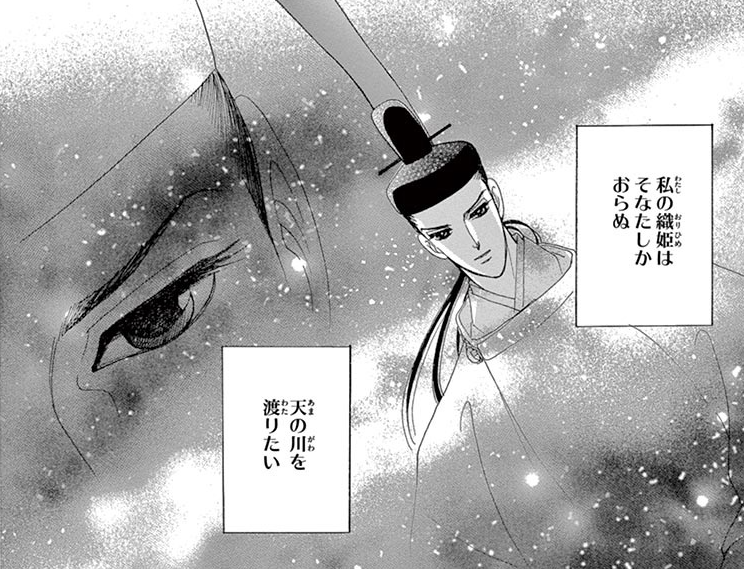
Sara sees the Emperor in a dream.
Panel from volume 13, page 102. ©Chiho Saito/Shogakukan
All that talk of the Amanogawa also sets the Emperor up to write Sara a poem that invokes another legendary river, the Mitsusegawa (三瀬川 – more commonly known today as Sanzunokawa, 三途川), which people must cross when they die. Here it is:
三瀬川 のちの逢瀬は 知らねども 来ん世をかねて 契りつるかな
Both the classical Japanese original and a modern Japanese gloss are included, and as usual, I use this as an opportunity to follow up a shorter, more direct translation with a more explicatory version. Here’s how I handled this poem:
Though I know not whether we will meet at the Mitsusegawa, let us pledge to meet again in lives to come.
(They say a woman is borne across the Sanzunokawa by the first man she loves. I may be unable to cross the river with you at the end of this life, but let us promise that we will cross together in a future life.)
This is not the first time that a poem in Torikae baya has made reference to this legend. After Tsuwabuki initiates his affair with Shi no Hime, he recites a poem to express the depth of his feelings for her, saying that he will carry her across the Mitsusegawa and that the two must be bound together by fate. The contrast is obvious: whereas Tsuwabuki’s poem tries to put an optimistic spin on pressuring Shi no Hime into doing what she’d rather be doing with her husband (and kind of ruining her life in the process), the Emperor’s poem reassures Sara that their relationship is more meaningful than whatever might have happened in the past.
But remember what I said about poems being recontextualised in Torikae baya? Well, in the original story, the Emperor’s poem doesn’t seem quite so sweet. Having seen very little of the naishi no kami – and unaware that they are the former chunagon – he sneaks into their room at night and gets down to business without feeling the need to ask. The naishi no kami doesn’t even realise who he is until halfway through! In the original context, that poem serves much the same purpose as Tsuwabuki’s. He even gets a response, a poem from the naishi no kami downplaying the value of making a promise for future lives, which reminds me of the incredulous replies the chunagon gives to the saisho no chujo (and Sara to Tsuwabuki) when the latter melodramatically suggests he will die of worry. The romance between the Emperor and the naishi no kami isn’t really so different from those more disastrous affairs.
Needless to say, Saito doesn’t portray Sara’s relationship with the Emperor like that. As I’ve talked about before, she often shows characters’ feelings and imbues them with more agency by changing the way that major events in the story take place. In the final “Atogaki baya” afterword, she specifically highlights how the former chunagon marrying the Emperor didn’t really strike her as a happy ending, and I’d say that same approach really helps take the somewhat depressing edge off the final outcome. The extended post-switch section of the manga demonstrates how Sara and the Emperor become gradually more interested in each other, and crucially, when they sleep together in Episode 63, Sara is actually into it.
The new context could have made the original poem feel out-of-place, but instead it changes the tone to be more readily interpretable as romantic. Saito’s use of poems from Torikaebaya monogatari is quite selective, with plenty being omitted, but it’s interesting to see this kind of repurposing. Another instance can be seen in Episode 56. Shortly before Suiren’s return from exile, she sends a heartfelt poem to Mitsuko; the same poem appears in the original story, but in the context of the former naishi no kami returning from Yoshino, checking up on various women and weighing up how to fit all these potential wives into a nice big house. Suiren in the manga is quite a different character, but the poem still serves a purpose. As is so often the case, these little changes and additions don’t reshape the plot as a whole, but they go a long way in advancing the “positive” version of the story that Saito wants to tell.
Thoughts from Episode 33: Life is but a dream
Episode 33 begins with the image of a tengu, appearing in Marumitsu’s dreams as a voice informs him that his children’s karmic debts have been repaid and they will return shortly. He then wakes up to learn that it’s true! Sara and Suiren are back to pick up each other’s lives where they left off, and their parents are overjoyed.
The news of their return soon reaches others: Kakumitsu, who is persuaded to take Shi no Hime and her children back in, and Tsuwabuki, who is too shocked about “Sara” coming back to even think about Shi no Hime. Tsuwabuki makes his way to the palace on the day Suiren arrives to take over Sara’s old job, approaching Suiren with his typical degree of discretion and earning himself a kick in the head. Later, the Emperor receives Suiren and expresses his relief that “Sara” is back at court.
Episode 33 begins with the image of a tengu, appearing in Marumitsu’s dreams as a voice informs him that his children’s karmic debts have been repaid and they will return shortly. He then wakes up to learn that it’s true! Sara and Suiren are back to pick up each other’s lives where they left off, and their parents are overjoyed.
The news of their return soon reaches others: Kakumitsu, who is persuaded to take Shi no Hime and her children back in, and Tsuwabuki, who is too shocked about “Sara” coming back to even think about Shi no Hime. Tsuwabuki makes his way to the palace on the day Suiren arrives to take over Sara’s old job, approaching Suiren with his typical degree of discretion and earning himself a kick in the head. Later, the Emperor receives Suiren and expresses his relief that “Sara” is back at court.
Finally, the real Sara shows up at the Nashitsubo pavilion with Torako and other attendants to begin work as the naishi no kami… only to meet another naishi no kami: Kakumitsu’s daughter San no Hime.
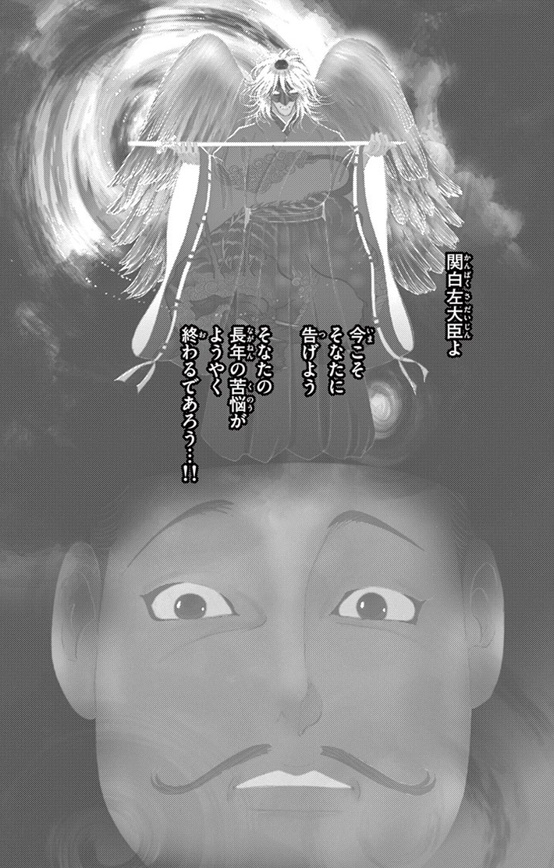
Marumitsu dreams of the tengu.
From volume 7, page 77. ©Chiho Saito/Shogakukan
And so, the big switch that Sara and Suiren prepared for last time is now complete. Marumitsu’s dream at the start of this chapter is, of course, equivalent to a key scene in the Heian period tale – a scene that I never tire of pointing out as the only time a tengu is mentioned in the source material. As such, I devoted quite a bit of time to working out how this scene is adapted and how to put that into English. Broadly speaking, it stays quite close to the original scene, though the visual focus is on the tengu, whereas the original suggests that Marumitsu only sees a priest who tells him about the tengu. Of the different versions, Saito’s wording is probably closest to Kuwabara Hiroshi’s modern Japanese translation, but with the notable distinction of omitting any specific mentions of the man’s children and their genders. Therefore, where other versions clearly state “[the tengu] changed the boy into a girl, the girl into a boy” and “the man will be a man and the woman a woman” (both from Willig’s translation), the manga avoids saying quite what the punishment was and quite what the remedy is. In fact, Marumitsu doesn’t seem certain either – the dream voice tells him “all things should soon settle rightly into their right places” and he then wakes up wondering what “rightly” (しかるべき) was supposed to mean.
Even apart from this big moment, references to dreams loom pretty large in Torikaebaya monogatari. Willig characterises the tale as a giko monogatari, a genre that is openly derivative of existing courtly literature (particularly The Tale of Genji) and notes “dreams” as one of the genre’s typical themes. One of the main ways this comes across in the original text is the many moments where an incident is described as “like a dream” (or some similar variation). The “dreamlike” description is applied frequently but not exclusively to dubiously consensual sex scenes, which I imagine has some connection to the figuratively and literally murky reality of courtship among the Heian nobility. I could swear I’ve read about this phenomenon occurring in other Heian literature too, but I couldn’t come up with a source on it today. Torikae baya, being in a visual medium, doesn’t reflect this tendency so much, but there is a moment early in Tsuwabuki’s affair with Shi no Hime when he wonders sadly if their night together was just a “sweet dream” never to reoccur.
Dreams are also associated with Yoshino no Miya in both the source material and the manga, with dream interpretation being one of his many areas of mystical knowledge. When the chunagon first leaves for Yoshino in the original story, he tells people he needs to take a break on the advice of a dream interpreter. This is apparently meant to put them off his scent, which I must say seems a bit counterintuitive, but at least it shows that people were taking dream interpretation very seriously! Anyway, it makes sense that Yoshino is an expert on these matters, as he serves an important role in the story as somebody with knowledge of the past and future and of the siblings’ secret. This is especially important in the manga, where he’s also closely associated with the tengu. Incidentally, Willig suggests in passing that he is connected to Marumitsu’s dream in the original story too, but so far I’ve found nothing to back this up.
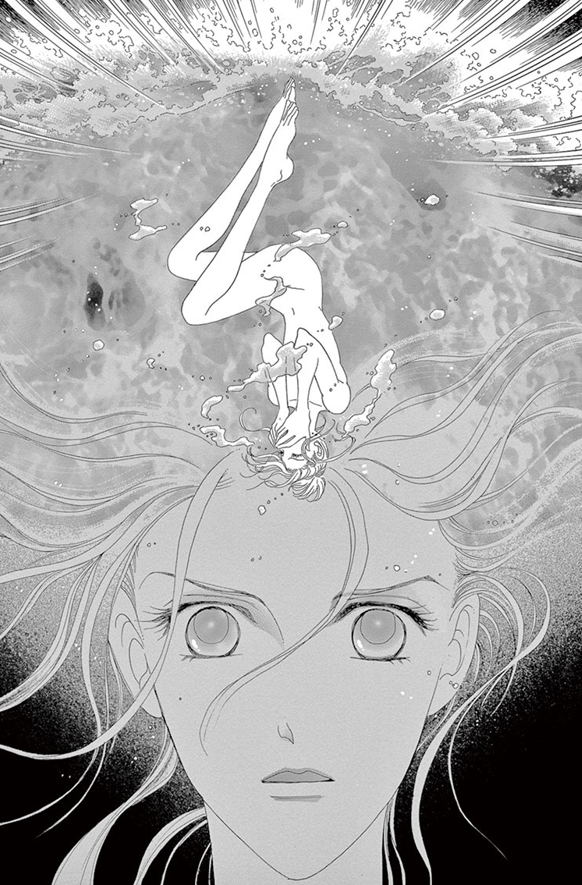
Sara dreams of drowning.
From volume 4, page 57. ©Chiho Saito/Shogakukan
Anyway, in the Torikae baya manga, the most common references to dreams are just dreams themselves! In Episode 3, Sara dreams about the “tengu” that kidnapped him and Suiren as children, and indicates that isn’t the first time. This dream shakes up the narrative of the story by revealing the idea of the tengu’s curse much earlier and treating it as something that weighs on the siblings’ minds, and because it is also a premonition of the eclipse incident, it gives Sara an early emotional connection to the future Emperor. And when things go wrong later, he and Suiren both suffer from nightmares: after his night with Tsuwabuki, Sara dreams that he is drowning (foreshadowing his suicide attempt in Uji), and following Sara’s disappearance, Suiren is plagued with confused thoughts about where he has gone and why. Similar moments occur later in the series too, including ones that call back to earlier dreams.
Altogether, I find that all these dreams – the ones experienced by the characters and the passing allusions to dreaming – serve two main purposes. In the overall narrative, they help to tie things together, giving the reader hints of what is to come and providing some explanation for events. But maybe more importantly, they contribute to a sense of ambiguity. The characters and the reader can’t always tell what is real, and distinctions aren’t always clear-cut. And as Togu suggests when she gazes out on the aptly named Yume no Wada and can’t help but quote the Man’yoshu, dreams and reality may not be so far apart.
Thoughts from Episode 31: Return to Yoshino
After spending quite a bit of time on the previous chapter (two posts over three weeks), let’s finally move on to Episode 31, the beginning of volume 7! Sara and Suiren have been reunited, Sara instructs Aguri – who imagines she’s seeing two of the same person – to let Tsuwabuki think Sara has vanished into thin air while the siblings head for Yoshino. There, they tell Yoshino no Miya of their intention to take up religious vows, and lament together about how they have ended up in this situation.
After spending quite a bit of time on the previous chapter (two posts over three weeks), let’s finally move on to Episode 31, the beginning of volume 7! Sara and Suiren have been reunited, Sara instructs Aguri – who imagines she’s seeing two of the same person – to let Tsuwabuki think Sara has vanished into thin air while the siblings head for Yoshino. There, they tell Yoshino no Miya of their intention to take up religious vows, and lament together about how they have ended up in this situation.
One day, the Emperor appears. Sara and Suiren eavesdrop as he seeks Yoshino’s advice regarding troubles at court and asks him to return to political life in Heian-kyo. Yoshino turns down the request and informs the Emperor that the real reason he was previously banished from the capital was because he coveted the former Emperor’s consort. Eventually, the current Emperor reluctantly accepts Yoshino’s refusal and goes on his way.
Sara and Suiren, having heard about the difficulties in the capital – including their father being literally worried sick about them and Togu being left without supporters – question whether they are doing the right thing in abandoning the secular world. At last, they decide to switch places (立場をとりかえ) and return to Heian-kyo.
This chapter is titled “The Secret of Yoshino” (吉野の秘め事), and as such, I’d like to get a bit more into Yoshino no Miya and his backstory. I did give him a little introduction earlier, but Episode 31 reveals details that were previously murky.
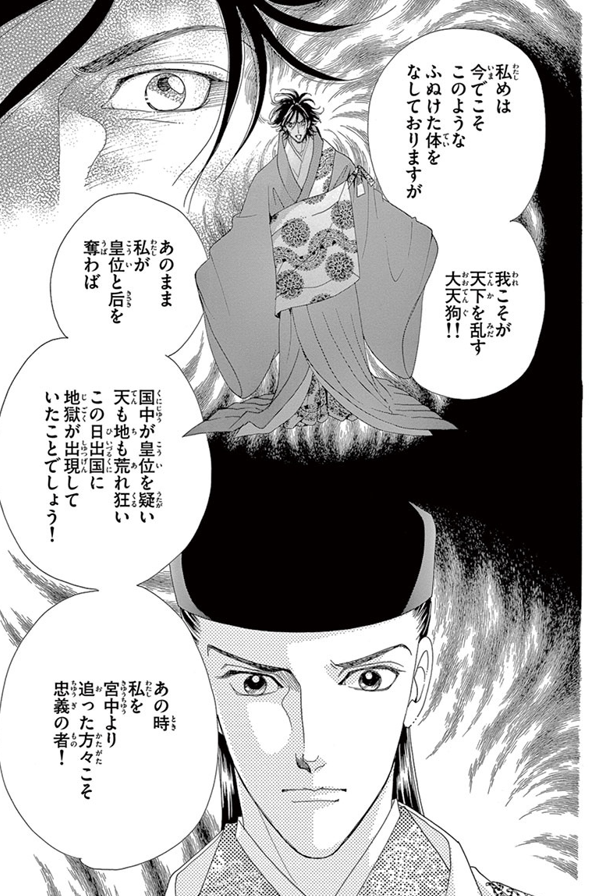
Page from volume 7, page 31.
©Chiho Saito/Shogakukan
So who is he? He refers to Suzakuin (the former Emperor) as his cousin, and therefore he is also a cousin to the current Emperor, who is Suzakuin’s younger brother. At some point in the past, he travelled to China and gained knowledge in esoteric fields such as physiognomy. That presumably occurred before a period ten-plus years prior to the current events, when he was involved in a scandal which resulted in his expulsion from the world of politics. He then secluded himself on the remote Yoshinoyama, where he prays for the safety and prosperity of the people in the capital, especially the imperial family, and especially especially Togu.
In this chapter, we learn the nature of that earlier scandal. Not only was he involved in a succession dispute with Suzakuin, but he lost that dispute – and we can deduce that that probably resulted in Suzakuin ascending the throne soon afterwards. Even worse, he desired Suzakuin’s late wife, and may well be the illegitimate father of the current Togu. When the current Emperor directly questions him about this in Episode 31, he denies that his relationship with Suzakuin’s wife reached that point, but the implication is that the stories are true. Of course, this would make his particular attachment to Togu make a lot of sense!
It’s also interesting when we compare his character to his counterpart in the original Torikaebaya monogatari. There, Yoshino no Miya has two beautiful daughters, whose mother was Yoshino’s Chinese wife who tragically died, leading him to take them back to Japan with him. He feels a responsibility to remain hidden away on Yoshinoyama, but wishes that his daughters could leave and live a more normal life; he gets his wish when Sara’s counterpart takes an interest in the elder daughter and Suiren’s counterpart later marries her in his stead. In the manga, Suzakuin’s late wife is the equivalent of Yoshino’s late wife, and Togu – as Suiren’s only love interest and Yoshino’s implied illegitimate daughter – turns out to be a composite character of the original Togu and Yoshino’s daughters.
And while revealing these dramatic details in Episode 31, Yoshino says one other interesting thing. As he insists that it was only right for him to driven away from the capital, he refers to himself as “the great tengu that sows chaos across the land” (天下を乱す大天狗). Now, a “tengu” can also figuratively mean an arrogant person, which would be a plausible interpretation in this context, but it isn’t the first time he’s been associated with tengu. On his very first appearance, his skills, his knowledge and his clothing led Sara and Suiren to mistake him for a tengu, and since then, he has made remarks about turning his back on a dark past. For him to call himself a “tengu” now – just before the only part of the original story where the tengu is mentioned – comes across as more than just a figure of speech. It suggests that while Togu takes on aspects of Yoshino’s daughters from Torikaebaya monogatari, the tengu’s story also becomes part of Yoshino’s story in this version of the tale.
Thoughts from Episode 29: The world beyond the capital, the cast beyond Sara and Suiren
A more typical post today, going over Episode 29 and having a little look at how the cast of the original story expands in Torikae baya.
Suiren, now looking just like Sara used to, is ready to go looking for her brother… except she doesn’t know a lot about going about as a man, riding horses, etc. But with some help from some servants who knew her as a child, she hides away in a palanquin and searches around Heian-kyo. There’s no sign of Sara at Aguri’s home, nor at Saemon’s, but at the latter she spots Tsuwabuki and realises he was Shi no Hime’s secret lover.
A more typical post today, going over Episode 29 and having a little look at how the cast of the original story expands in Torikae baya.
Suiren, now looking just like Sara used to, is ready to go looking for her brother… except she doesn’t know a lot about going about as a man, riding horses, etc. But with some help from some servants who knew her as a child, she hides away in a palanquin and searches around Heian-kyo. There’s no sign of Sara at Aguri’s home, nor at Saemon’s, but at the latter she spots Tsuwabuki and realises he was Shi no Hime’s secret lover.
Meanwhile, Sara is in Uji, encouraging Tsuwabuki to check on the poorly Shi no Hime and generally getting tired of his nonsense. Suiren and her entourage also come to Uji and ask around for a man who looks just like Suiren. Little do they know that Sara is having a stroll nearby with Torako and Toramitsu! Sara gets worked up after seeing a performance involving a tengu, then collapses in pain – but not before making eye contact with Suiren by pure chance. Of course, neither understands what they’ve just seen, and so Suiren departs, believing that Sara is nowhere to be found.
Plenty happens in this chapter, and we get nods to ongoing themes – Suiren’s discomfort in trying to take on a masculine role, Tsuwabuki’s naïve dreams of a happy family with as many wives as he likes, the seemingly mystical connection between Sara and Suiren, even a tengu! – with some striking visuals along the way. I’ll have more to say about these things later, but today, I want to return to an old topic and talk about the cast of Torikae baya.
The source material doesn’t introduce a lot of specific characters, and even fewer by a consistent name or identifier. Most of them appear in the manga too, in some cases being given nicknames in addition to their changing ranks. The most obvious examples are Sarasoju and Suiren, whom we might have some difficulty recognising at this point in the story, with Sara staying at Tsuwabuki’s villa dressing in women’s clothes and Suiren searching for him while dressed in men’s clothes.
But of course, manga is not the same as a (mostly) prose narrative from the Heian period. In totally verbal storytelling, only the plot-significant characters really need to be mentioned, and the reader’s imagination can fill in the blanks with as many background figures as one might expect in the busy palace. But unless you go all closeups all the time, a manga adaptation needs to show the Heian court in action, so a handful of characters just isn’t enough!
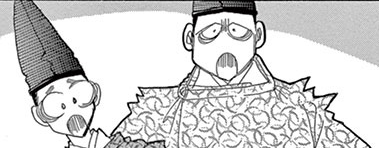
Sara imagines Akimasa and Tadasuke’s reaction.
Panel from volume 4, page 7. ©Chiho Saito/Shogakukan
That means some characters from the original story have new, expanded roles, such as Togu, Umetsubo, and to a lesser extent, people like Aguri and Saemon. In addition to those, though, are many, many more. Some character designs reappear, suggesting they are meant to be the same person showing up again and again. I asked Saito about whether she had names or titles in mind for any of the unidentified background characters, and she indicated that she avoided doing that as she didn’t feel confident enough about the time period to get it right when going beyond the source material. But she does name new characters sometimes. The danger of getting details wrong is often mitigated by having the identified characters be true one-offs whom we never hear from again, but there are quite a few who are recurring characters.
The most prominent of these so far are probably Tachibana no Akimasa and Minamoto no Tadasuke, the Lenny and Carl of Sara and Tsuwabuki’s work lives. Their purpose in the story is to demonstrate that Sara is well-liked at court and has friends who aren’t Tsuwabuki: they show up at social events, and theirs are the faces Sara pictures in Episode 16 when he worries about people’s reactions if they were to learn of his secret. They appear several times, and Akimasa is also integrated a bit more into the goings-on of the Heian court, turning out to have a job as a high steward (式部 の 大輔 – shikibu no taifu) under Shikibu-kyo no Miya.
A few named minor characters appear in Episode 29. Torako and Toramitsu arguably appear in the original story – there are brief mentions of children of the siblings’ wetnurses – but otherwise they’re pretty much new characters. Torako in particular plays a fairly substantial role, continuing to serve Sara even long past this point in the story.
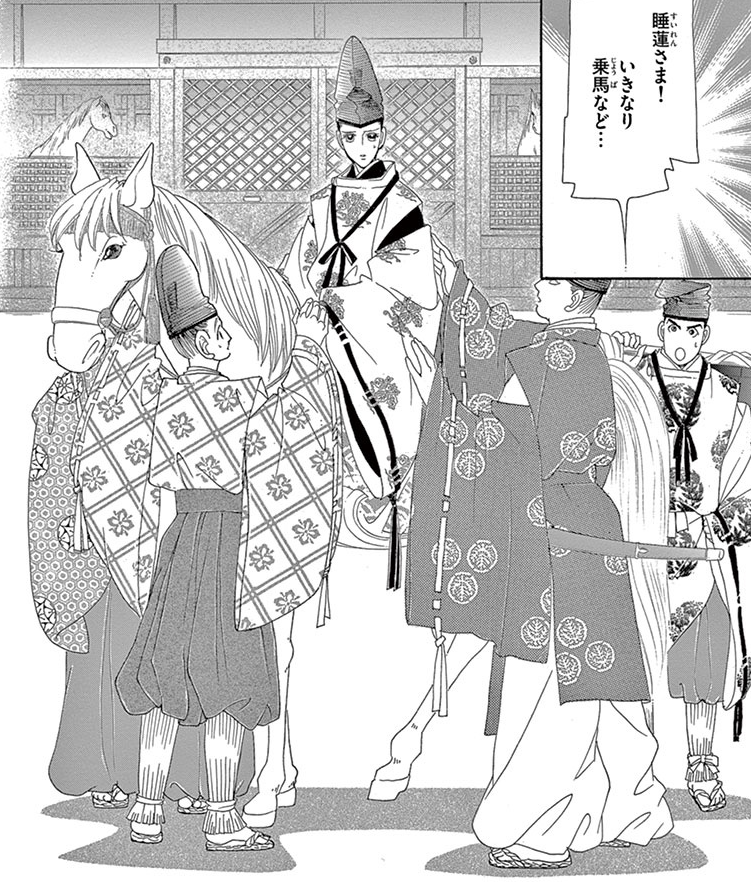
Pictured: Suiren (dressed as Sara), Gyuomaru, Jiroemon, Hayabusamaru, another guy.
Panels from volume 6, page 118. ©Chiho Saito/Shogakukan
We’re introduced to Suiren’s male servants too. One is apparently Sara’s former stable hand, and he introduces himself as Gyuomaru, while another is called Jiroemon. Suiren’s mother picked out these two and three other unnamed guys specifically because they knew Suiren as a child, and it’s possible these also correspond to the vague “wetnurse’s children” from Torikaebaya monogatari, but they’re effectively new characters. And besides them, this chapter mentions other people in passing, like Kakumitsu’s wife/Shi no Hime’s mother – who later makes a brief appearance – and Jiroemon’s aunt, a maid named Hiiragi. We even learn that Sara’s old horse is called Hayabusamaru!
While not every chapter has quite so many recurring or named characters, it’s fair to say that Saito does expand on the core cast more than she thought she dared to. And I think it’s for the best! It just wouldn’t be very interesting if an adaptation in a visual medium like manga didn’t show a bit more life in Heian-kyo, so adding these supporting characters is arguably just as important as showing all the historical architecture and beautiful clothes.
I’ve been meaning to put together a chart of the characters and their relationships at some point, a bit like the ones that already exist in the manga volumes. Of course, including everyone would make it much more complicated than the existing charts, and that’s what’s stopped me so far… but I still want to do it one of these days!
Thoughts from Episode 28: Suiren makes up her mind
Following the previous chapter’s visit to Uji to check in on Sara’s depressing storyline, we get the conclusion to Suiren’s dilemma in Heian-kyo. Everyone at court now knows that the Emperor has requested Suiren as a wife, so Suiren returns from her brief absence to give Togu an explanation. Togu assumes she has accepted the Emperor’s proposal and offers congratulations, having made an effort to get over her previous jealousy.
Following the previous chapter’s visit to Uji to check in on Sara’s depressing storyline, we get the conclusion to Suiren’s dilemma in Heian-kyo. Everyone at court now knows that the Emperor has requested Suiren as a wife, so Suiren returns from her brief absence to give Togu an explanation. Togu assumes she has accepted the Emperor’s proposal and offers congratulations, having made an effort to get over her previous jealousy.
But that isn’t really why Suiren has come! They have a conversation in private, while a dramatic storm conveniently shields them from eavesdroppers. After a roundabout conversation during which Suiren says she wants to leave and go looking for Sara, she finally reveals her biggest secret, even opening her robes to prove it to the disbelieving Togu. Togu faints, and when she wakes up she thinks Suiren is already gone – but she’s actually hung around to formally announce her departure. Leaving Togu distraught, Suiren finally makes her big exit, then goes to her parents to have her hair cut and put on Sara’s clothes, ready to begin the search for her missing brother.
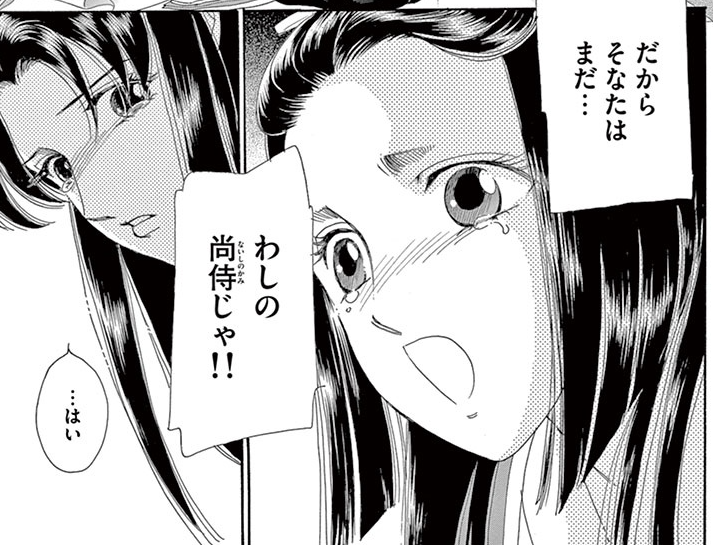
Panels from volume 6, page 107.
©Chiho Saito/Shogakukan
It says a lot about Torikae baya that the complex relationship between Suiren, a young woman harbouring a big secret about her personal background, and the adolescent Togu – who is also importantly her boss – is the healthiest romantic pairing in the story by a pretty big margin! Crucially, this is also a point where the manga diverges from the source material – not in the fact that it happens at all, but in how the characters and their relationship are portrayed.
Rosette F Willig, the translator of the original Torikaebaya monogatari into English, makes the case that the story effectively has just one main character, the chunagon, who is “played” by the two siblings one after another. The “sister” takes on the role until the situation becomes untenable, then the pair decide in Yoshino to switch places, so the “brother” then takes over. One impact of this is that the naishi no kami’s storyline is not explored in much detail. The “brother” simply becomes the naishi no kami, is smitten by the female Togu, and then can no longer continue in the position on account of having almost immediately impregnated her. Switching places to become the new chunagon is an easy decision for this version of the character, who takes quickly to life as a man, and isn’t even that devoted to Togu once other charming ladies become available!
Torikae baya’s Suiren is quite different, and plenty of time is devoted to showing that. Her shyness isn’t just a phase that she quickly grows out of, though her confidence does grow through her work as naishi no kami. And whereas her 12th-century (or thereabouts) counterpart’s attraction to Togu appears as some kind of masculine “instinct” coming to the surface, Suiren is instead shown to be scared that that could be the case. For example, in Episode 26, she panics after kissing Togu and says to herself: “I held Togu-sama as a man would.” It isn’t taken for granted here that she would want to live a man’s life given the choice, and she only takes Sara’s place when she feels she must.
When I wrote about Tsuwabuki finding out about Sara’s secret, I explained that Saito took what happens pretty quickly in Torikaebaya monogatari and expanded on it, with the effect of exploring characters’ emotions and changing how it all comes across to readers. The same thing basically happens in this case: instead of Togu finding out everything at once, her relationship with Suiren slowly develops, until Suiren reveals her secret and leaves, apparently never to return. This makes the characters more interesting, their storyline more romantic, and the overall plot less focused on how great it is to be a Heian gentleman.
Thoughts from Episode 15: The secret’s out (sort of)
This chapter, the last one in Volume 3, sees recent plot threads come to a head. Sara has just been promoted to Middle Councillor (chunagon, 中納言), but he now strongly suspects that the father of Shi no Hime’s child is Tsuwabuki. While he attends a celebratory party, Tsuwabuki is with Shi no Hime at that very moment, and as usual seems to be thinking mainly about Sara. When Sara steps away from the party, he overhears Tsuwabuki and Shi no Hime, confirming his fears.
Some time later, once the cherry trees are in bloom, Sara speaks with the Emperor, who it turns out vividly remembers what Sara told him during the eclipse incident (now a couple of years earlier). After the Emperor says “nothing will change while you merely wait on a miracle” and a bit about acting for other people than oneself, Sara makes a big decision.
This chapter, the last one in Volume 3, sees recent plot threads come to a head. Sara has just been promoted to Middle Councillor (chunagon, 中納言), but he now strongly suspects that the father of Shi no Hime’s child is Tsuwabuki. While he attends a celebratory party, Tsuwabuki is with Shi no Hime at that very moment, and as usual seems to be thinking mainly about Sara. When Sara steps away from the party, he overhears Tsuwabuki and Shi no Hime, confirming his fears.
Some time later, once the cherry trees are in bloom, Sara speaks with the Emperor, who it turns out vividly remembers what Sara told him during the eclipse incident (now a couple of years earlier). After the Emperor says “nothing will change while you merely wait on a miracle” and a bit about acting for other people than oneself, Sara makes a big decision.
Sara invites Tsuwabuki to a tiny room and reveals that he knows the truth about the baby. In an emotional conversation, he offers to leave Shi no Hime so she can be with Tsuwabuki, but Tsuwabuki can’t accept this. Eventually, Sara gets so annoyed with his irresponsible attitude that he changes his tune and announces their friendship to be over. This is an even worse outcome for Tsuwabuki – who is in love with Sara – and so… he accidentally admits that he is in love with Sara. Confused and angry, Sara goes to leave, and in an attempt to stop him, Tsuwabuki inadvertently grabs his chest, potentially discovering Sara’s secret.
Things in the story were already going badly wrong before this point, but mostly behind closed doors. Episode 15 is where it all really starts to unravel. Aptly, the title is “Secrets” – though I’m not quite satisfied with this translation. The original title is 秘め事 (himegoto), which does mean “secret”, but it also happens to include the sound “hime”, homophonous with 姫 which basically means a girl or young lady in the context of the Heian court (for example Shi no Hime, “fourth daughter”). I feel like this double meaning is deliberate, given that it could apply to both of the “secrets” in this chapter: the true parentage of Sara and Shi no Hime’s daughter, and Sara’s hidden identity. Perhaps at some point I’ll manage to come up with a new title that reflects all of this!
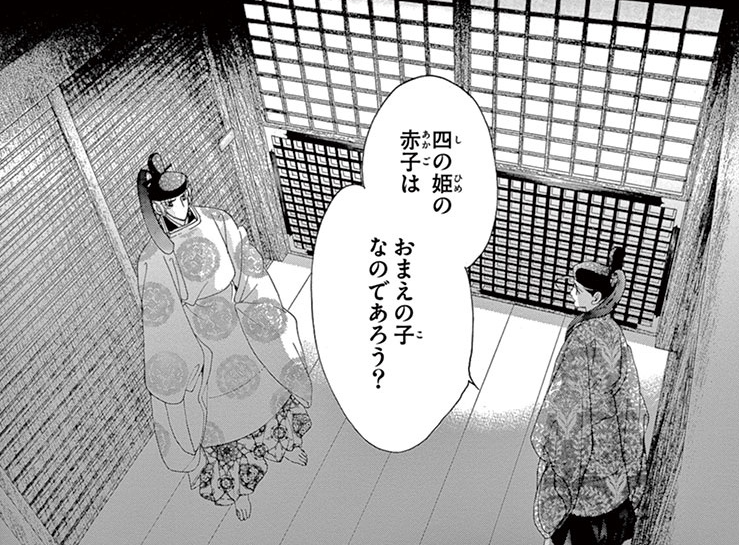
Panel from volume 3, page 172.
©Chiho Saito/Shogakukan
On a different note, I want to say a bit today about changes to the original story of Torikaebaya monogatari. First of all, even though Saito does a lot to make the characters sympathetic and interesting, she doesn’t change an awful lot in terms of the major plot points. Now, some of those plot points could seem quite cruel to our protagonists considering their characterisation in the manga – sorry to spoil a story that’s been out for about 800 years, but the siblings don’t get to continue living in their initial roles! – so what does Saito do about this in Torikae baya?
The main thing she does is, instead of changing where the plot ends up, she changes the way that it happens. I wrote before about the recurring tengu appearances as a great example of expanding a small point in Torikaebaya monogatari in interesting ways, and it’s similar with some of the big plot developments. Whereas the discovery of the chunagon’s secret in the original story happens very fast, the manga breaks it down and spreads it out over multiple chapters.
An important effect of this is that it lets us see more of how the characters feel. In Episode 15, Sara takes the initiative to go and speak to Tsuwabuki, making the difficult decision to end his marriage so that Shi no Hime can have a fulfilling relationship with a man who loves her. He also makes the conscious choice to tell Tsuwabuki that he knows about the affair. As the scene plays out, Sara’s cold determination gives way to anger. Finally, after a moment of shock for both him and Tsuwabuki, he flees, scared about what has just happened, but also still unsure what Tsuwabuki is actually thinking.
That’s quite a lot of material that doesn’t appear in Torikaebaya monogatari! However, the ultimate outcome is the same in both versions of the story. Saito could have changed these plot points entirely, but she didn’t, and so I would rather characterise these adjustments not as fundamental changes but as additions or expansions.
And on that note, I’ll leave it until next time, where the situation goes from bad to worse!