
Blogging about my Torikae baya manga translation project.
Back to school
At the University of Edinburgh, where I’m working on my PhD (and where I also do part-time teaching!), staff are currently on strike as the latest part of a long-running dispute to avoid redundancies which are ostensibly required despite the university’s notable wealth. There’s also been quite a bit of noise about the university’s plans to put an end to dozens of programmes by the end of the 2026-2027 academic year. This has been met with public backlash, which the senior management in their infinite wisdom appear not to have anticipated. It isn’t the ideal backdrop when I’m expecting to complete my degree within the next year and somehow make some professional use of it afterwards…
Because of all this, I write today’s post with the subject of education very much on my mind. And while I’ve written a couple of times lately about the educational angle of Torikae baya, I realise I’ve said very little about education in the manga. So what was education like for the people of the Heian court?
At the University of Edinburgh, where I’m working on my PhD (and where I also do part-time teaching!), staff are currently on strike as the latest part of a long-running dispute to avoid redundancies which are ostensibly required despite the university’s notable wealth. There’s also been quite a bit of noise about the university’s plans to put an end to dozens of programmes by the end of the 2026-2027 academic year. This has been met with public backlash, which the senior management in their infinite wisdom appear not to have anticipated. It isn’t the ideal backdrop when I’m expecting to complete my degree within the next year and somehow make some professional use of it afterwards…
Because of all this, I write today’s post with the subject of education very much on my mind. And while I’ve written a couple of times lately about the educational angle of Torikae baya, I realise I’ve said very little about education in the manga. So what was education like for the people of the Heian court?
The word for “university” in modern Japanese is daigaku (大学), which originally referred to the Confucian book of Great Learning. This is reflected in the name of an educational institution active in Heian-kyo, the daigaku-ryo (大学寮 – roughly “Bureau of Great Learning”). There, noblemen were trained and tested in subjects including history, (Chinese) literature, law and of course Confucianism, under the tutelage of the hakase (博士).
A few hakase appear in Torikae baya, where I’ve been translating their title as “Master”. All the way back in Episode 3, the Masters of Astronomy, Chronometry and Divination showed up to deliver ominous news to the Emperor (later Suzakuin). I think these guys don’t have quite the same professorial role as the hakase of the daigaku-ryo though: while they come from the on’yoryo (Bureau of Yin and Yang), which was part of the Nakatsukasa-sho, the daigaku-ryo was under the umbrella of the shikibu-sho, where Shikibu-kyo no Miya and Akimasa do their jobs. However, a hakase from the daigaku-ryo is specifically mentioned in Episode 16, when the Master of Letters (monjo hakase, 文章博士) sets the theme at the poetry party. (Incidentally, a famous holder of the position of monjo hakase was Sugawara no Michizane, to whom students now pray for academic success.) And similarly, at the flower viewing party where Sara takes his leave from the court, a hakase – probably the monjo hakase again – provides themes for the poetry recital.
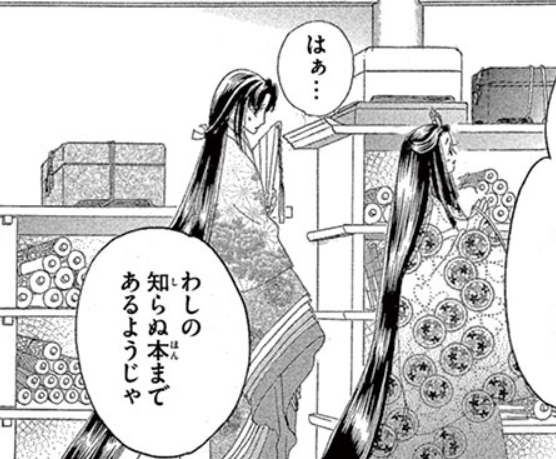
Suiren moves into the Nashitsubo with shelvesworth of books from home.
Cropped panel from volume 2, page 62. ©Chiho Saito/Shogakukan
But although these teachers make cameos, there is no actual mention of the daigaku-ryo in Torikae baya. In practice, it wasn’t necessarily where everybody went to study, even though the government sometimes wanted them to; realistically, children of the nobility were typically home-schooled. This form of education is hinted at in one of the manga afterwords, where Saito notes that training in the classics, calligraphy, diary writing and religion was part of boys’ preparation to enter the palace workforce. They would then continue to learn from their seniors and from their predecessors’ meticulous work diaries.
It’s worth pointing out that I said boys there intentionally. This kind of formal education was only for boys and men (and, as you may imagine, only those of the upper stratum of society). Girls of noble birth were also educated, but the subjects might vary depending on their circumstances. Murasaki Shikibu is well known for having been proficient in Chinese thanks to having a father who was a published writer of Chinese poetry. The study of Chinese by women was evidently not as forbidden as some suggest, but it apparently had pros and cons: intelligence was much admired, but the diaries of Murasaki and her contemporary Sei Shonagon indicate that there was something gauche about flaunting one’s academic gifts.
The difference between boys’ and girls’ education comes across in Episode 32 of Torikae baya, when Sara and Suiren learn how to take on each other’s roles. Yoshino is surprised to discover that Suiren is so adept at Chinese, having been raised as a girl – it turns out this is because of her bookish proclivities – and then offers to teach her other traditionally masculine subjects like Confucianism and formal writing. And in the final chapter, Suiren alludes to the different expectations for men’s and women’s writing when she reassures Sara that nobody would believe the story she wrote (implied to be Torikaebaya monogatari) could be a man’s work.
So there you have it! Education never really takes centre stage in the narrative of Torikae baya, but it’s bound up in so much of the society and culture of the setting that there’s actually quite a bit that you can say about it. It’s almost as if, contrary to what some would have you believe, education has… value?
Torikae baya as gakushu manga
Last week, I wrote about the importance of the shōjo genre/format as context for Torikae baya, and in the process, I spent a bit of time justifying my decision to define Torikae baya as a shōjo manga at all. This time, I don’t exactly throw all that in the bin, but I do want to say a bit about how else we might categorise this series.
Last week, I wrote about the importance of the shōjo genre/format as context for Torikae baya, and in the process, I spent a bit of time justifying my decision to define Torikae baya as a shōjo manga at all. This time, I don’t exactly throw all that in the bin, but I do want to say a bit about how else we might categorise this series.
As I mentioned before, there are four main categories for manga based on what kind of magazine it is first published in: shōjo (girls), shōnen (boys), josei (women) and seinen (men). Besides these, there are some other magazine categories, like ones aimed at little kids – sometimes gendered and sometimes not – and ones decidedly not aimed at kids. Others concentrate on particular themes or styles, like BL or 4-koma. Or manga might not appear in specialist magazines at all. Miyazaki Hayao, for example, has written several manga over his career, but not one in any of the big four categories: instead, they were published in places like an anime magazine, a scale model hobbyist magazine and a Communist Party newspaper for children.
One other category is gakushū manga – basically, educational manga – which is often published in book form rather than in magazines. When I worked in Japanese primary schools, I remember classroom bookshelves full of manga biographies of famous historical figures. Gakushū manga can cover any school subject, and they’re not even necessarily targeted at children – manga can teach you about boring grown-up subjects like statistics and economics too.
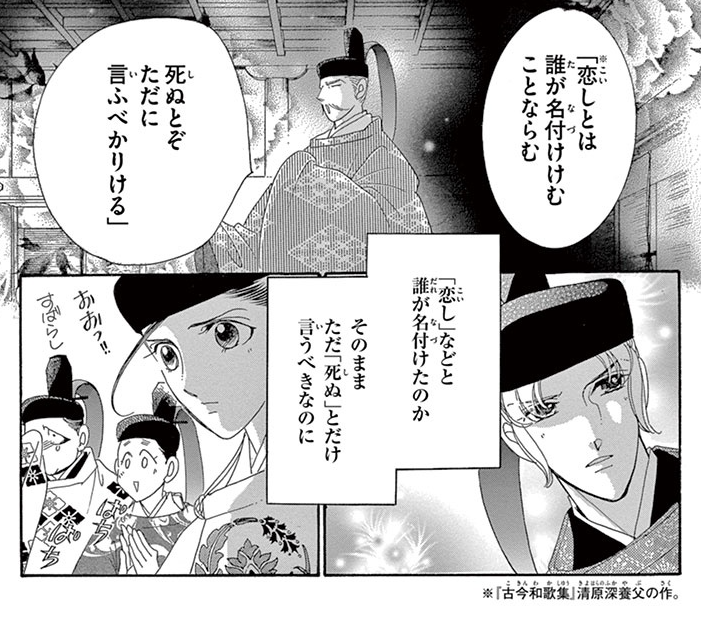
A poem from the Kokin wakashu, with a modern Japanese translation and a footnote citation.
Panels from volume 4, page 12. ©Chiho Saito/Shogakukan
A broader definition of gakushū manga is also possible, as we can see in the Nippon Foundation’s “Manga Edutainment” project: this site explicitly uses the label of gakushū manga not in the sense I just spoke about, but as an umbrella term for a variety of manga in all sorts of genres with educational value, handpicked by manga writers, academics, etc. And in the “literature” section is – you guessed it! – Torikae baya, selected by shōjo manga scholar Fujimoto Yukari.
What’s helpful about thinking about Torikae baya as a gakushū manga? For one, it aligns with my idea that aside from things like entertainment and a “positive” outlook, one of Saito’s motivations in adapting Torikaebaya monogatari is education. In our interview, she talked about the amount of background research involved in the adaptation and how she wanted to put it to good use. This comes across in elements like the volume afterwords and the inclusion of a range of Heian court events.
It also helps to answer the question of how to adapt a work like Torikaebaya monogatari in the medium of shōjo manga. Classic shōjo conventions allow for techniques like organising panels and pages in ways that are more complicated than was the norm in early serialised manga, which is handy for depicting the Heian court as full of life. When it comes to textual aspects, word balloons contain speech, while outside of balloons there are (broadly defined) sound effects and plenty of internal monologue, treated a bit like a voiceover. This is all well and good for showing readers what’s happening and how characters feel, but it doesn’t offer an easy solution for teaching them about the setting. To do that, Saito adds things like chunks of third-person explicatory narration, footnotes and modern Japanese translations of poetry alongside the original – features one might expect to encounter in gakushū manga adaptations of Heian period literature.
Of course, the point of this isn’t to say that the boundaries of shōjo manga are so strict that a single footnote changes the genre! If anything, I want to stress the opposite: there is such variety in possible modes of expression in manga that even if a writer is working within a particular genre, they can pull from a much wider toolbox depending on what they want to do. To some extent, just about any manga adaptation of a lesser-known 800-year-old text is going to have at least some educational motive – even if it’s only to the extent of “hey check this out!” – so it shouldn’t come as a great surprise that in Torikae baya, Saito supplements her usual shōjo style with elements common in more overtly educational material.