Torikae baya as gakushu manga
Last week, I wrote about the importance of the shōjo genre/format as context for Torikae baya, and in the process, I spent a bit of time justifying my decision to define Torikae baya as a shōjo manga at all. This time, I don’t exactly throw all that in the bin, but I do want to say a bit about how else we might categorise this series.
As I mentioned before, there are four main categories for manga based on what kind of magazine it is first published in: shōjo (girls), shōnen (boys), josei (women) and seinen (men). Besides these, there are some other magazine categories, like ones aimed at little kids – sometimes gendered and sometimes not – and ones decidedly not aimed at kids. Others concentrate on particular themes or styles, like BL or 4-koma. Or manga might not appear in specialist magazines at all. Miyazaki Hayao, for example, has written several manga over his career, but not one in any of the big four categories: instead, they were published in places like an anime magazine, a scale model hobbyist magazine and a Communist Party newspaper for children.
One other category is gakushū manga – basically, educational manga – which is often published in book form rather than in magazines. When I worked in Japanese primary schools, I remember classroom bookshelves full of manga biographies of famous historical figures. Gakushū manga can cover any school subject, and they’re not even necessarily targeted at children – manga can teach you about boring grown-up subjects like statistics and economics too.
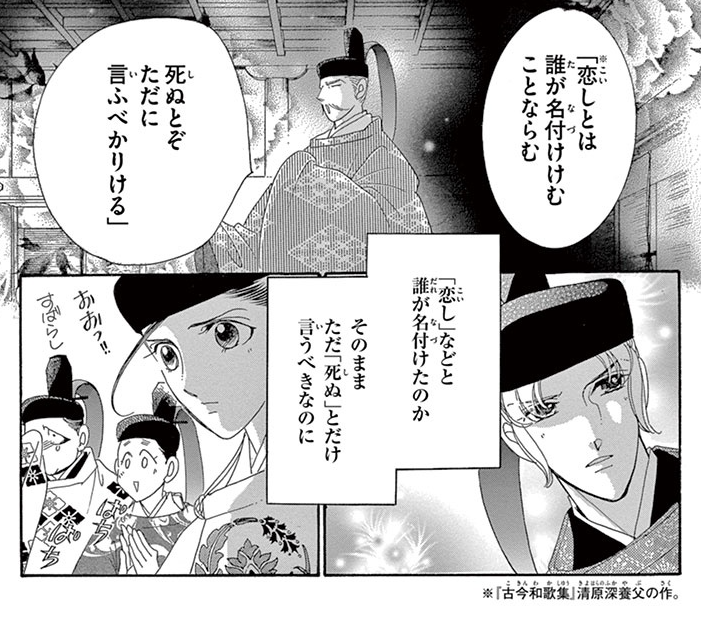
A poem from the Kokin wakashu, with a modern Japanese translation and a footnote citation.
Panels from volume 4, page 12. ©Chiho Saito/Shogakukan
A broader definition of gakushū manga is also possible, as we can see in the Nippon Foundation’s “Manga Edutainment” project: this site explicitly uses the label of gakushū manga not in the sense I just spoke about, but as an umbrella term for a variety of manga in all sorts of genres with educational value, handpicked by manga writers, academics, etc. And in the “literature” section is – you guessed it! – Torikae baya, selected by shōjo manga scholar Fujimoto Yukari.
What’s helpful about thinking about Torikae baya as a gakushū manga? For one, it aligns with my idea that aside from things like entertainment and a “positive” outlook, one of Saito’s motivations in adapting Torikaebaya monogatari is education. In our interview, she talked about the amount of background research involved in the adaptation and how she wanted to put it to good use. This comes across in elements like the volume afterwords and the inclusion of a range of Heian court events.
It also helps to answer the question of how to adapt a work like Torikaebaya monogatari in the medium of shōjo manga. Classic shōjo conventions allow for techniques like organising panels and pages in ways that are more complicated than was the norm in early serialised manga, which is handy for depicting the Heian court as full of life. When it comes to textual aspects, word balloons contain speech, while outside of balloons there are (broadly defined) sound effects and plenty of internal monologue, treated a bit like a voiceover. This is all well and good for showing readers what’s happening and how characters feel, but it doesn’t offer an easy solution for teaching them about the setting. To do that, Saito adds things like chunks of third-person explicatory narration, footnotes and modern Japanese translations of poetry alongside the original – features one might expect to encounter in gakushū manga adaptations of Heian period literature.
Of course, the point of this isn’t to say that the boundaries of shōjo manga are so strict that a single footnote changes the genre! If anything, I want to stress the opposite: there is such variety in possible modes of expression in manga that even if a writer is working within a particular genre, they can pull from a much wider toolbox depending on what they want to do. To some extent, just about any manga adaptation of a lesser-known 800-year-old text is going to have at least some educational motive – even if it’s only to the extent of “hey check this out!” – so it shouldn’t come as a great surprise that in Torikae baya, Saito supplements her usual shōjo style with elements common in more overtly educational material.