
Blogging about my Torikae baya manga translation project.
Thoughts from Episode 32: Trading places
The manga reaches a key turning point in the story now, as Sara and Suiren plan their return to the capital to fill each other’s former roles. They teach one another how to look and behave to avoid suspicion, and Yoshino no Miya helps Suiren overcome her anxiety around men.
But what Episode 32 concentrates on mostly is events in Heian-kyo. In an effort to alleviate Marumitsu’s stress, the Emperor declares that he is rescinding his request for Suiren’s hand in marriage – much to the jealous Umetsubo’s delight. Meanwhile, Kakumitsu tries to have his as-yet unseen daughter San no Hime installed as Togu’s naishi no kami, but Togu rejects him, wanting to wait until Suiren recovers from her alleged ailment.
The manga reaches a key turning point in the story now, as Sara and Suiren plan their return to the capital to fill each other’s former roles. They teach one another how to look and behave to avoid suspicion, and Yoshino no Miya helps Suiren overcome her anxiety around men.
But what Episode 32 concentrates on mostly is events in Heian-kyo. In an effort to alleviate Marumitsu’s stress, the Emperor declares that he is rescinding his request for Suiren’s hand in marriage – much to the jealous Umetsubo’s delight. Meanwhile, Kakumitsu tries to have his as-yet unseen daughter San no Hime installed as Togu’s naishi no kami, but Togu rejects him, wanting to wait until Suiren recovers from her alleged ailment. As Kakumitsu abandons decorum and complains openly about Togu, a shady bunch of vice ministers plot to get rid of her, ideally in favour of Shikibu-kyo no Miya. By the end of the chapter, they put their plan into action, with a man showing up in Togu’s bedchamber, thus exposing lax security in the Nashitsubo pavilion, stirring up gossip about Togu, and making Kakumitsu even more determined to restructure Togu’s staff.
Something we see quite a bit of at this stage in the manga, roughly between Episodes 31 and 34, is use of the verb とりかえる (to exchange, trade, substitute, etc). As that is indeed the verb used in the title of the story, you might think that isn’t so strange, but until now it’s been used sparingly. It appeared back in Episode 1, first when Marumitsu laments that things would be so much simpler if his children’s personalities were the other way around, and then a few times specifically in reference to the siblings trading outfits in order to escape the tengu bandits. That chapter ends with this scene:
SARA and SUIREN, both looking the same in their nightclothes and with their hair down, examine the clothes together.
SUIREN I never liked these boys' clothes,
but now that I know I'll never put my arms through those sleeves again,
I felt the desire to see the genpuku outfit...
SARA I feel the same way.
I wanted to properly say goodbye to my life as a girl...
...
Shall we switch clothes one last time?
Your mogi outfit,
and my genpuku outfit.
And aptly, we also say goodbye to the word とりかえる. The only time it is used again between Episode 1 and Episode 31 is when Marumitsu repeats his opening line in the new context of marriage discussions surrounding both Sara and Suiren.
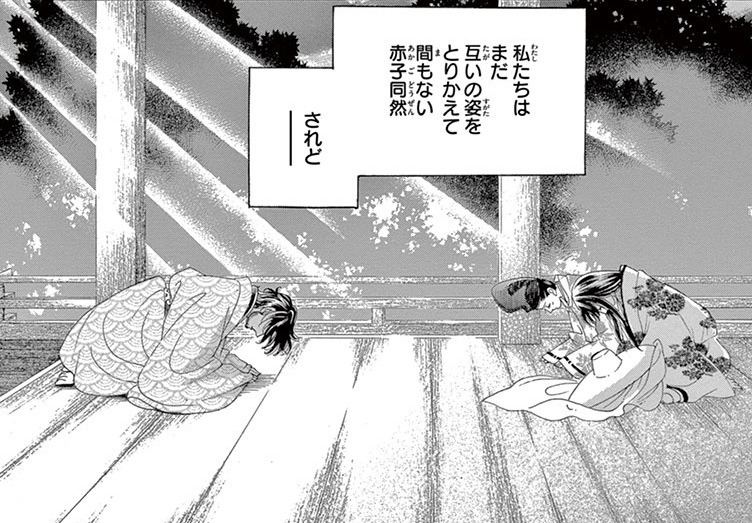
Panel from volume 7, page 74.
©Chiho Saito/Shogakukan
I find it very interesting that it takes so long for とりかえる to re-emerge, and that this is the first time Sara and Suiren talk about switching their positions or appearances, rather than just their clothes as in Episode 1. While readers might be tempted to think of the early decision to give Sara a genpuku (boys’ coming-of-age ceremony) and Suiren a mogi (girls’ coming-of-age ceremony) as the central “switch” of the title, the way the siblings describe their situation shows that to them, this is the moment where they change and take on roles that don’t suit them. And sure enough, this chapter basically gives us a montage where they learn how to live as one another, which requires them to really push back against their natural instincts.
But even though there’s basically no discussion of とりかえる for large portions of the story, there are actually several occasions where one sibling stands in for the other. They are, after all, similar enough in appearance to seem like two parts of one person. Obviously, they put on each other’s clothes to outwit the bandits in Episode 1, but then there’s also the incident where Sara suddenly has to impersonate Suiren while speaking to the Emperor from behind a blind.
Another situation where Sara dresses in women’s clothes – though not with the goal of appearing like Suiren – is in Episode 14. I didn’t say very much about it in my earlier blog post about that chapter, but to lull some greedy regional officials into a false sense of security, Sara and Tsuwabuki put on a show wearing women’s clothes. They perform a song from the legend of Yamato Takeru, impressing the spectators who seem to conveniently forget that in the legend, Yamato Takeru disguises himself as a woman to gain access to his enemies, maybe a stone’s throw away from where they’re sitting.
And there’s another important occasion much later, where the siblings’ situation is very different, but Sara has a reason to take on Suiren’s appearance again (and I would say “for the last time”, but there is a bonus chapter that suggests they’re not entirely done switching places). I won’t go into detail about it here, since we’re still nowhere near that point in the story, but it’s another moment that fits in with a pattern that these earlier scenes establish.
One aspect of these “trading places” incidents is of course to play around with the central conceit of the story, but more importantly, they present the siblings’ irregularity as something of a superpower. Yoshino addresses this directly in this chapter, telling them that very few others share “the combined knowledge and experience of both man and woman” (男と女の二倍の知識と経験). Living with a secret causes both Sara and Suiren a great deal of heartache, and Sara especially suffers a lot, but it also enables them to do things that most others can’t. And ultimately, what pushes them to switch positions and return to Heian-kyo isn’t some idea that they should “go back” to how they “should” be; it’s the realisation that they have a unique opportunity to help their loved ones, and that they can still do good in the world even after the unravelling of their lives so far.
As an aside, it’s now been a year since I started the blog! A few weeks ago I wrote about how far the project has come since then, but I just wanted to say once again, thank you for reading! Hopefully I’ll be able to keep this going even as I get closer to the end of the project!