Thoughts from Episode 30: Two for the price of one
At the end of the previous chapter, Sara was having a medical incident, and at just the same time, Suiren came to the conclusion Sara couldn’t be found in Uji. In Episode 30, Tsuwabuki rushes back to his villa to learn that Sara’s baby was stillborn. Tsuwabuki is shocked, but Sara insists that he return to Shi no Hime, who is ready to give birth herself.
Having unknowingly caught sight of Sara last time, Suiren is worked up over the fact that she can’t stop thinking about the mystery woman. After worrying about being drawn to somebody other than Togu, it finally occurs to her that Sara too might’ve changed his appearance. She takes her attendants to Uji again, and some rumours lead them to the villa. While Aguri, Torako and Toramitsu head out for ingredients to make Sara’s favourite foods to cheer him up, Suiren enters the villa, alarming the maids who think they’ve seen a ghost. Finding that Sara is already gone, she hurries outside. She finds Sara wading out into the Ujigawa, calls out to him, and they embrace happily.
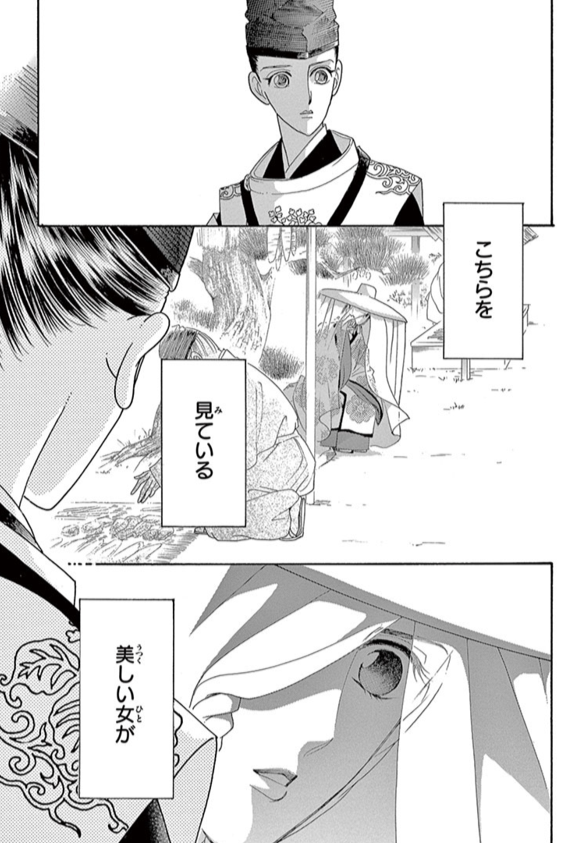
Suiren and Sara spot each other in Episode 29.
Page from volume 6, page 149. ©Chiho Saito/Shogakukan
And so, as Volume 6 comes to a close, Sara and Suiren have found each other again, with much having happened since their last contact. The chapter title reflects this: 魂合う (tama au) means something like “becoming one” or “understanding one another” in a soulmate sort of way. This is of course a bit tricky to translate into English given that their mysterious connection isn’t a romantic one, so what did I do about it? Wanting it to be similarly short and snappy, I decided to associate it with how the siblings describe their connection. There’s a scene in the previous chapter, when Suiren is fearing what might’ve happened to Sara, and she says:
I've felt like I’m in a trance, seeking out a lost half of myself…
And I don't know what will become of me if I can't find my other half…
So when it came to translating the title of Episode 30, I went with “Two Halves”, diverging from the original line to instead call back to Suiren’s line in a way that (hopefully!) will give readers the same sense of the siblings’ connection that 魂合う is supposed to express.
And on that note, I want to say a bit more today about that connection, as it’s a major focus of this chapter. After worrying that she’s attracted to the mystery woman in Uji, there are a couple of steps before Suiren realises that she saw Sara. First, it occurs to her that what caught her attention was the woman’s resemblance to herself; she then imagines that she witnessed another version of herself, from the past.
How could the same person be in two places at once? The maids at the villa offer one answer: they question whether the person visiting the house is a yurei (ユーレイ, a spirit of the dead, “ghost” in my translation) or an ikiryo (生霊, something more akin to an astral projection, tentatively “doppelganger” in my translation). The latter was a popular idea in the Heian period, even famously appearing in The Tale of Genji, and obviously doesn’t require the apparition to be of someone who is deceased.
The idea of Sara and Suiren as the same person aligns with the argument that Torikaebaya monogatari basically has one main character “played” by two individuals. The manga gives each sibling more time to shine, so we know they’re separate people, but as far as the people who know them are concerned, they might as well be one and the same. We’ve seen this in the way that Tsuwabuki looks at one and imagines the other, and the incident where Sara impersonates Suiren in a conversation with the Emperor.
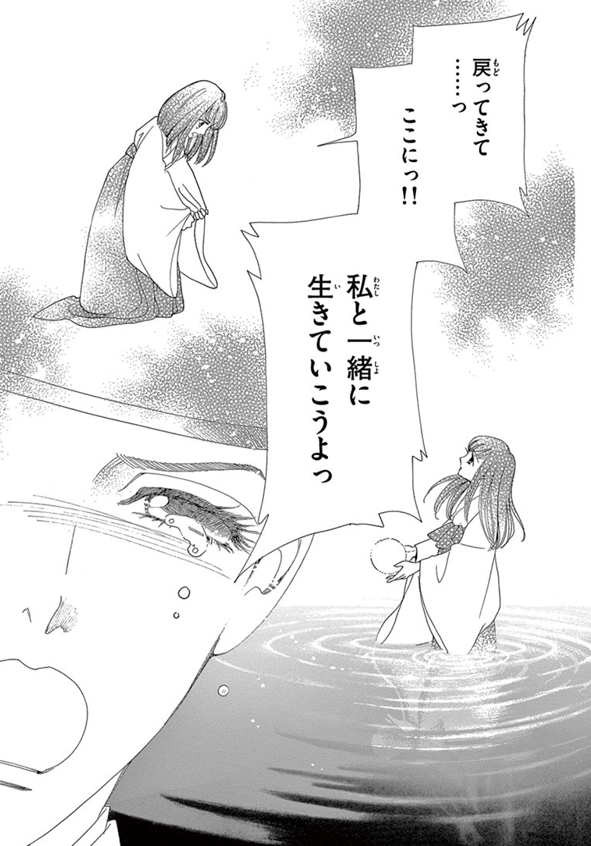
Suiren shouts out to Sara and pictures them as children in Episode 30.
Page from volume 6, page 187. ©Chiho Saito/Shogakukan
I’m also interested in the sense of Sara and Suiren as two equal parts of a whole as it relates to yin and yang. This concept was relevant to religion and philosophy of the Heian period, as seen earlier in the manga when the divination experts from the on’yoryo show up to give advice about the eclipse. The manga even prominently shows a taijitu (aka a “yin-yang symbol”) in Episode 27, when Sara is thinking about Tsuwabuki’s flighty, divided-loyalties nature. I find it really quite funny that the most explicit reference to yin and yang is a bit of a superficial application of the concept, given that it’s actually very fitting for Sara and Suiren.
Like yin and yang, Sara and Suiren are opposites with an interdependent relationship. They live in separate spheres and harbour secrets that are mirror images of each other, and when Sara disappears, Suiren feels the need to go in search of him. Notably, yin and yang are associated with the female and male principles respectively – so how does this show in Sara and Suiren? Well, Sara exhibits many of the qualities associated with yang: he’s bright and energetic, and he’s regularly compared to sunlight. Suiren, meanwhile, is more quiet and passive, and has the personal name Tsukimitsu, meaning “moonlight”. But it isn’t totally straightforward! Despite his cheery demeanour, Sara isn’t seen to be quite as outgoing as a young man should be, especially with the ladies. Meanwhile, Suiren worries in this chapter that some kind of masculine unfaithfulness has awoken in her.
In the context of yin and yang, this apparent contradiction still makes sense. As the taijitu demonstrates with the smaller circles in each half, the interconnectedness of the two means that each contains the other. Sara and Suiren are unusual compared with the other people around them, but the fact that they each have facets of the other gives them this special bond, and we’ve seen many times – since Episode 1, in fact! – that it also makes them able to achieve things that others might not.
It might come as a surprise that this deep connection between the siblings is something that isn’t actually present in Torikaebaya monogatari! In the Heian period version, they don’t know each other very well and interact quite rarely until the time comes for them to trade places, hence the idea that they basically take turns playing the “lead” role. But there’s obviously something interesting about the dynamic of these characters following a similar but opposite path, and so it’s one of many things that the manga explores to a degree that the source material never did.