More thoughts from Episode 30: A sarasoju by any other name
I’m back! There was no blog post last week because at the time I’d normally write it, I was in Torino, at the InTO MANGA: Critical Paths in Manga Studies conference. It was a privilege to be on a panel and get to talk about part of my project alongside such clever people! In my presentation, I focused on something I touched on a bit in this post from last August, using Episodes 15 and 16 as an example of how Saito expands on smaller plot points, adds cliffhangers, etc in service of telling the story of Torikaebaya monogatari the way she wants to tell it. And apart from that, I had a lot of fun throughout the conference, and I was really struck by the variety of subject matter – people had so much to say about manga from all kinds of angles!
Now that I’ve returned, I actually want to stick with Episode 30 just a wee bit longer, as it offers a good jumping-off point for another topic I wanted to return to. A couple of months ago, I wrote about the significance of the word 散る (chiru – to fall, to scatter, to die nobly) in relation to Sara’s departure from the court and in relation to his name. So just as I foretold back then, today I’ll say some more about the meaning of sarasoju!
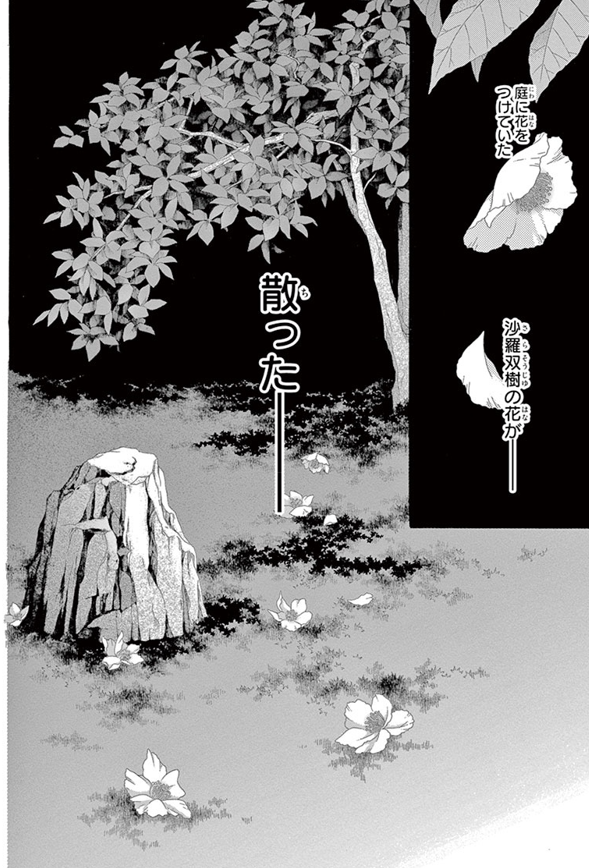
Page from volume 6, page 154.
©Chiho Saito/Shogakukan
Episode 30 opens with flowers falling from a tree. Before Tsuwabuki comes rushing to Uji to learn of Sara’s miscarriage, Sara narrates:
庭に花をつけていた
沙羅双樹の花が――
散った――
Sara uses the word 散る again, referring specifically to the flowers of the 沙羅双樹 (sarasoju) tree. The images and words parallel the opening of Episode 23 – the one in which Sara leaves the capital – where we see a blooming cherry tree in the court and Sara tells us he will disappear (also 散る). Both of these moments use seasonal flowers as a metaphor for death or departure.
Later in this chapter, the word 散る comes up once more. Before going to see Shi no Hime and help with her childbirth, Tsuwabuki vows to cherish Sara always, but Sara knows better, and thinks:
言葉だけが...
私たちの間を
舞い散るばかり
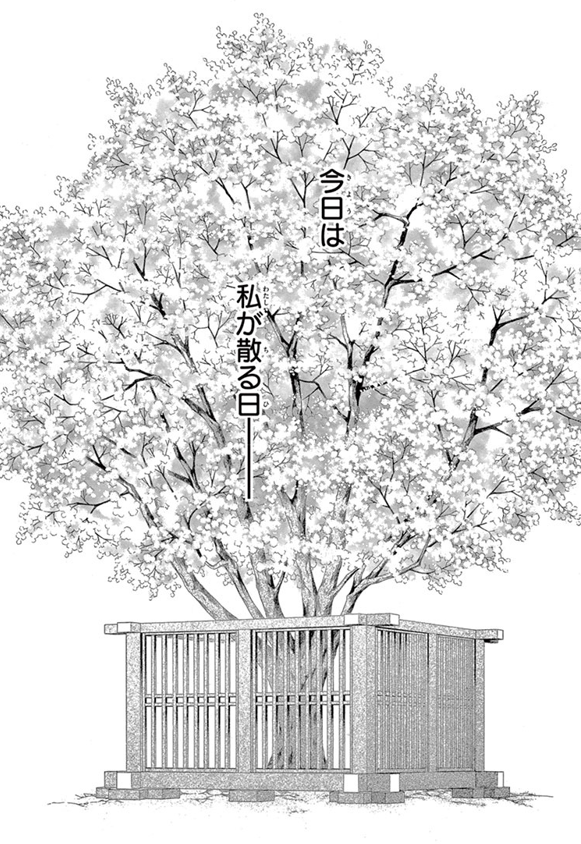
Page from volume 5, page 80.
©Chiho Saito/Shogakukan
This time, he’s saying that Tsuwabuki’s words are falling between the two of them. The word used for “fall” is 舞い散る (maichiru), a variation on 散る meaning to fall down softly, as if dancing, particularly when talking about flowers, petals, etc. This time, of course, the subject is words rather than flowers – but “word” (言葉) itself contains 葉 (leaf)! So with that in mind, I see this as a clear evocation of the same imagery as all the previous uses of 散る, suggesting something fleeting, inconsequential. In an effort to preserve this link, I chose to foreground the botanical theme in my translation:
Mere words…
flutter down like leaves
between you and me.
And now finally, what’s so significant about sarasoju? I mentioned way back that Sara is named after a tree that was growing nearby when he was born. Sarasoju is the Japanese name for the Indian sal tree. The “soju” part (双樹 – two trees) specifically references the story that the Buddha died under a pair of sal trees which then spontaneously bloomed out of season. The tree’s short-lived flowers thus represent impermanence, and their most famous appearance in Japanese literature is the opening lines of the Tale of the Heike, which use the sal flower as a reminder that all good things must come to an end.
Not the most cheerful thing to be named after, and the then-Emperor thinks so too when Sara enters court service early in Torikae baya. He relates the story of the Buddha’s passing and says, “It's an odd name for a vivacious young lad like you.” Sara is familiar with the story, and with the fact that the flowers are known for blooming in the morning and falling by the evening. But as eloquent as ever, he concludes:
Gracefully living one's life to the full for only one day.
I believe that is a beautiful way to live.
I am proud to bear such a name.
Apart from showing that Sara is suave and discerning enough to deserve an instantaneous promotion, this foreshadows the life Sara ends up having in Heian-kyo: bright, but sadly brief. 🥲
“Sarasoju” trees and fallen flowers at Torin’in in Kyoto.
By the way, the flowers that fall in the garden of Tsuwabuki’s Uji villa are actually not sal flowers – or at least, they’re not the same flowers that appear in Buddhist teachings. That’s because in Japan, sarasoju also refers to a different tree. Japan doesn’t have the right climate for real sal trees to grow, but rather than give up on the idea, temples opted to use an unrelated but visually somewhat similar briefly-blooming tree in its place. And so the term is used both for the original tree found in India and for the natsutsubaki or “summer camelia” (incidentally not really a camelia either).
I can’t quite get my head around what role that last element would play in this big nesting doll of metaphors, but at least I got to see the flowers myself when I was in Japan! I went to Torin’in, a temple in Kyoto that has the trees in its garden, and although they were already shrivelling up on the ground by the time I saw them, it was nice to get a real feel for how quickly they come and go, and maybe get a bit better at spotting them when they keep showing up in Torikae baya…