Thoughts from Episode 31: Return to Yoshino
After spending quite a bit of time on the previous chapter (two posts over three weeks), let’s finally move on to Episode 31, the beginning of volume 7! Sara and Suiren have been reunited, Sara instructs Aguri – who imagines she’s seeing two of the same person – to let Tsuwabuki think Sara has vanished into thin air while the siblings head for Yoshino. There, they tell Yoshino no Miya of their intention to take up religious vows, and lament together about how they have ended up in this situation.
One day, the Emperor appears. Sara and Suiren eavesdrop as he seeks Yoshino’s advice regarding troubles at court and asks him to return to political life in Heian-kyo. Yoshino turns down the request and informs the Emperor that the real reason he was previously banished from the capital was because he coveted the former Emperor’s consort. Eventually, the current Emperor reluctantly accepts Yoshino’s refusal and goes on his way.
Sara and Suiren, having heard about the difficulties in the capital – including their father being literally worried sick about them and Togu being left without supporters – question whether they are doing the right thing in abandoning the secular world. At last, they decide to switch places (立場をとりかえ) and return to Heian-kyo.
This chapter is titled “The Secret of Yoshino” (吉野の秘め事), and as such, I’d like to get a bit more into Yoshino no Miya and his backstory. I did give him a little introduction earlier, but Episode 31 reveals details that were previously murky.
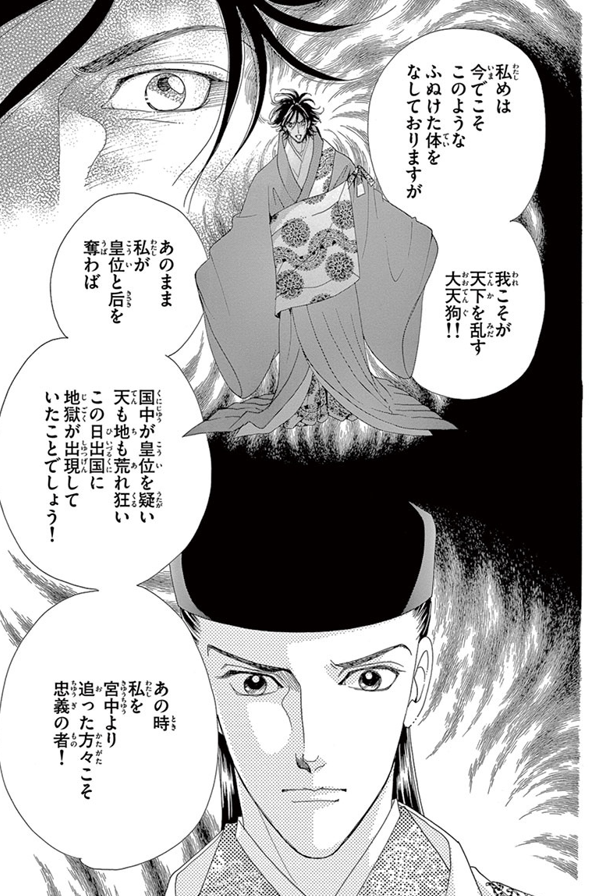
Page from volume 7, page 31.
©Chiho Saito/Shogakukan
So who is he? He refers to Suzakuin (the former Emperor) as his cousin, and therefore he is also a cousin to the current Emperor, who is Suzakuin’s younger brother. At some point in the past, he travelled to China and gained knowledge in esoteric fields such as physiognomy. That presumably occurred before a period ten-plus years prior to the current events, when he was involved in a scandal which resulted in his expulsion from the world of politics. He then secluded himself on the remote Yoshinoyama, where he prays for the safety and prosperity of the people in the capital, especially the imperial family, and especially especially Togu.
In this chapter, we learn the nature of that earlier scandal. Not only was he involved in a succession dispute with Suzakuin, but he lost that dispute – and we can deduce that that probably resulted in Suzakuin ascending the throne soon afterwards. Even worse, he desired Suzakuin’s late wife, and may well be the illegitimate father of the current Togu. When the current Emperor directly questions him about this in Episode 31, he denies that his relationship with Suzakuin’s wife reached that point, but the implication is that the stories are true. Of course, this would make his particular attachment to Togu make a lot of sense!
It’s also interesting when we compare his character to his counterpart in the original Torikaebaya monogatari. There, Yoshino no Miya has two beautiful daughters, whose mother was Yoshino’s Chinese wife who tragically died, leading him to take them back to Japan with him. He feels a responsibility to remain hidden away on Yoshinoyama, but wishes that his daughters could leave and live a more normal life; he gets his wish when Sara’s counterpart takes an interest in the elder daughter and Suiren’s counterpart later marries her in his stead. In the manga, Suzakuin’s late wife is the equivalent of Yoshino’s late wife, and Togu – as Suiren’s only love interest and Yoshino’s implied illegitimate daughter – turns out to be a composite character of the original Togu and Yoshino’s daughters.
And while revealing these dramatic details in Episode 31, Yoshino says one other interesting thing. As he insists that it was only right for him to driven away from the capital, he refers to himself as “the great tengu that sows chaos across the land” (天下を乱す大天狗). Now, a “tengu” can also figuratively mean an arrogant person, which would be a plausible interpretation in this context, but it isn’t the first time he’s been associated with tengu. On his very first appearance, his skills, his knowledge and his clothing led Sara and Suiren to mistake him for a tengu, and since then, he has made remarks about turning his back on a dark past. For him to call himself a “tengu” now – just before the only part of the original story where the tengu is mentioned – comes across as more than just a figure of speech. It suggests that while Togu takes on aspects of Yoshino’s daughters from Torikaebaya monogatari, the tengu’s story also becomes part of Yoshino’s story in this version of the tale.