Thoughts from Episode 33: Life is but a dream
Episode 33 begins with the image of a tengu, appearing in Marumitsu’s dreams as a voice informs him that his children’s karmic debts have been repaid and they will return shortly. He then wakes up to learn that it’s true! Sara and Suiren are back to pick up each other’s lives where they left off, and their parents are overjoyed.
The news of their return soon reaches others: Kakumitsu, who is persuaded to take Shi no Hime and her children back in, and Tsuwabuki, who is too shocked about “Sara” coming back to even think about Shi no Hime. Tsuwabuki makes his way to the palace on the day Suiren arrives to take over Sara’s old job, approaching Suiren with his typical degree of discretion and earning himself a kick in the head. Later, the Emperor receives Suiren and expresses his relief that “Sara” is back at court.
Finally, the real Sara shows up at the Nashitsubo pavilion with Torako and other attendants to begin work as the naishi no kami… only to meet another naishi no kami: Kakumitsu’s daughter San no Hime.
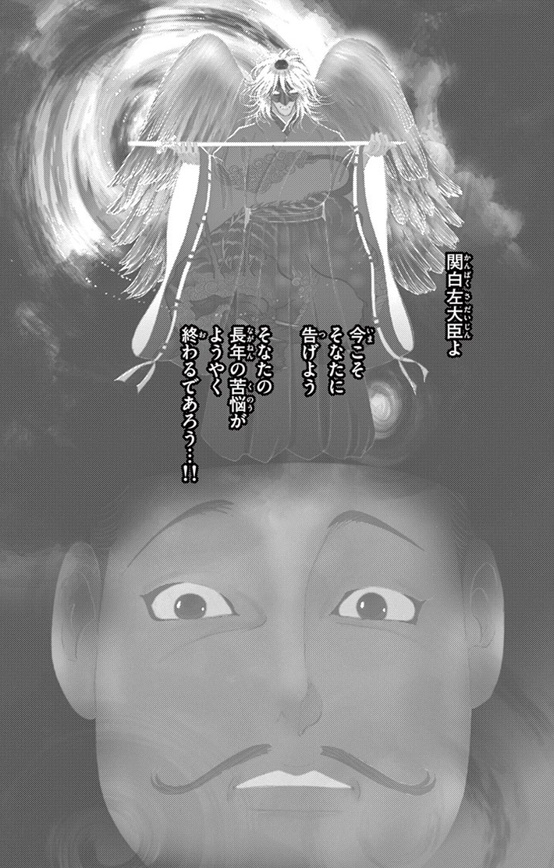
Marumitsu dreams of the tengu.
From volume 7, page 77. ©Chiho Saito/Shogakukan
And so, the big switch that Sara and Suiren prepared for last time is now complete. Marumitsu’s dream at the start of this chapter is, of course, equivalent to a key scene in the Heian period tale – a scene that I never tire of pointing out as the only time a tengu is mentioned in the source material. As such, I devoted quite a bit of time to working out how this scene is adapted and how to put that into English. Broadly speaking, it stays quite close to the original scene, though the visual focus is on the tengu, whereas the original suggests that Marumitsu only sees a priest who tells him about the tengu. Of the different versions, Saito’s wording is probably closest to Kuwabara Hiroshi’s modern Japanese translation, but with the notable distinction of omitting any specific mentions of the man’s children and their genders. Therefore, where other versions clearly state “[the tengu] changed the boy into a girl, the girl into a boy” and “the man will be a man and the woman a woman” (both from Willig’s translation), the manga avoids saying quite what the punishment was and quite what the remedy is. In fact, Marumitsu doesn’t seem certain either – the dream voice tells him “all things should soon settle rightly into their right places” and he then wakes up wondering what “rightly” (しかるべき) was supposed to mean.
Even apart from this big moment, references to dreams loom pretty large in Torikaebaya monogatari. Willig characterises the tale as a giko monogatari, a genre that is openly derivative of existing courtly literature (particularly The Tale of Genji) and notes “dreams” as one of the genre’s typical themes. One of the main ways this comes across in the original text is the many moments where an incident is described as “like a dream” (or some similar variation). The “dreamlike” description is applied frequently but not exclusively to dubiously consensual sex scenes, which I imagine has some connection to the figuratively and literally murky reality of courtship among the Heian nobility. I could swear I’ve read about this phenomenon occurring in other Heian literature too, but I couldn’t come up with a source on it today. Torikae baya, being in a visual medium, doesn’t reflect this tendency so much, but there is a moment early in Tsuwabuki’s affair with Shi no Hime when he wonders sadly if their night together was just a “sweet dream” never to reoccur.
Dreams are also associated with Yoshino no Miya in both the source material and the manga, with dream interpretation being one of his many areas of mystical knowledge. When the chunagon first leaves for Yoshino in the original story, he tells people he needs to take a break on the advice of a dream interpreter. This is apparently meant to put them off his scent, which I must say seems a bit counterintuitive, but at least it shows that people were taking dream interpretation very seriously! Anyway, it makes sense that Yoshino is an expert on these matters, as he serves an important role in the story as somebody with knowledge of the past and future and of the siblings’ secret. This is especially important in the manga, where he’s also closely associated with the tengu. Incidentally, Willig suggests in passing that he is connected to Marumitsu’s dream in the original story too, but so far I’ve found nothing to back this up.
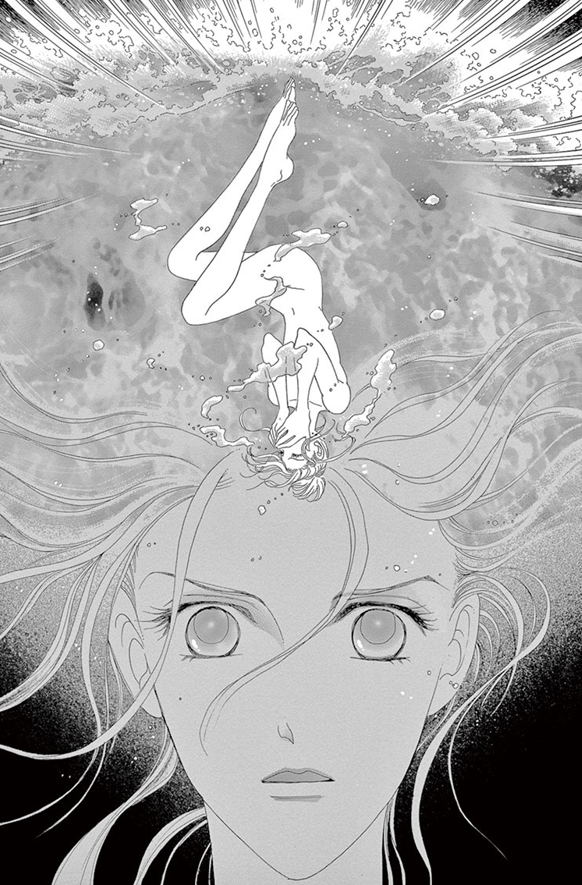
Sara dreams of drowning.
From volume 4, page 57. ©Chiho Saito/Shogakukan
Anyway, in the Torikae baya manga, the most common references to dreams are just dreams themselves! In Episode 3, Sara dreams about the “tengu” that kidnapped him and Suiren as children, and indicates that isn’t the first time. This dream shakes up the narrative of the story by revealing the idea of the tengu’s curse much earlier and treating it as something that weighs on the siblings’ minds, and because it is also a premonition of the eclipse incident, it gives Sara an early emotional connection to the future Emperor. And when things go wrong later, he and Suiren both suffer from nightmares: after his night with Tsuwabuki, Sara dreams that he is drowning (foreshadowing his suicide attempt in Uji), and following Sara’s disappearance, Suiren is plagued with confused thoughts about where he has gone and why. Similar moments occur later in the series too, including ones that call back to earlier dreams.
Altogether, I find that all these dreams – the ones experienced by the characters and the passing allusions to dreaming – serve two main purposes. In the overall narrative, they help to tie things together, giving the reader hints of what is to come and providing some explanation for events. But maybe more importantly, they contribute to a sense of ambiguity. The characters and the reader can’t always tell what is real, and distinctions aren’t always clear-cut. And as Togu suggests when she gazes out on the aptly named Yume no Wada and can’t help but quote the Man’yoshu, dreams and reality may not be so far apart.