
Blogging about my Torikae baya manga translation project.
Thoughts from Episode 65: NEARLY the end
Here we are, at the last chapter of Torikae baya – officially not titled “episode 65” but “final episode”. There are a few different plot threads that get their conclusions here, and for that reason, I’ll only write about the first half or so today, with another post to cover the remaining pages.
We’ve been firmly in coda territory for a few chapters, but to give Episode 65 at least some sense of climactic drama, a cliffhanger was set up last time, with the pregnant Sara suddenly falling unconscious. As the Emperor prays, he encounters Sara in a dream, held underwater by some mysterious beads. Sara fights off the beads, the Emperor helps him out, and when he awakens, it turns out the child has been born!
Here we are, at the last chapter of Torikae baya – officially not titled “episode 65” but “final episode”. There are a few different plot threads that get their conclusions here, and for that reason, I’ll only write about the first half or so today, with another post to cover the remaining pages.
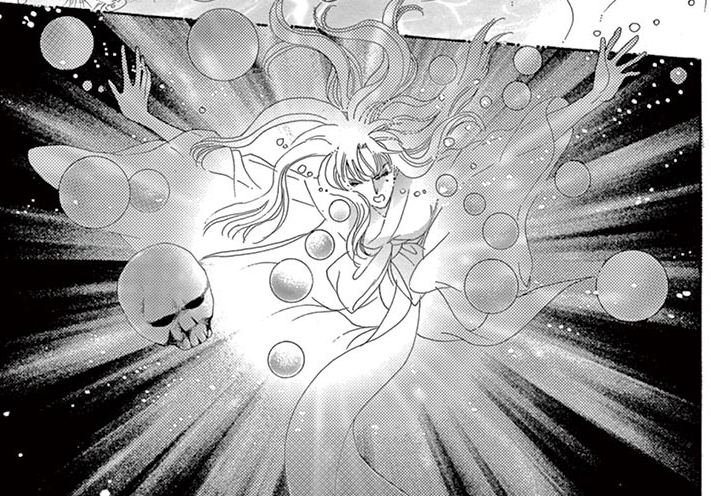
Sara struggles with the rosary beads.
Panel from volume 13, page 151. ©Chiho Saito/Shogakukan
We’ve been firmly in coda territory for a few chapters, but to give Episode 65 at least some sense of climactic drama, a cliffhanger was set up last time, with the pregnant Sara suddenly falling unconscious. As the Emperor prays, he encounters Sara in a dream, held underwater by some mysterious beads. Sara fights off the beads, the Emperor helps him out, and when he awakens, it turns out the child has been born!
After this incident, Umetsubo comes to the Emperor to declare her intention to take religious vows. She reveals that she received cursed rosary beads from Genkaku, but had them exorcised – an act that may have helped Sara survive. Later, the Emperor visits Marumitsu’s residence to mark 50 days since the baby’s birth, and it appears that Sara and the Emperor both had the dream about the river and the beads. The Emperor says the baby will be the new Togu and Sara will be Empress, and hands out some more promotions while he’s at it. Finally (for now), he visits the newly anointed nun Umetsubo with her father Kakumitsu, and asks her to act as a mother to Yuzuru so he can take up a new role helping the infant Togu.
The drama that opens this chapter is of course very short-lived – was there ever any serious doubt that Sara would make it out safely this late in the game? – but it does link up nicely with other things that have been going on. When he dreams of being in the river at the end of Episode 64, he identifies it as the Sanzunokawa, where people go when they die and which Tsuwabuki invoked in a poem to Shi no Hime. The Emperor, though, interprets it as the Amanogawa, further emphasising the connection to his remarks in Episode 63, and dashingly helps Sara across.
But apart from the specific links to those two legendary rivers, this incident fits into recurring references to drowning more broadly. In Episode 17, Sara has a nightmare in which he is drowning, and when he goes to seek Yoshino’s advice in Episode 21, he gazes into the river and imagines himself floating in the water. Similar visuals appear elsewhere, including the title pages for both Episodes 28 and 29, ramping up the foreshadowing before Sara wades out into the Ujigawa in despair. We could even look out for every occasion Sara and Suiren are reflected in the water’s surface, and it may well also be meaningful that Sara once helps save a man from drowning during his river rerouting work.
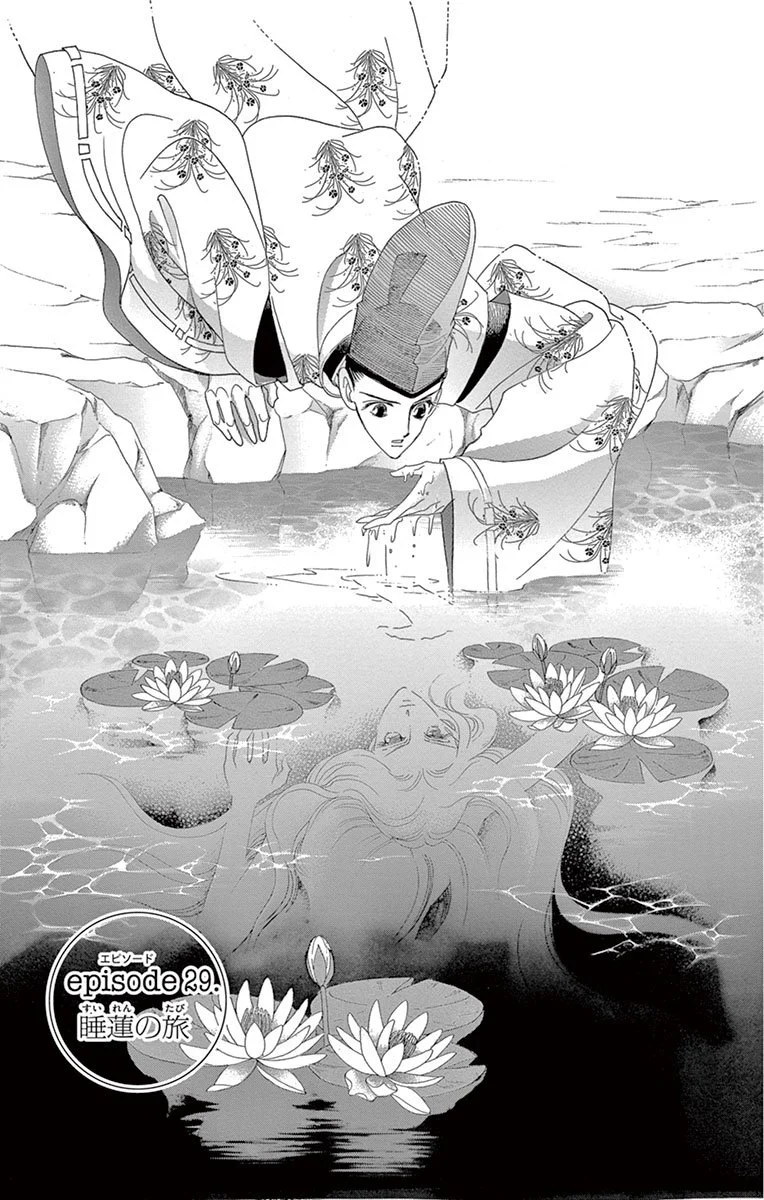
Suiren sees Sara reflected in the water.
Episode 29 title page from volume 6, page 117. ©Chiho Saito/Shogakukan
I’m not going to argue that Torikae baya is the first artistic work to use “drowning” as a motif, but I do think it’s interesting to see it keep coming up, and particularly the way that it returns at the end. The two points where Sara is at risk of drowning are clearly different: in the first, he attempts to take his own life after losing a baby, and is rescued only thanks to his eerily similar sibling, but this time, he fights back against a targeted attack, then returns to his happy new relationship and safely gives birth. Basically, while he wanted to die halfway through the story, he wants to live by the end.
I’ve mentioned before that there are plenty of references to The Tale of Genji in this manga, notably during the portion set in Uji, and these drowning references feel like a big one. When Sara opts for suicide by drowning in the Ujigawa to escape a life governed by the whims of a fickle man, he echoes the plight of Ukifune, one of the main characters of Genji’s so-called Uji chapters, who does the same thing when she is caught in the middle of a love triangle. To really drive home the comparison, when Suiren begins to fear that it may be impossible to find Sara again in Episode 29, she pictures an empty floating boat (literally “ukifune” 浮舟).
But the thing is, there’s already a more standard way of comparing the main characters of Torikaebaya monogatari to the main characters of Genji. The other two sides of Ukifune’s love triangle are Kaoru and Niou, famous for their contrasting personalities: Kaoru is the melancholic overthinker while Niou is libidinous and impulsive. Do you see where this is going? In a post-Genji tale like Torikaebaya monogatari, Kaoru and Niou seem like obvious reference points for the characters we know respectively as Sara and Tsuwabuki.
It’s interesting enough that a character apparently merely posing as a man should be inspired by Kaoru, but adding the Ukifune comparison in the manga adds another dimension. It fits in very well with Yoshino’s claim that the siblings’ unusual “combined knowledge and experience of both man and woman” makes them special. Sara experiences life as a popular but brooding young man and as a mistreated woman, and maybe in the end, the understanding that comes from this is what gives him a strong will to live after all.
Thoughts from Episode 27: The Uji Chapter
This chapter takes a break from Suiren’s spiralling situation in Heian-kyo to jump back a few weeks and pay a visit to Sara’s spiralled situation in Uji. The end of Episode 26 gave a brief glimpse at a woman (?) with a cat, who turned out to be none other than Sara. This time, we learn that since his sudden disappearance in the previous volume, Sara has been at Tsuwabuki’s villa in Uji, mainly under the care of Torako, Toramitsu and assorted servants.
This chapter takes a break from Suiren’s spiralling situation in Heian-kyo to jump back a few weeks and pay a visit to Sara’s spiralled situation in Uji. The end of Episode 26 gave a brief glimpse at a woman (?) with a cat, who turned out to be none other than Sara. This time, we learn that since his sudden disappearance in the previous volume, Sara has been at Tsuwabuki’s villa in Uji, mainly under the care of Torako, Toramitsu and assorted servants.
Tsuwabuki himself is also around some of the time, though he travels between Uji and his job in the capital. Smitten, he has a wonderful time dolling up Sara, who decides to grin and bear it until the baby is born. Then one day, Tsuwabuki receives a letter from Saemon, informing him that Shi no Hime – Sara’s wife who is scandalously also pregnant with Tsuwabuki’s child… – has been thrown out of her home. And when Tsuwabuki goes to visit Shi no Hime (at Sara’s insistence), he finds her feeble and hopeless, and is so moved by her situation that he vows to nurse her back to health. Finally, all alone in Uji, Sara can do nothing but compose a Sad Moon Poem™.
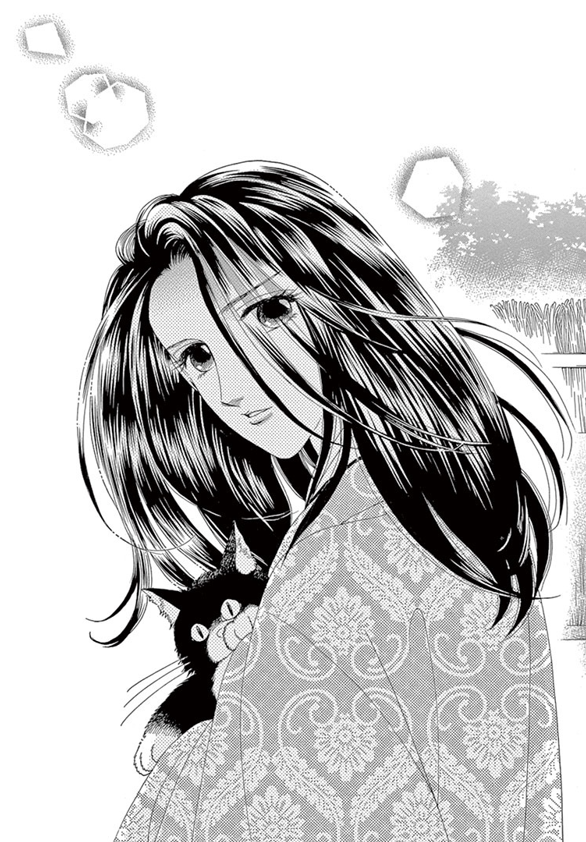
Panel from volume 6, page 43.
©Chiho Saito/Shogakukan
Not for the first time, the story of Torikae baya (and its source material) bears some resemblance to The Tale of Genji. The final ten chapters of Genji are famously known as “the Uji chapters”, taking place after the titular character passes away and focusing instead on his sons, legitimate and illegitimate, as they compete over women in Uji. Now, Torikae baya’s own Uji chapter is Sara’s first appearance after he vanished from the capital, an act the story repeatedly associates with death. To cap it off, I’m even convinced that the title of Episode 24 (霧の迷い), when everyone is wondering what happened to Sara, is meant to bring to mind the title of the chapter where Genji dies (雲隠).
Another interesting aspect of this chapter is that after a pretty linear chronology up to now, the beginning of Sara’s time in Uji is presented as a flashback. Just as Suiren tells her parents she’s reached a decision in the previous chapter, we see “Sara-hime” holding a cat. Then after rewinding to Sara and Tsuwabuki’s arrival in Uji – specifically a month and a half earlier – and looking at Sara’s new life there, that cat is the signal that the story has caught up to where Episode 26 left off. It belongs to Aguri, who is going home after visiting Sara.
I find this interesting because it just isn’t a technique that Saito uses very often in this series! Events follow one after another, and most flashbacks are just a panel or two, often to scenes that we’ve already encountered once. The narrative jumps significantly forward in time at a few points, but rarely back. The only other similar part that I can think of happens in Episode 62, and even then it’s quite brief.
That’s not to say that the timeline is totally straightforward though. I talked before about the complexity of the story’s timeline and looking out for hints of how much time passes between events. Another complicating factor is that around this point in the story, we learn a bit more about things that happened in the past. Tucked in among the political gossip in Episode 26, Shikibu-kyo no Miya refers to a previous succession dispute which resulted in one of the parties withdrawing to Yoshino. Yoshino no Miya has himself hinted at having a dark past, such as when he implied that he had to be reborn after being exiled for his misdeeds.
At this stage, this is all we really know about this mysterious incident, and that it happened over ten years ago but not too much over ten years ago (ほんの十数年前, according to Shikibu-kyo). But we learn a bit more in the coming chapters, with implications for the timeline, for Yoshino, and for other characters in the story.
Thoughts from Episode 18: Feast your eyes on this!
Last time, Sara was tasked with sorting out the flooding of the Kamogawa. Since then, he’s been getting on with the job, and when he reports back, the Emperor wants to speak to him up close. Tsuwabuki fears that the Emperor knows something about Sara, but really, it’s because he has designs on Suiren – which is just as bad! Sara agrees to have Suiren perform music at an upcoming moon-viewing party. But after Umetsubo makes an embarrassing effort to threaten Suiren (who is in hysterics when her bullying methods are lifted directly from The Tale of Genji), Togu decides it’s too risky to attend the party at all.
On the day of the party, Sara informs the Emperor that Suiren is unwell. When the Emperor then sends a sympathy gift her way, Sara encourages her to reply with a rubbish poem to put him off. Unfortunately, the Emperor decides to show up in person, and when Suiren instinctively flees the scene, Sara is left pretending to be her while the Emperor attempts a conversation from the other side of a blind. As the Emperor leaves, a convenient gust of wind lets him see Sara – who doesn’t know who he thinks he saw.
Last time, Sara was tasked with sorting out the flooding of the Kamogawa. Since then, he’s been getting on with the job, and when he reports back, the Emperor wants to speak to him up close. Tsuwabuki fears that the Emperor knows something about Sara, but really, it’s because he has designs on Suiren – which is just as bad! Sara agrees to have Suiren perform music at an upcoming moon-viewing party. But after Umetsubo makes an embarrassing effort to threaten Suiren (who is in hysterics when her bullying methods are lifted directly from The Tale of Genji), Togu decides it’s too risky to attend the party at all.
On the day of the party, Sara informs the Emperor that Suiren is unwell. When the Emperor then sends a sympathy gift her way, Sara encourages her to reply with a rubbish poem to put him off. Unfortunately, the Emperor decides to show up in person, and when Suiren instinctively flees the scene, Sara is left pretending to be her while the Emperor attempts a conversation from the other side of a blind. As the Emperor leaves, a convenient gust of wind lets him see Sara – who doesn’t know who he thinks he saw.
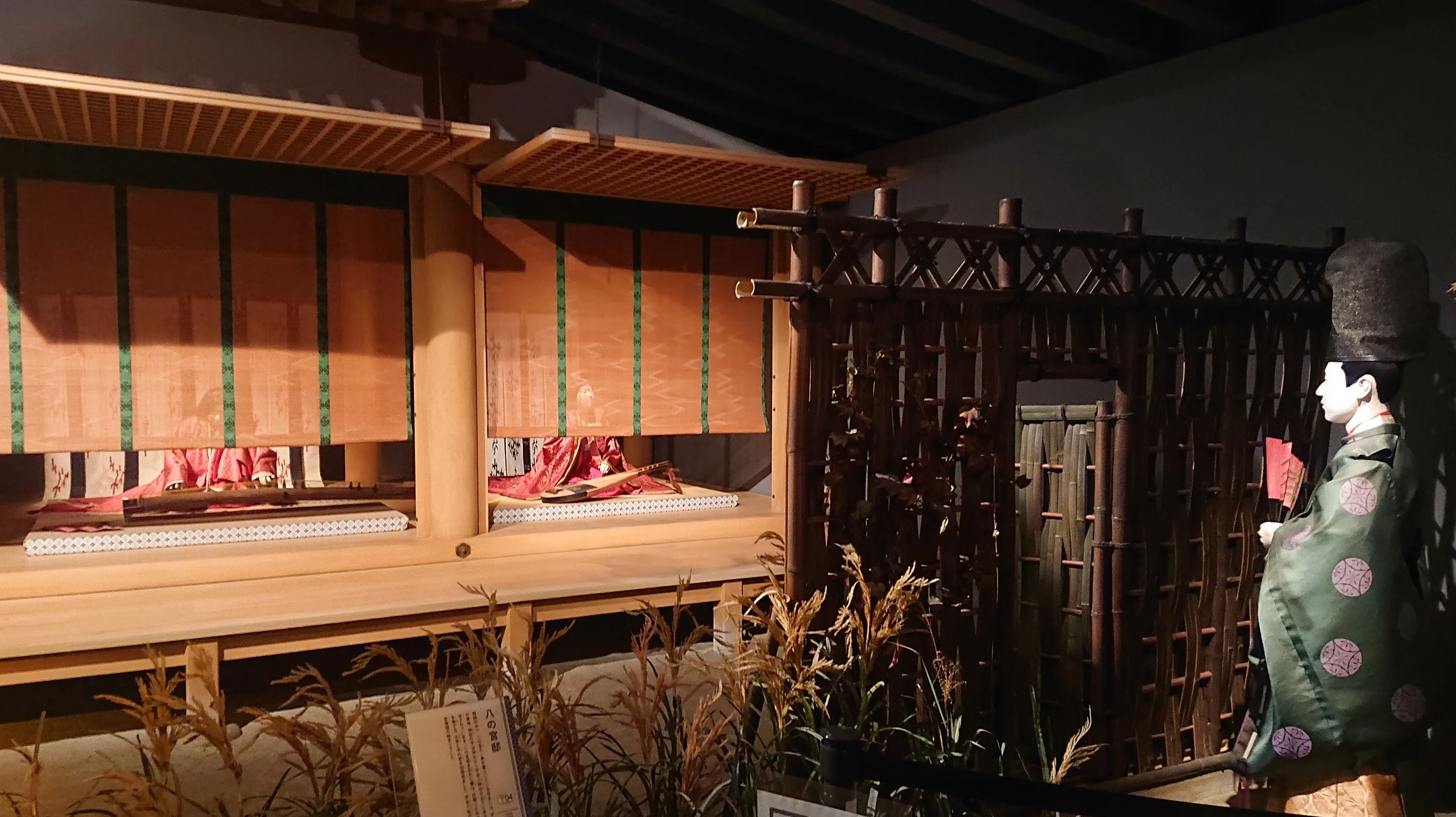
Recreation of a famous kaimami scene at The Tale of Genji Museum in Uji.
That last scene provides today’s little topic for discussion: the idea of kaimami (垣間見). Literally “looking through a gap in a fence”, this refers to the practice of observing someone indirectly, from behind some form of partition. These acts of voyeurism were all the rage in the Heian period, when architecture didn’t create much real privacy, but inner areas were dim and dark, and members of the opposite sex – especially those of different social positions – weren’t normally supposed to see one another. And because of that, kaimami scenes show up a lot as a kind of “love at first sight” motif in The Tale of Genji and other places.
In Torikae baya, as well, we see that men are not supposed to directly look at women of high status if they aren’t married. In Sara’s early days at court, he gallantly shields the court ladies from sight when the blind hiding them falls down. When he first encounters Umetsubo, she strikes him with her fan for having the insolence to look up as she walks by. And when courting Shi no Hime, he sits outside her sleeping area and simply hopes she’ll respond when he speaks.
On the other hand, Tsuwabuki, who sees himself as a passionate romantic like Genji, is unsurprisingly the manga’s #1 peeping tom. The standout scenes are in Episodes 8-9, when he goes to pay Suiren an unexpected visit – at first he is enchanted by her looks, but her violent reaction leaves him feeling confused – and in Episode 10, when he hears Shi no Hime playing the koto and spots her from afar. In both of these incidents, the thrill of these furtive glimpses isn’t enough for Tsuwabuki; he is immediately too excited to hold himself back.

Tsuwabuki sees Suiren for the first time.
Panel from volume 2, page 114. ©Chiho Saito/Shogakukan
When the Emperor in today’s episode asks Sara to arrange a kaimami, a major worry is of course that it will end the same way as those scenes with Tsuwabuki. Eventually, he speaks with Sara and believes him to be Suiren, thanks to the blind between them, but Sara is still panicking over the possibility that the Emperor will rush in after all. But when he finally gets the glimpse he was looking for, he is satisfied and leaves. Obviously, one thing doesn’t inevitably lead to the other. Sometimes kaimami is just a matter of idle nosiness. It’s not even necessarily a phenomenon of men ogling women – the moment where Sara hides the court ladies from view happens because they were so eager to get an eyeful of handsome young guys like Sara and Tsuwabuki that they knocked the blind down themselves.
Anyway, it’s very interesting to think about! Kaimami scenes appear in Torikae baya because they’re such a well-known aspect of Heian culture and therefore part of the aesthetic Saito wants to portray. But at the same time, the concept is a reminder of how the society operated and particularly how separate men’s and women’s lives were. In a way, the same cultural expectations and architectural practicalities that lead to practices like kaimami are what make it possible for Sara and Suiren to live as they do with very few people noticing anything out of the ordinary.
Digression: Research trip report
Something different this week! I’ve hinted in previous posts that I’ve been on a trip in Japan over the summer, and now that I’m finally back, I want to talk about what happened.
The main purpose of the research trip – which I managed to do with funding from the Great Britain Sasakawa Foundation, the Japan Foundation Endowment Committee and the School of Literatures, Languages and Cultures at the University of Edinburgh – was to take part in a summer school programme for classical Japanese at Doshisha University in Kyoto. Over six weeks and a bit, I learnt the basics of classical Japanese (kobun) and how to understand texts. While I was there, I also took the chance to visit some of the locations from Torikae baya and – very excitingly!! – I went to Tokyo and spoke to Saito Chiho in person about the manga.
Something different this week! I’ve hinted in previous posts that I’ve been on a trip in Japan over the summer, and now that I’m finally back, I want to talk about what happened.
The main purpose of the research trip – which I managed to do with funding from the Great Britain Sasakawa Foundation, the Japan Foundation Endowment Committee and the School of Literatures, Languages and Cultures at the University of Edinburgh – was to take part in a summer school programme for classical Japanese at Doshisha University in Kyoto. Over six weeks and a bit, I learnt the basics of classical Japanese (kobun) and how to understand texts. While I was there, I also took the chance to visit some of the locations from Torikae baya and – very excitingly!! – I went to Tokyo and spoke to Saito Chiho in person about the manga.
First, the course. For about three hours each weekday morning, we spent the first week or two going through all the main grammar points in Shirane’s Classical Japanese: A Grammar. It’s a pretty dry book, but there isn’t really any way around reading over and memorising all the conjugations and auxiliary verbs and particles, and I think this textbook handles it all pretty comprehensively! And even though this intensive approach was a lot of hard work and effort, it meant we could fairly quickly move on and start practicing applying what we’d covered by looking at original texts.
Classical Japanese is very different from modern Japanese. A lot of the words resemble ones we know now, but they might behave differently, or have different meanings. Plus, there are words for things that we just don’t have in the modern world. A lot of the conjugation rules in modern Japanese evolved as the sounds or uses of older patterns changed with time, sometimes frustratingly turning into things that look a lot like different older rules (I’m convinced that in whatever form Japanese takes in the future, there will be a whole new set of unrelated structures that all abbreviate to ん). But once you start getting the hang of the old rules, then you can start breaking it all down and trying to understand. And you know, it does actually get easier with practice!
In the last post, I gave an example of a part in Torikae baya that I’ve now been able to retranslate with better understanding of how to approach classical quotations. I’m looking forward to applying this knowledge elsewhere too, to translate poems like these better, but also to take a look at the original text and see for myself where different interpretations come from.
In between studying, buying things to take home and seeing an all-women Castlevania musical, I found time to seek out some of the locations that appear in the manga. The places in Torikae baya are often depicted in very specific detail, and I was keen to see some of them for myself and get a sense of where things are and what they’re like.
I went to Kurama, where Sara and Suiren get kidnapped by the “tengu” bandits in Episode 1. The main attraction is the temple, but if you keep walking up the mountain, you reach an area where gnarled tree roots are exposed above the ground. It’s very striking, and that’s probably why Saito put it in the manga! After Sara and Suiren run away from the gang, this is where Marumitsu finds them sleeping in the morning.
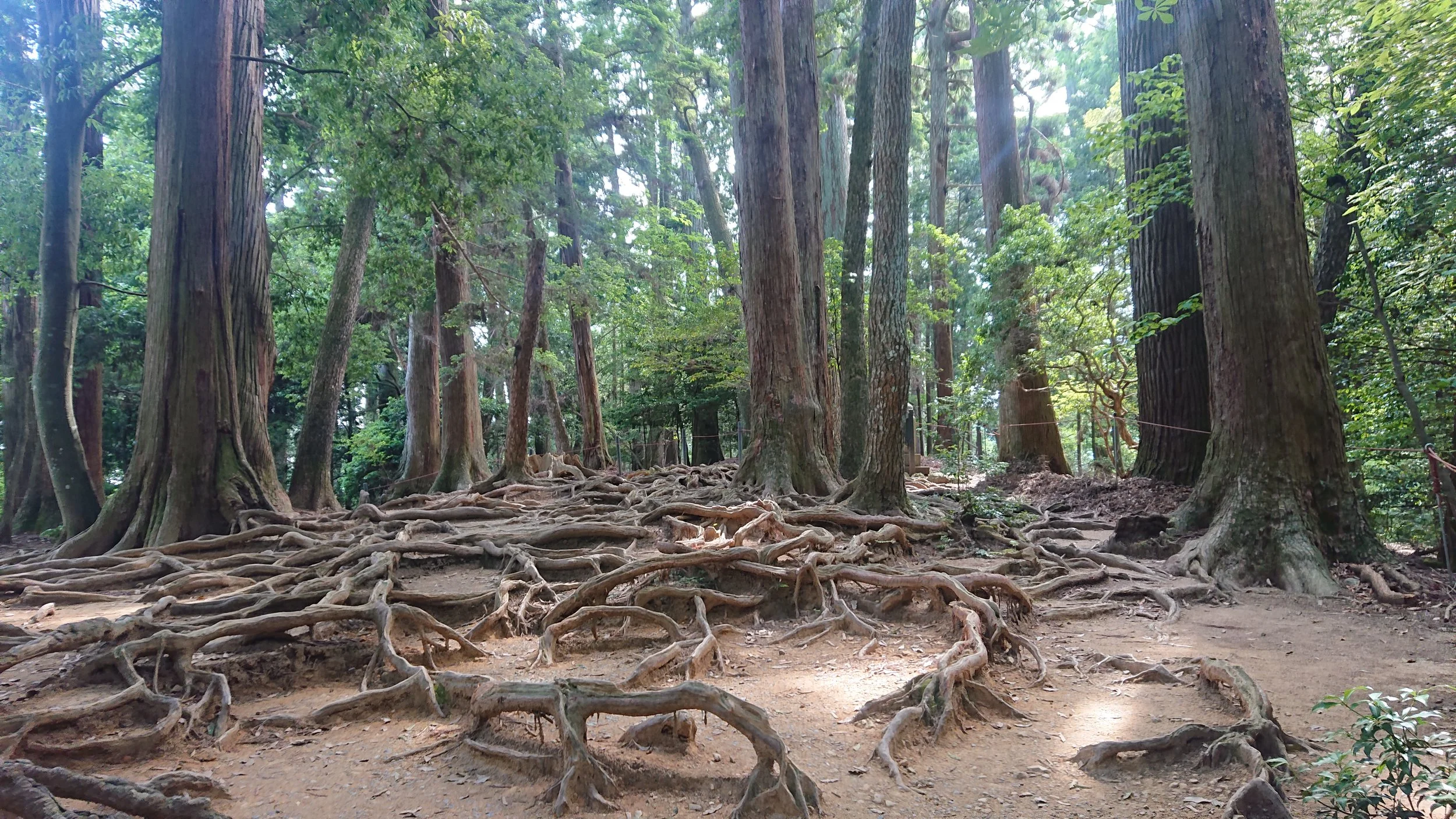
Trees in Kurama.

Marumitsu finds Sara and Suiren.
Panel from volume 1, page 33. ©Chiho Saito/Shogakukan
Conveniently, the university and my accommodation were both near the old Imperial Palace, which is easier to visit than I think it used to be. Buildings here serve as models for their counterparts in Torikae baya, including the Shishinden and the Seiryoden.
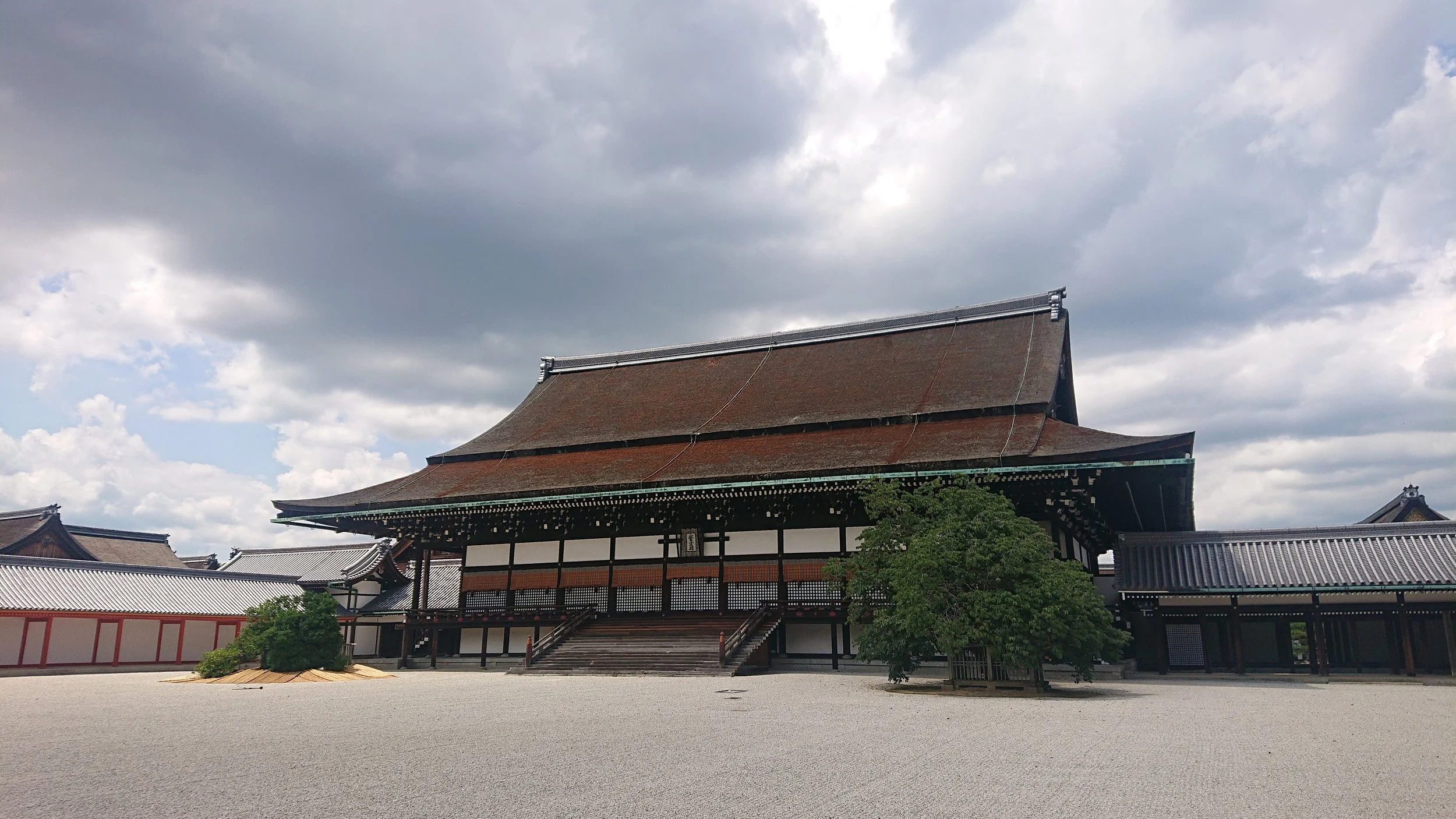
The current Shishinden at the Imperial Palace in Kyoto.
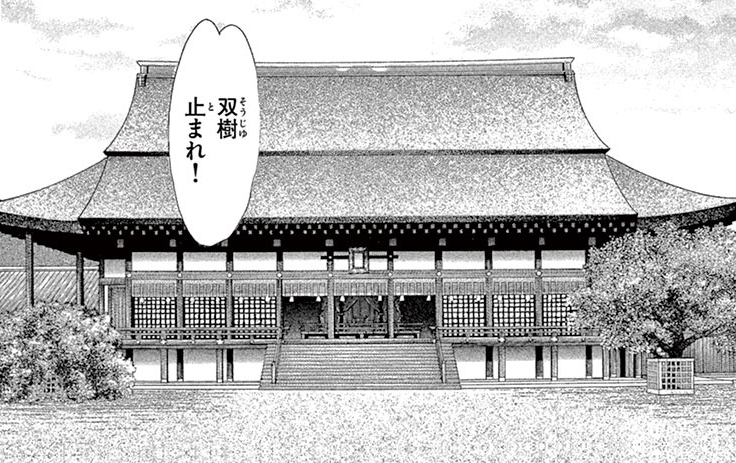
The Shishinden as it appears in the manga.
Panel from volume 1, page 116. ©Chiho Saito/Shogakukan
Yoshino is another major location in Torikae baya. I’ve been there a few times before, but always to Yoshinoyama, the mountain itself, so I hadn’t seen it quite as it appears in the manga. By visiting the area around Yume no Wada this time, I understood that the palace they go to must be this one, and that Sara and Suiren’s search for fireflies probably takes them along the Kisadanigawa and up the mountain from the east side, not at all the route that visitors take to Yoshinoyama nowadays. I also happened to go there at about the same time of year as Episode 13 in the manga – I didn’t spot any fireflies, but I suppose they didn’t either in the end!
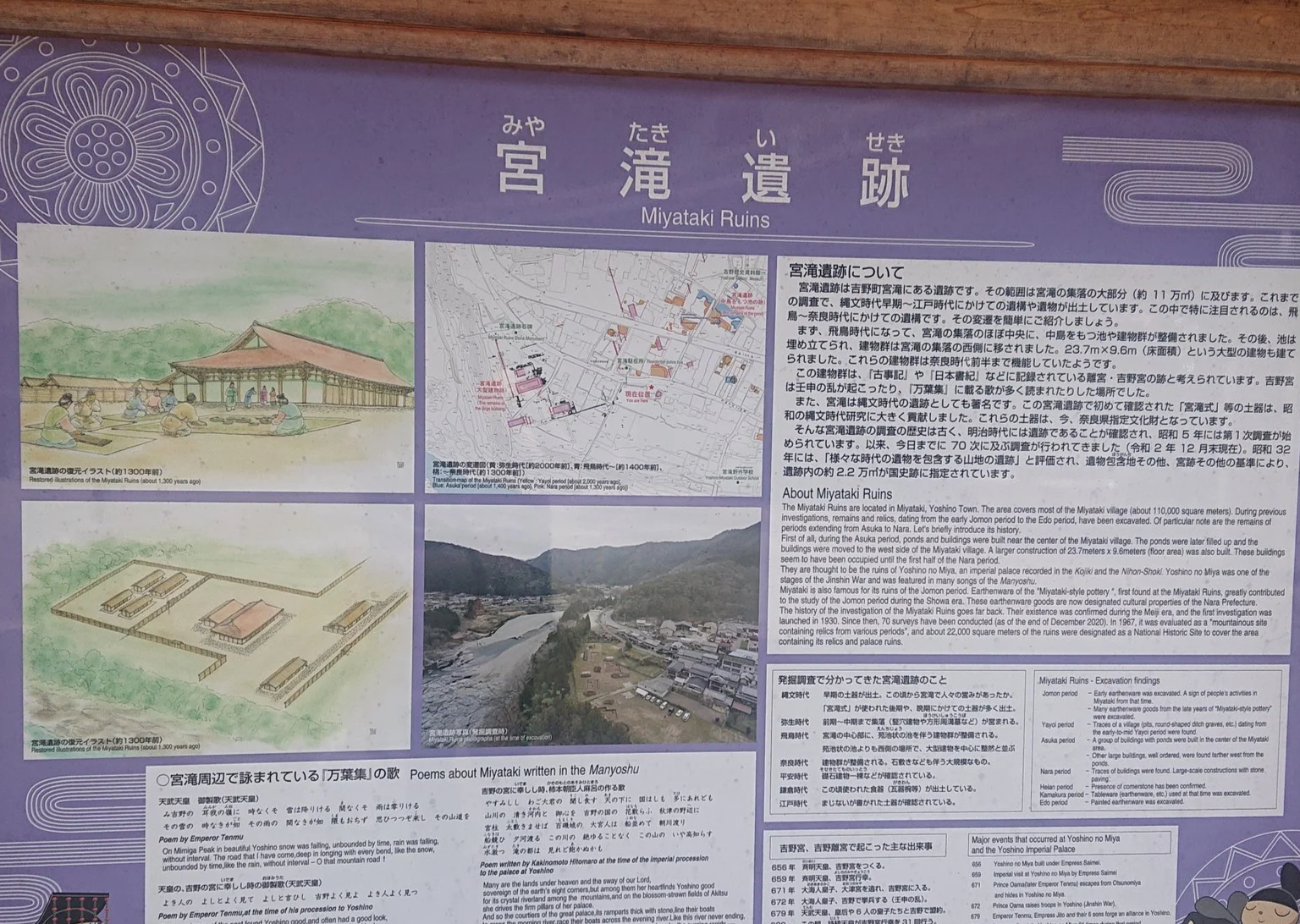
Part of a notice board at the excavation site of the Miyataki Ruins in Yoshino.
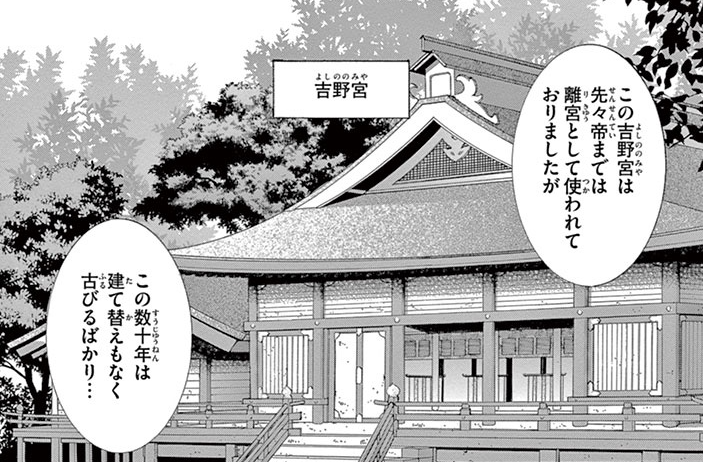
The palace at Yoshino in the manga.
Panel from volume 3, page 80. ©Chiho Saito/Shogakukan
The class took a field trip to Uji, mainly because of its connection to the Tale of Genji, but it is also a location a bit later in Torikae baya, particularly around the Ujibashi, a bridge that has various historical and literary claims to fame (though it has been rebuilt many times and the current one is really quite new). The nearby Tale of Genji Museum also has some useful information about customs and architecture of the Heian period.
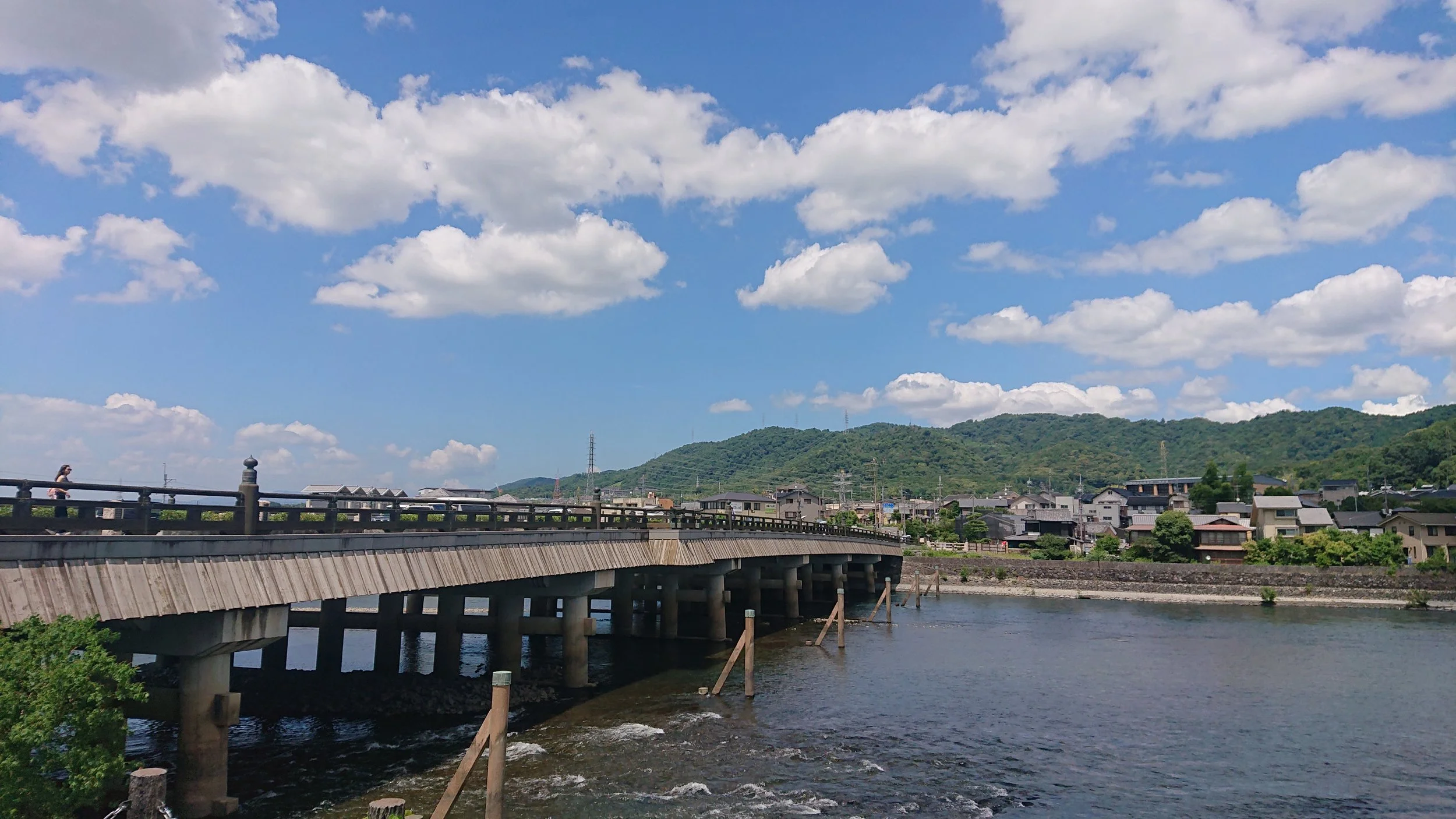
The current Ujibashi.
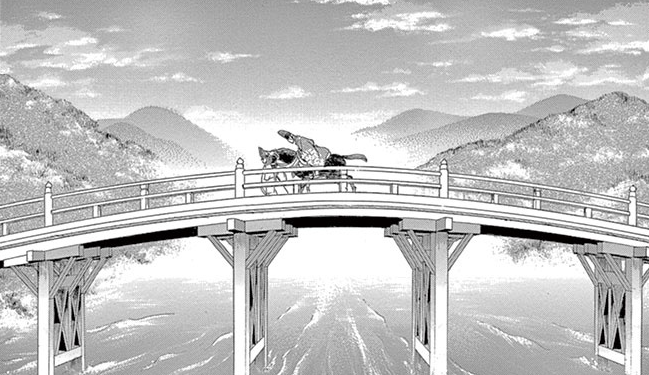
Tsuwabuki crossing the Ujibashi.
Panel from volume 6, page 155. ©Chiho Saito/Shogakukan
Getting to see these places for myself was fun, but informative too! I got a clearer sense of scale and distance, which helped me understand some of the manga scenes better. For example, you get a very strong sense of the danger Sara and Suiren face in Episode 1 when you realise they have to flee uphill to such a remote hiding place on the mountain. There’s no guarantee that their father would find them before the bandits do – if at all.
Besides these specific locations, I also visited places like Torin’in, a temple known for sarasoju flowers, and the Kyoto International Manga Museum. All in all, it was good just to have the chance to stay for an extended period right in the middle of where Torikae baya takes place!
And last but not least, I was lucky enough to get to interview Saito Chiho herself! Though there is a bit of information available about how she approached writing Torikae baya in a few magazine interviews and the afterwords that appear in each manga volume, I was interested to learn more about the process, her sources, etc. During our interview, I heard about how much background research was involved and how she wanted to show the near-constant annual cycle of ceremonies in the Heian court. I got a strong sense that making the story feel more positive (not that everything is exactly happy in the manga, but in contrast with the quite austere and fatalistic Buddhist messaging of the source material) was a key factor in the adjustments she made in the adaptation.
I also got to see her workroom and take a look at the many books that informed the adaptation. Besides different versions of Torikaebaya monogatari, there was a lot about Heian period customs, beliefs and – of course – clothes. Afterwards, I even managed to find copies of a couple of the books she showed me! It was a really exciting opportunity, and I learnt a lot and got plenty of motivation from it too.
And so that’s what I’ve been up to for the past couple of months! It’s been so busy that the main translation work has slowed down a bit, but now that I’m home, I’ll get back on track and hopefully be able to do a better job with everything I’ve learnt since!
Thoughts from Episode 7: Sara meets Shi no Hime, Suiren meets Togu
This chapter revolves around the implementation of decisions made last time: Sara goes ahead with his marriage to Shi no Hime and Suiren goes to court to work for the new Togu. At the end of Episode 6, we find out that Shi no Hime isn’t happy to marry somebody as low-ranking as Sara (not that he knows anything about it), and so as he initiates the proceedings by visiting her for three consecutive nights in this chapter, he faces an uphill struggle.
This chapter revolves around the implementation of decisions made last time: Sara goes ahead with his marriage to Shi no Hime and Suiren goes to court to work for the new Togu. At the end of Episode 6, we find out that Shi no Hime isn’t happy to marry somebody as low-ranking as Sara (not that he knows anything about it), and so as he initiates the proceedings by visiting her for three consecutive nights in this chapter, he faces an uphill struggle.
On the first night, Shi no Hime remains silent in her bedchamber (御帳台) and has an attendant meet him to deliver a letter saying she is ill; determined to succeed, Sara sleeps on the floor. The next night, Sara’s attempts to speak to her finally get a response, but it’s an angry one. On the third and final night, after everyone thinks he’s given up, Sara takes a leaf out of Tsuwabuki’s book and barges in on her in her bedchamber. He finds out that she blames a scar on her forehead for the fact that she won’t be marrying the Emperor after all, and tries to convey some sympathy. In the end, Sara thinks he has to sleep on the floor again, until Shi no Hime snappily implies he should join her.
Meanwhile, Suiren arrives at the palace, scared out of her wits by the throngs of people, and meets the adorable Togu. As it turns out, Togu is a nerd who immediately starts gossiping with Suiren about The Tale of Genji, and when she learns that Suiren also writes, she insists on reading her work – to Suiren’s clear embarrassment. Things go so well that at the end of an evening of reading, Togu won’t let Suiren leave, and invites her to sleep over in her own bedchamber.

Sara bowing outside Shi no Hime’s bedchamber.
Panel from volume 2, page 46. ©Chiho Saito/Shogakukan
Before anything else, I’ll briefly address the use of “bedchamber”. The buildings in the palace are laid out in the shinden-zukuri style, which has presented a few difficulties in translation – ones I’m not sure I’ve adequately resolved yet! Mostly this has involved which things I should describe as verandas, hallways, corridors, etc... but this time the issue is with where people sleep. Rather than a modern bed in a modern bedroom, the michodai (御帳台) is a raised platform surrounded by curtains in a larger room. The challenge here is that it’s still fairly spacious and is totally closed off, making it somewhere in between a big bed and a small bedroom. Also, looking at the situations we’re seeing so far, I don’t think it’s always accurate to describe them as characters literally getting into each other’s beds – so at this stage at least, I’ve settled for “bedchamber”.
Of course, what I really want to talk about today is the fact that this is the chapter where Suetsumuhana is mentioned! When Togu and Suiren first meet, Togu asks Suiren for her favourite female character in The Tale of Genji. Suiren pauses and answers “Suetsumuhana”, and Togu says she agrees.
As I briefly mention here, this character doesn’t stand out for her beauty and talents. The name we know her as refers to the safflower, which is traditionally used to make red dye. Genji, the story’s lustful protagonist, compares her to the flower in a poem, alluding to her big red nose. Apart from her unfortunate appearance, Suetsumuhana is also remembered for living in a dilapidated mansion, being difficult to deal with and having old-fashioned tastes.
So I thought it was fascinating that Suiren and Togu both agree that she’s the best girl in The Tale of Genji! It’s only one passing mention, but it says something about the two characters. Both are shy and reclusive, and they both feel out-of-place in their current positions: Suiren, who was first introduced as Marumitsu’s baby son, doesn’t think she’s cut out for working at the palace as a naishi no kami, while it’s public knowledge that Togu is only in her role – usually given to a male heir of the Emperor – as a stopgap measure. It makes some sense that they might relate to a literary character who is clearly not the ideal woman.
And then I decided to use that as my handle just as a fun reference! Incidentally, the avatar is another reference, this time to Takahata Isao’s film Only Yesterday (おもひでぽろぽろ), where safflower-picking plays a big part.