Thoughts from Episode 65: NEARLY the end
Here we are, at the last chapter of Torikae baya – officially not titled “episode 65” but “final episode”. There are a few different plot threads that get their conclusions here, and for that reason, I’ll only write about the first half or so today, with another post to cover the remaining pages.
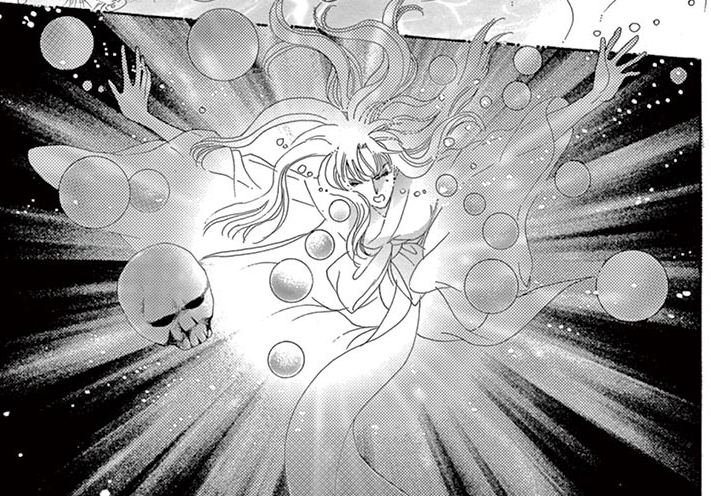
Sara struggles with the rosary beads.
Panel from volume 13, page 151. ©Chiho Saito/Shogakukan
We’ve been firmly in coda territory for a few chapters, but to give Episode 65 at least some sense of climactic drama, a cliffhanger was set up last time, with the pregnant Sara suddenly falling unconscious. As the Emperor prays, he encounters Sara in a dream, held underwater by some mysterious beads. Sara fights off the beads, the Emperor helps him out, and when he awakens, it turns out the child has been born!
After this incident, Umetsubo comes to the Emperor to declare her intention to take religious vows. She reveals that she received cursed rosary beads from Genkaku, but had them exorcised – an act that may have helped Sara survive. Later, the Emperor visits Marumitsu’s residence to mark 50 days since the baby’s birth, and it appears that Sara and the Emperor both had the dream about the river and the beads. The Emperor says the baby will be the new Togu and Sara will be Empress, and hands out some more promotions while he’s at it. Finally (for now), he visits the newly anointed nun Umetsubo with her father Kakumitsu, and asks her to act as a mother to Yuzuru so he can take up a new role helping the infant Togu.
The drama that opens this chapter is of course very short-lived – was there ever any serious doubt that Sara would make it out safely this late in the game? – but it does link up nicely with other things that have been going on. When he dreams of being in the river at the end of Episode 64, he identifies it as the Sanzunokawa, where people go when they die and which Tsuwabuki invoked in a poem to Shi no Hime. The Emperor, though, interprets it as the Amanogawa, further emphasising the connection to his remarks in Episode 63, and dashingly helps Sara across.
But apart from the specific links to those two legendary rivers, this incident fits into recurring references to drowning more broadly. In Episode 17, Sara has a nightmare in which he is drowning, and when he goes to seek Yoshino’s advice in Episode 21, he gazes into the river and imagines himself floating in the water. Similar visuals appear elsewhere, including the title pages for both Episodes 28 and 29, ramping up the foreshadowing before Sara wades out into the Ujigawa in despair. We could even look out for every occasion Sara and Suiren are reflected in the water’s surface, and it may well also be meaningful that Sara once helps save a man from drowning during his river rerouting work.
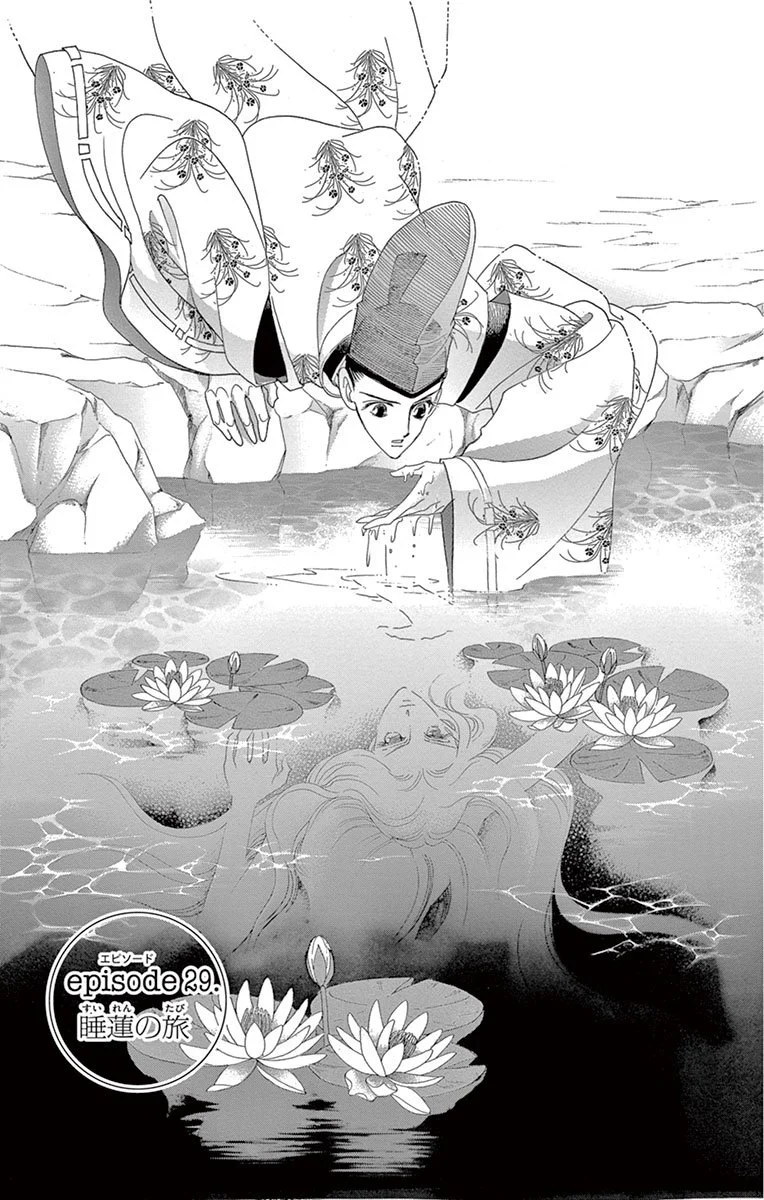
Suiren sees Sara reflected in the water.
Episode 29 title page from volume 6, page 117. ©Chiho Saito/Shogakukan
I’m not going to argue that Torikae baya is the first artistic work to use “drowning” as a motif, but I do think it’s interesting to see it keep coming up, and particularly the way that it returns at the end. The two points where Sara is at risk of drowning are clearly different: in the first, he attempts to take his own life after losing a baby, and is rescued only thanks to his eerily similar sibling, but this time, he fights back against a targeted attack, then returns to his happy new relationship and safely gives birth. Basically, while he wanted to die halfway through the story, he wants to live by the end.
I’ve mentioned before that there are plenty of references to The Tale of Genji in this manga, notably during the portion set in Uji, and these drowning references feel like a big one. When Sara opts for suicide by drowning in the Ujigawa to escape a life governed by the whims of a fickle man, he echoes the plight of Ukifune, one of the main characters of Genji’s so-called Uji chapters, who does the same thing when she is caught in the middle of a love triangle. To really drive home the comparison, when Suiren begins to fear that it may be impossible to find Sara again in Episode 29, she pictures an empty floating boat (literally “ukifune” 浮舟).
But the thing is, there’s already a more standard way of comparing the main characters of Torikaebaya monogatari to the main characters of Genji. The other two sides of Ukifune’s love triangle are Kaoru and Niou, famous for their contrasting personalities: Kaoru is the melancholic overthinker while Niou is libidinous and impulsive. Do you see where this is going? In a post-Genji tale like Torikaebaya monogatari, Kaoru and Niou seem like obvious reference points for the characters we know respectively as Sara and Tsuwabuki.
It’s interesting enough that a character apparently merely posing as a man should be inspired by Kaoru, but adding the Ukifune comparison in the manga adds another dimension. It fits in very well with Yoshino’s claim that the siblings’ unusual “combined knowledge and experience of both man and woman” makes them special. Sara experiences life as a popular but brooding young man and as a mistreated woman, and maybe in the end, the understanding that comes from this is what gives him a strong will to live after all.