
Blogging about my Torikae baya manga translation project.
Summary and observations on Volume 10: Machinations and calculations
Volume 10 distinguishes itself from most previous volumes by explicitly taking place over a limited period of time. We begin fairly soon after Tango no Sekku – which occurs on the 5th day of the 5th month – Togu reveals that she plans to step down after a ceremony at the end of the 6th month, and this volume ends before that has happened. So that means that a lot needs to fit into six or seven weeks!
Volume 10 distinguishes itself from most previous volumes by explicitly taking place over a limited period of time. We begin fairly soon after Tango no Sekku – which occurs on the 5th day of the 5th month – Togu reveals that she plans to step down after a ceremony at the end of the 6th month, and this volume ends before that has happened. So that means that a lot needs to fit into six or seven weeks!
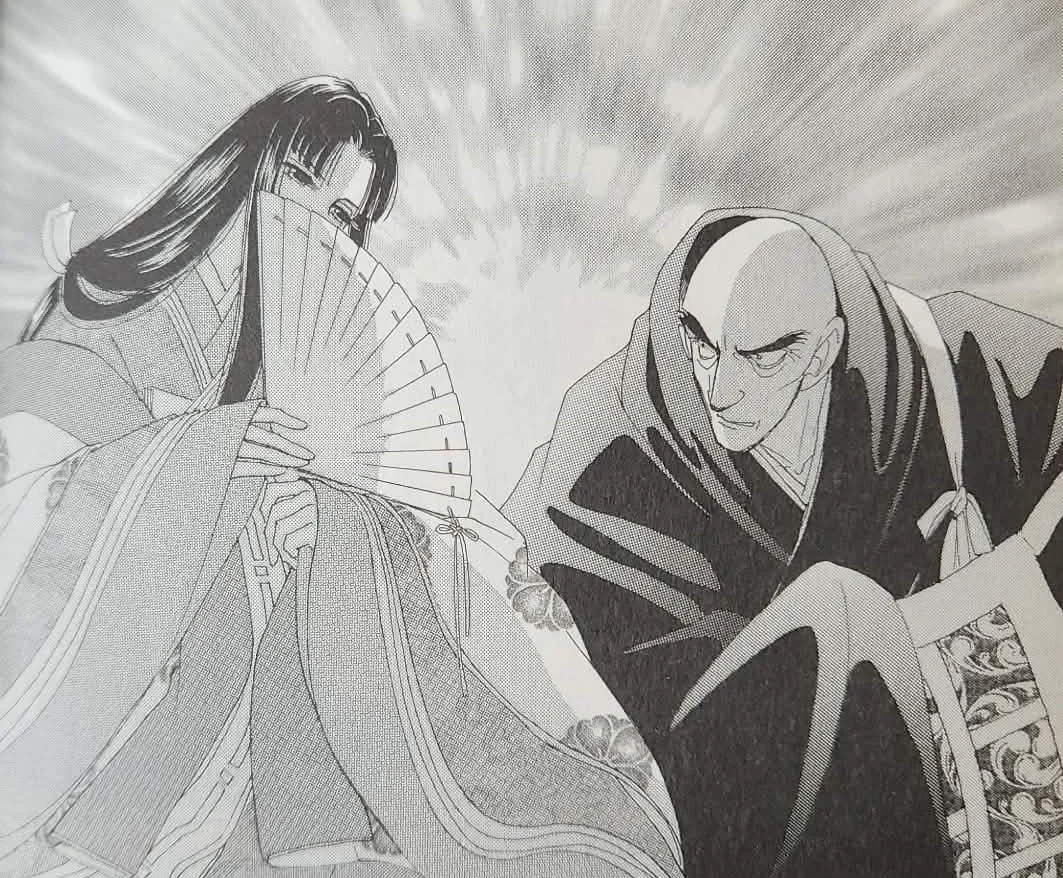
Sara and Ginkaku.
Panel from volume 10, page 48. ©Chiho Saito/Shogakukan
Much of the excitement involves the arrival of Ginkaku and Yuzuru, and Sara’s efforts to find evidence of Ginkaku’s misdeeds. Yuzuru, as we heard last time, is a little-known prince whom Shikibu-kyo no Miya has proposed as a potential new Togu. And when he attends court for his first audience with the Emperor, followed closely by the monk Ginkaku – his other political backer – it turns out that Yuzuru is a young boy. Sara, who is sure that Ginkaku is the same monk he overheard cursing a protective amulet in Kurama, is tasked with training the clueless Yuzuru until he is fit for the job of Togu. Despite Sara’s suspicions about Ginkaku, it appears that Yuzuru and Shikibu-kyo are only pawns in the monk’s plot, and Sara becomes something of a parental figure to Yuzuru, an orphan.
Throughout, Sara has to deal with being closer to the Emperor than ever as his naishi no kami. As I mentioned previously, working as the Emperor’s naishi no kami was a popular route to his bed, and in these chapters, the Emperor is perfectly happy for everyone to assume this is exactly what is going on. This bothers Sara, but when he realises that Ginkaku sees him as a threat, he decides to plant a rumour himself that “Suiren” (as nearly everyone knows Sara) is pregnant. The Emperor is initially angry, assuming this means Sara is sleeping with someone else, but then even more openly flirtatious after learning it was a ploy.
The ploy nearly works, but ultimately backfires: Ginkaku anonymously tries to poison Sara, then bribes one of Sara’s attendants to terminate the alleged pregnancy (by pushing him off this kind of bridge). Sara doesn’t manage to show the poison to the Emperor, and that attendant tells Ginkaku that Sara has a suspicious scar. Ginkaku combines this knowledge with some information from the bitter Umetsubo, and concludes that “Suiren” used to be “Sara”…
While all this is going on, Sara contacts Yoshino no Miya. Yoshino is shocked to hear the intrigue, as Ginkaku is someone who played a major role in getting him expelled from the capital years before. He therefore seeks out Suiren, who is living in minor exile herself in Ashiya, under the name Fujiwara no Tsukimitsu. Suiren is unwilling to return to Heian-kyo while she might still harm Togu’s reputation, but she does go to Kurama in search of evidence. And around the same time Ginkaku is threatening to reveal Sara’s big secret, Suiren finds an extremely evil-looking demon skull – but can she get it to the capital?
Other observations in this volume, which got me triangulating a lot of things:
Togu’s imminent retirement puts San no Hime in a tough spot, since an ex-Togu has no naishi no kami. One option is to follow Sara and becomes the Emperor’s naishi no kami – she was, after all, quite open about her desire to “produce” a future Togu herself. In the time since, however, she has become very attached to Togu, and now that she feels the Emperor has abandoned her, she has gone off him completely. As a result, she no longer sees Sara as a love rival.
I mentioned that Yuzuru is a young boy, but how young? I’d estimate that he’s younger than the current Togu was when she was instated, given his innocence and inability to quite understand what title he’s been given (親王 – imperial prince). I had thought Togu had to be between 9 and 12 when she began, since the scandal that probably led to her birth was ほんの十数年前 (“only” ten-plus years ago) in Year 18. But I was recently re-reading Episode 13, where she says she previously met Yoshino ten years earlier. Yoshino is surprised she remembers, so it would have to be an early memory, but she does specifically recall his premonition that she would become Togu, so I doubt it happened before she was, say, 3. All of this to say that I think her starting age (in Year 16) must be at the very top end of my previous estimate, making her 12 or even 13. And Yuzuru is therefore… 9? 10?
Related to that, we learn some more about that scandal. Yoshino and Ginkaku both studied in China, and it was Ginkaku’s jealousy over the Chinese Emperor’s esteem for Yoshino that then led him to encourage rumours about Yoshino and Suzakuin’s wife. This is one point where the timeline vis-à-vis real-world history doesn’t quiiite add up. Yoshino was apparently a kentoshi (遣唐使), an envoy during the Tang dynasty (up to 907 CE – the last missions there were even earlier) and he specifies that it was the Tang Emperor who liked him, but Ginkaku went to China during the Song dynasty (from 960 CE). Yoshino probably isn’t old enough for that kind of time gap, and he surely isn’t old enough if people are reading The Tale of Genji (written in the early 11th century). If the “Tang” term was being used in a generic sense for China in general, it might’ve worked, but these specific details make it a definite anachronism. On the bright side, this hazy sense of Yoshino’s personal history lends the character another layer of mystique!
At the same time, we get some new details about the imperial line. When Togu first talked about Yoshino in Episode 12, she said he’d been the third-in-line to Suzakuin’s predecessor. He later described himself as Suzakuin’s cousin. Now, when he speaks about Ginkaku, he refers to Suzakuin’s predecessor by the name Anraku (安楽) and specifies that he was Suzakuin’s father. Also, when Shikibu-kyo first brought up Yuzuru’s name in Episode 45, the Emperor knew Yuzuru to be the son of Sadayori (貞頼), the eighth prince of Kyogoku (京極), one more Emperor back before Suzakuin. Quite where Yuzuru fits in would depend on how Kyogoku and Anraku were related – remember that it doesn’t have to be father-son – but it’s clear that he’s far from the frontline in terms of potential successors. When I made the character chart recently, I couldn’t fit in every connection, but since then I’ve been thinking it might at least be useful to try and recreate the imperial family tree to go along with that chart and the timeline – so maybe that will happen at some point!
Thoughts from Episode 31: Return to Yoshino
After spending quite a bit of time on the previous chapter (two posts over three weeks), let’s finally move on to Episode 31, the beginning of volume 7! Sara and Suiren have been reunited, Sara instructs Aguri – who imagines she’s seeing two of the same person – to let Tsuwabuki think Sara has vanished into thin air while the siblings head for Yoshino. There, they tell Yoshino no Miya of their intention to take up religious vows, and lament together about how they have ended up in this situation.
After spending quite a bit of time on the previous chapter (two posts over three weeks), let’s finally move on to Episode 31, the beginning of volume 7! Sara and Suiren have been reunited, Sara instructs Aguri – who imagines she’s seeing two of the same person – to let Tsuwabuki think Sara has vanished into thin air while the siblings head for Yoshino. There, they tell Yoshino no Miya of their intention to take up religious vows, and lament together about how they have ended up in this situation.
One day, the Emperor appears. Sara and Suiren eavesdrop as he seeks Yoshino’s advice regarding troubles at court and asks him to return to political life in Heian-kyo. Yoshino turns down the request and informs the Emperor that the real reason he was previously banished from the capital was because he coveted the former Emperor’s consort. Eventually, the current Emperor reluctantly accepts Yoshino’s refusal and goes on his way.
Sara and Suiren, having heard about the difficulties in the capital – including their father being literally worried sick about them and Togu being left without supporters – question whether they are doing the right thing in abandoning the secular world. At last, they decide to switch places (立場をとりかえ) and return to Heian-kyo.
This chapter is titled “The Secret of Yoshino” (吉野の秘め事), and as such, I’d like to get a bit more into Yoshino no Miya and his backstory. I did give him a little introduction earlier, but Episode 31 reveals details that were previously murky.
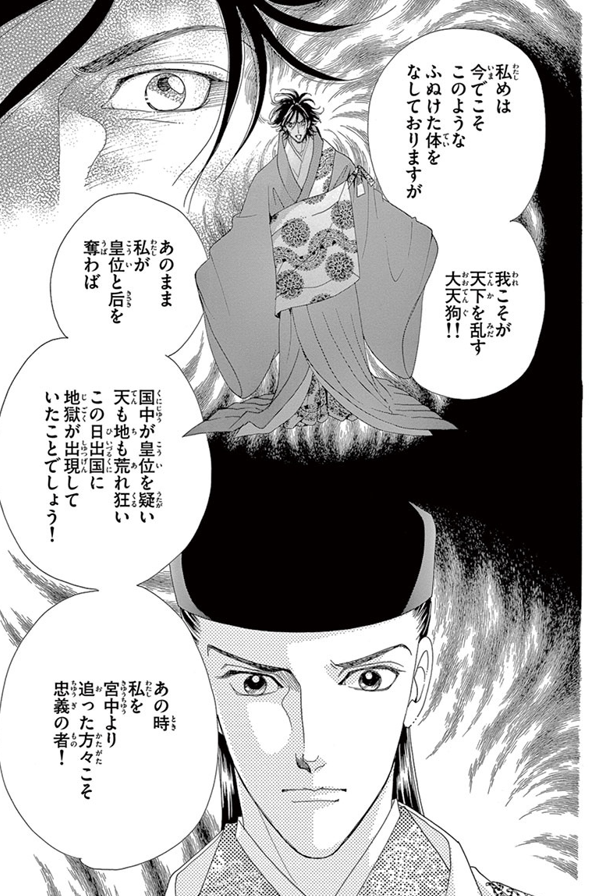
Page from volume 7, page 31.
©Chiho Saito/Shogakukan
So who is he? He refers to Suzakuin (the former Emperor) as his cousin, and therefore he is also a cousin to the current Emperor, who is Suzakuin’s younger brother. At some point in the past, he travelled to China and gained knowledge in esoteric fields such as physiognomy. That presumably occurred before a period ten-plus years prior to the current events, when he was involved in a scandal which resulted in his expulsion from the world of politics. He then secluded himself on the remote Yoshinoyama, where he prays for the safety and prosperity of the people in the capital, especially the imperial family, and especially especially Togu.
In this chapter, we learn the nature of that earlier scandal. Not only was he involved in a succession dispute with Suzakuin, but he lost that dispute – and we can deduce that that probably resulted in Suzakuin ascending the throne soon afterwards. Even worse, he desired Suzakuin’s late wife, and may well be the illegitimate father of the current Togu. When the current Emperor directly questions him about this in Episode 31, he denies that his relationship with Suzakuin’s wife reached that point, but the implication is that the stories are true. Of course, this would make his particular attachment to Togu make a lot of sense!
It’s also interesting when we compare his character to his counterpart in the original Torikaebaya monogatari. There, Yoshino no Miya has two beautiful daughters, whose mother was Yoshino’s Chinese wife who tragically died, leading him to take them back to Japan with him. He feels a responsibility to remain hidden away on Yoshinoyama, but wishes that his daughters could leave and live a more normal life; he gets his wish when Sara’s counterpart takes an interest in the elder daughter and Suiren’s counterpart later marries her in his stead. In the manga, Suzakuin’s late wife is the equivalent of Yoshino’s late wife, and Togu – as Suiren’s only love interest and Yoshino’s implied illegitimate daughter – turns out to be a composite character of the original Togu and Yoshino’s daughters.
And while revealing these dramatic details in Episode 31, Yoshino says one other interesting thing. As he insists that it was only right for him to driven away from the capital, he refers to himself as “the great tengu that sows chaos across the land” (天下を乱す大天狗). Now, a “tengu” can also figuratively mean an arrogant person, which would be a plausible interpretation in this context, but it isn’t the first time he’s been associated with tengu. On his very first appearance, his skills, his knowledge and his clothing led Sara and Suiren to mistake him for a tengu, and since then, he has made remarks about turning his back on a dark past. For him to call himself a “tengu” now – just before the only part of the original story where the tengu is mentioned – comes across as more than just a figure of speech. It suggests that while Togu takes on aspects of Yoshino’s daughters from Torikaebaya monogatari, the tengu’s story also becomes part of Yoshino’s story in this version of the tale.
Thoughts from Episode 26: Togu or not Togu?
As I suggested last week, palace politics come up as an important thread in Episode 26. But first, if you thought things were awkward between Suiren and Togu after the shrine incident, wait until you see them now!
After the dramatic kiss that ended volume 5, Suiren quickly takes her leave, fearing that there is no return for her. She later calls in sick, prompting Togu to visit her, wanting to understand her feelings but not knowing how to ask. Togu instead asks about the story Suiren is writing – which sounds like it might resemble Torikae baya – and Suiren hastily stops her from reading it, causing her to leave.
As I suggested last week, palace politics come up as an important thread in Episode 26. But first, if you thought things were awkward between Suiren and Togu after the shrine incident, wait until you see them now!
After the dramatic kiss that ended volume 5, Suiren quickly takes her leave, fearing that there is no return for her. She later calls in sick, prompting Togu to visit her, wanting to understand her feelings but not knowing how to ask. Togu instead asks about the story Suiren is writing – which sounds like it might resemble Torikae baya – and Suiren hastily stops her from reading it, causing her to leave.
Elsewhere in the palace, complaints are ramping up about Togu not being available for ceremonies, while old man Fujiwara once again unsubtly hints that the Emperor should take Suiren as a wife and produce a new heir. And when Suiren later visits her parents, she learns that he has come around to that point of view too. Suiren decides she must do something… which we will find out more about in another episode.
There’s a lot of talk in this chapter about succession. We hear about the idea of replacing Togu, the official successor to the Emperor, who is still hoping to have a son one day. There’s even a brief discussion of having someone take over Sara’s “empty” position as General, but the Emperor is determined to wait until he returns.
As a reminder, the current Emperor has reigned since Episode 6, when there was a bit of shuffling around of roles. The previous Emperor abdicated, moving to a residence called the Suzakuin, which has also since been used as a sort of name for him. His younger brother, the then crown prince (or Togu 東宮) took his place, and Suzakuin’s daughter became Togu. That a girl took on that role was immediately considered notable – as I mentioned much much earlier, she is referred to as 女東宮 (girl crown prince), and the original Torikaebaya monogatari may be the first place this wording was used. And in the time since, that’s something that random court officials have been seen to take issue with. They scoff at her efforts to do her job, and when she isn’t around to do her job in this chapter, they insinuate (predictably) that it’s “that time of the month”.
Just as reigning female emperors were a rarity in Japanese history and always qualified through the male bloodline, the current Togu in Torikae baya is expected to just keep the seat warm as a temporary measure. The ideal scenario is that the Emperor will finally have a suitable (male) heir who can take over. Some hope that a new wife will help make that happen, but at this point in the story, there is now significant chat about replacing her immediately with an alternative. Even her allies don’t particularly want her remaining in the role, noting that as a female Togu, she is prevented from living a more normal life. While they want to protect her from criticism, they also feel it would be in her best interests to be relieved from the position.
However, as obvious as it seems that our Togu won’t remain the Togu indefinitely, this chapter also reminds us that she is in fact first in line to the throne. When Suiren panics after the kiss, she says to herself, “she’s the future Emperor!” There are later points as well that point out the degree of responsibility she has.
Incidentally, I keep saying “emperor” because the words used in Japanese (including 帝, 天皇) for the reigning monarch are the same, regardless of the gender of the officeholder – as is the case with “Togu”, for that matter. And I think this is part of why this Togu is such an interesting character! Just like Sara and Suiren, she is someone in a role supposedly inappropriate for her, but she still carries it out to the best of her ability.
But all this talk about imperial succession doesn’t just go away. This becomes a major storyline later on, and we also learn just now that it’s not the first time in living memory. When the people at court talk about replacing Togu in this chapter, Shikibu-kyo no Miya, a brother-in-law of the Emperor, seems a popular candidate, but he is quick to rule himself out. He reminds the others of a scandal ten-plus years earlier, when a succession dispute led a “good man” to leave the capital and go to Yoshino. Now who could that be? I’ll just leave it there for now and let you ponder the significance of that... 😉
Thoughts from Episode 25: The Heian rumour mill
We’ve reached the final chapter of volume 5, and as usual, it ends on a dramatic cliffhanger! But before that, it resolves the cliffhanger from last time. Kakumitsu has just discovered that his granddaughter was fathered by Tsuwabuki, and so he confronts Shi no Hime about this. Long story short, he kicks his pregnant daughter out of the house, along with her existing child and her attendant Saemon.
Meanwhile, Togu is being weird around Suiren after their awkward moment alone together last time. To make matters worse, the Emperor, worried about Sara and the impact of his disappearance on his family members (remember that the siblings’ father Marumitsu is basically the prime minister!), asks Togu to have Suiren join him on a boating trip. Suiren does attend, but sits behind a screen in near total silence while Marumitsu reminisces emotionally about Sara and Suiren’s first meeting.
We’ve reached the final chapter of volume 5, and as usual, it ends on a dramatic cliffhanger! But before that, it resolves the cliffhanger from last time. Kakumitsu has just discovered that his granddaughter was fathered by Tsuwabuki, and so he confronts Shi no Hime about this. Long story short, he kicks his pregnant daughter out of the house, along with her existing child and her attendant Saemon.
Meanwhile, Togu is being weird around Suiren after their awkward moment alone together last time. To make matters worse, the Emperor, worried about Sara and the impact of his disappearance on his family members (remember that the siblings’ father Marumitsu is basically the prime minister!), asks Togu to have Suiren join him on a boating trip. Suiren does attend, but sits behind a screen in near total silence while Marumitsu reminisces emotionally about Sara and Suiren’s first meeting.
However, when Suiren returns from the day out, she learns that Togu is in a foul mood. Suiren goes to see her and finds out that Togu was convinced that “boating” meant “boating 😏😏😏” and the prospect of Suiren not coming back that night upset her for some reason. The two get closer and closer, and finally kiss.
Once again, Sara is nowhere to be seen, except in flashbacks, and so we continue to see the sweet situation between Suiren and Togu develop. It’s worth noting that although there is also a relationship between their counterpart characters in the original Torikaebaya monogatari, the way it’s portrayed in this manga is different in some important ways – but that’s a topic I plan to delve into a bit later.
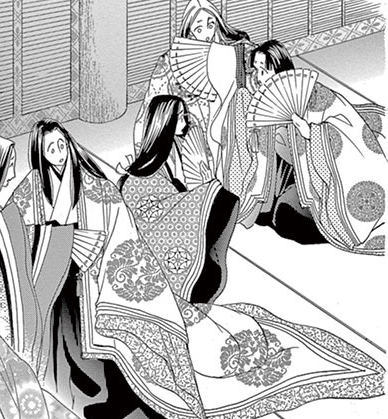
Panel from volume 5, page 159.
©Chiho Saito/Shogakukan
What I want to focus on today is another thing that Episode 25 shows a lot of: rumours. While Saito devotes a lot of attention to the main characters and providing them with more complexity than they have in the source material, there are many aspects of Torikae baya that help to convey the atmosphere of the Heian court – from careful depictions of locations to a range of seasonal events. And another example of that is the significance of the rumour mill in characters’ lives.
Let’s go through some relevant cases from this week’s chapter. Kakumitsu had no idea that Shi no Hime and Tsuwabuki had had an affair until Shi no Hime’s sister Umetsubo decided to tell him about the latest hot gossip. Once he disowns Shi no Hime, it only spreads more rumours: men and women of the court are quick to conclude that Sara vanished as a result of his wife’s infidelity (not that they’ve figured out who the other man was). Soon, Togu’s other attendants are prodding Suiren about the topic, and even the Emperor hears “awful rumours” (心ない噂) relating to Sara. And of course, when he invites Suiren to join him on his boat, the Emperor must know that this will make people’s imaginations run wild too, especially since Suiren’s grandfather has been advocating for the Emperor to take her as a wife for months at this point. Even Marumitsu’s story about Sara and Suiren as children – despite being about an event the readers are familiar with – is something he didn’t witness himself, so he can only report what he heard from a servant who was there at the time.
So why does this matter apart from providing atmosphere? I think it’s helpful as a reminder of how things operate in a political environment like the imperial court, and how that impacts plot developments. It’s a lot easier to say “these misunderstandings could be avoided if people just talked to each other!” if a story is set in a school or something, but remember that this is the government. You can expect people to have hushed conversations not just because they love a bit of relationship gossip, but also for the sake of behind-the-scenes political shenanigans. And when a lot of people aren’t really expected to see one another directly, it’s no wonder that hearsay is all they know.
This point about politics will only become more significant in Volume 6 and beyond. You may remember that some people are unconvinced by Togu’s aptitude for her position because she’s a girl. The growing movement to remove her soon becomes a major plot point – and I might even have some more to say about that next time!