More thoughts from Episode 65: The End
The time has come! As promised last week, this post goes over the second half of the 65th (and final) chapter, with a bit of commentary on where we’ve ended, why it’s interesting and what comes next for this project.
Following the previous events, Sara is formally crowned as Empress, while the Emperor and Suzakuin watch on and discuss the situation with Ichi no Himemiya (Mitsuko; the now former Togu) and General “Sarasoju” (Suiren). Suiren later visits Mitsuko, the two having both learnt that they have been granted permission to get married. However, having overheard the Emperor and Suzakuin’s conversation, Tsuwabuki thinks this would lead to disaster, believing it to be a situation like the earlier marriage between Sara and Shi no Hime. He therefore waits for Suiren to emerge in the morning after visiting Mitsuko, and confronts her. Suiren says nothing, but places Tsuwabuki’s hand on her chest and leaves, laughing. Tsuwabuki is utterly perplexed – for a moment he seems to think Heian surgeons must’ve had techniques lost to history – and aptly, that’s the last we see of him.
The narrative then jumps ahead… let’s say some years later. At Marumitsu’s residence, Mitsuko and San no Hime try to resolve a dispute between a tearful boy and a boisterous girl (clues identify the boy as Suiren and Mitsuko’s child and the girl as Sara and the Emperor’s). Sara catches Suiren nearby, writing a story based on the siblings’ experiences. While they reminisce, Marumitsu and his wives watch the squabbling children, a sight that reminds Marumitsu of a certain other boy and girl.
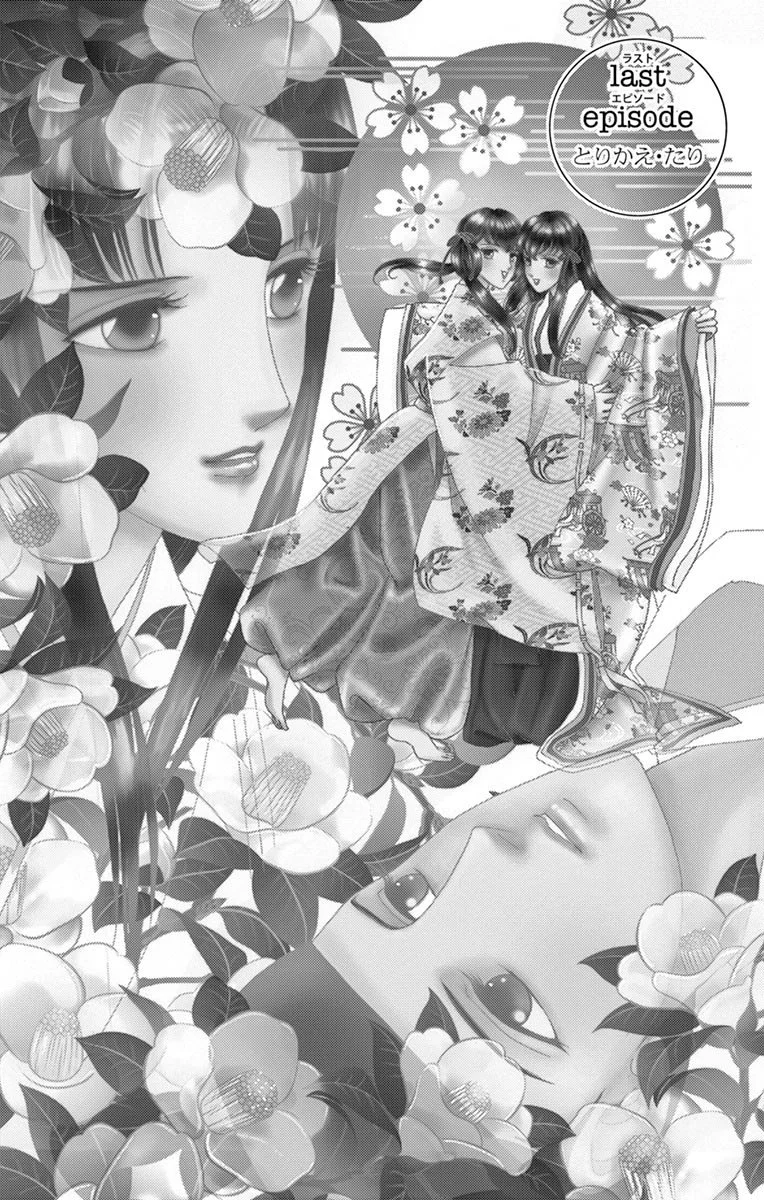
Episode 65 title page from volume 13, page 148.
©Chiho Saito/Shogakukan
And that’s it! After everything that’s happened over the 65 chapters, Sara and Suiren are living their post-switch lives comfortably, remembering the past and looking to the future. And despite the various tweaks along the way, the ending reached in the manga is still fundamentally the same as in the original Torikaebaya monogatari. Whether that ending is satisfying depends on how you look at it, but as suggested a few weeks ago, I find that by taking more time with the second half of the story and conveying each step of the way as down to the protagonists’ choices (at least partly), it puts a new spin on the same ending that makes it happier than it might’ve felt otherwise.
I briefly noted last time that this chapter is officially called the “final episode” rather than “episode 65”. Now I’d like to take a look at the title, “Torikae tari”: this is, of course, a twist on the title of the manga, and as it stands, my translation leaves it in Japanese just as I’ve left the manga’s title in Japanese. The new phrase replaces the desiderative suffix baya (think “if only…”) with the perfective or resultative auxiliary verb tari (think “has happened”), turning Marumitsu’s old line “I wish I could switch them” to “they have been switched” – or, if you like, “the change is complete”.
Something I’ve thought about a bit is the significance of the fact that “torikau” (取り替ふ) is a transitive verb, meaning that it acts upon a grammatical object. With no other words present, the phrase torikaebaya implies a subject and object, and in the tale, the subject is the father. It struck me as quite sad to think that the siblings don’t even get to be (grammatically) the subjects of their own story. They are truly at the mercy of fate: things happen to them, and they just go along for the ride.
Fate is obviously a recurring theme in Saito’s manga version, and we get a reminder of it in this chapter. During the ceremony where Sara becomes Empress, he remembers that Yoshino no Miya – knower of things and (figuratively??) a tengu – said this would happen one day. And in a sense, it really was all destined to happen, because it’s a fictional story based on an existing story with a particular premise and particular plot points that remain the same in the manga. Attention is brought to this too, with Suiren continuing to write a story that has come up a couple of times already, and which is implied to be Torikaebaya monogatari or something a lot like it. Interestingly, she reassures that nobody will trace it back to her (or rather, “Sarasoju”) because she writes using hiragana – then considered a women’s style.
The last point is also interesting because we don’t know who really wrote Torikaebaya monogatari. In Rosette F Willig’s thesis, where she translates the original story, she summarises existing discussion over whether the author was a man or a woman. She then considers two other possibilities: that as there were at least two versions, a woman may have rewritten a man’s work, or even that the author was somebody whose own life was something like the chunagon’s.
But really, there’s no way of knowing who actually wrote the story in its two versions, or whether there might have even been more than two. For that matter, since distributing literature at the time would’ve meant borrowing manuscripts and/or hand-copying them, the version we ended up with could have contained errors or changes of its own.
In contrast, we know exactly who wrote modern adaptations like Torikae baya. To return to the earlier point about transitive verbs, I realised at one point that I’d been thinking of “adapt” in too much of an intransitive sense, wondering what had changed between different adaptations as if it were some kind of natural process. But while “adapt” can be used either way, I think it’s actually more interesting to see it as transitive: this version of the story was written by a known individual with ideas to bring to the table. Whoever wrote Torikaebaya monogatari, Saito wrote Torikae baya, and did so in a way that gives the siblings a more active role in the story. Even in Saito’s version, their father still gets the final word, but notably, it’s to say this:
HIGASHI I suppose
you're thinking ‘if only I could change those two’?
MARUMITSU No.
MARUMITSU is shown in profile, looking thoughtful.
MARUMITSU The children are fine
just as they are.
It's not for me to decide.
They will be what they want to be.
Though Sara and Suiren didn’t get to change certain details of their predestined story, they did make some choices of their own along the way, and perhaps the next generation will fare better.
You might notice something of a parallel between the in-story “fate” that the characters push against on the one hand, and another “fate” determined by the source material which Saito then had to contend with on the other. And this is exactly what I’m interested in tying together in my thesis! Since completing a first draft of the translation back in December, I’ve been slowly working on making the translation more consistent and good, and working out a shortlist of translated chapters to go into the thesis. Recently, I’ve also been doing some more reading to determine what should go into the commentary and how. I have about a year left to bring it all together!
And finally, although this is the end of the chapter-by-chapter progress through the manga on the blog, I will continue to post! There are several things I never got to discuss as much as I wanted, and obviously still more progress to be made in the overall project. So thank you for reading so far, and please stick around for more! 🥰