Changes and ‘Za Chenji!’
If you’ve read any of my previous blog posts, you’ll have realised that the original Torikaebaya monogatari is quite old – definitely old enough for a few versions of the tale to have made the rounds. In the last few weeks, I’ve mostly been reading/rereading some of the different translations and adaptations that exist. So on that note, let’s take a look at the other manga adaptation of Torikaebaya monogatari: Yamauchi Naomi’s Za Chenji!
Za Chenji! (a transliteration of “The Change”) was published in Hana Yume EPO magazine between 1986 and 1988. Rather than being a direct adaptation of Torikaebaya monogatari, it’s based on an early-80s novel adaptation, also titled Za Chenji!, by celebrated shōjo novel author Himuro Saeko (probably best known outside Japan for Ocean Waves). Still, it does basically follow the story we know. Another manga, Torikaebaya ibun by Kihara Toshie, actually predates Yamauchi’s manga by a few years, but as it takes the basic concept of the gender switch and then runs with it in quite a different direction (it isn’t even set in the Heian period!!) I just don’t think it’s directly comparable with Za Chenji! and Torikae baya.
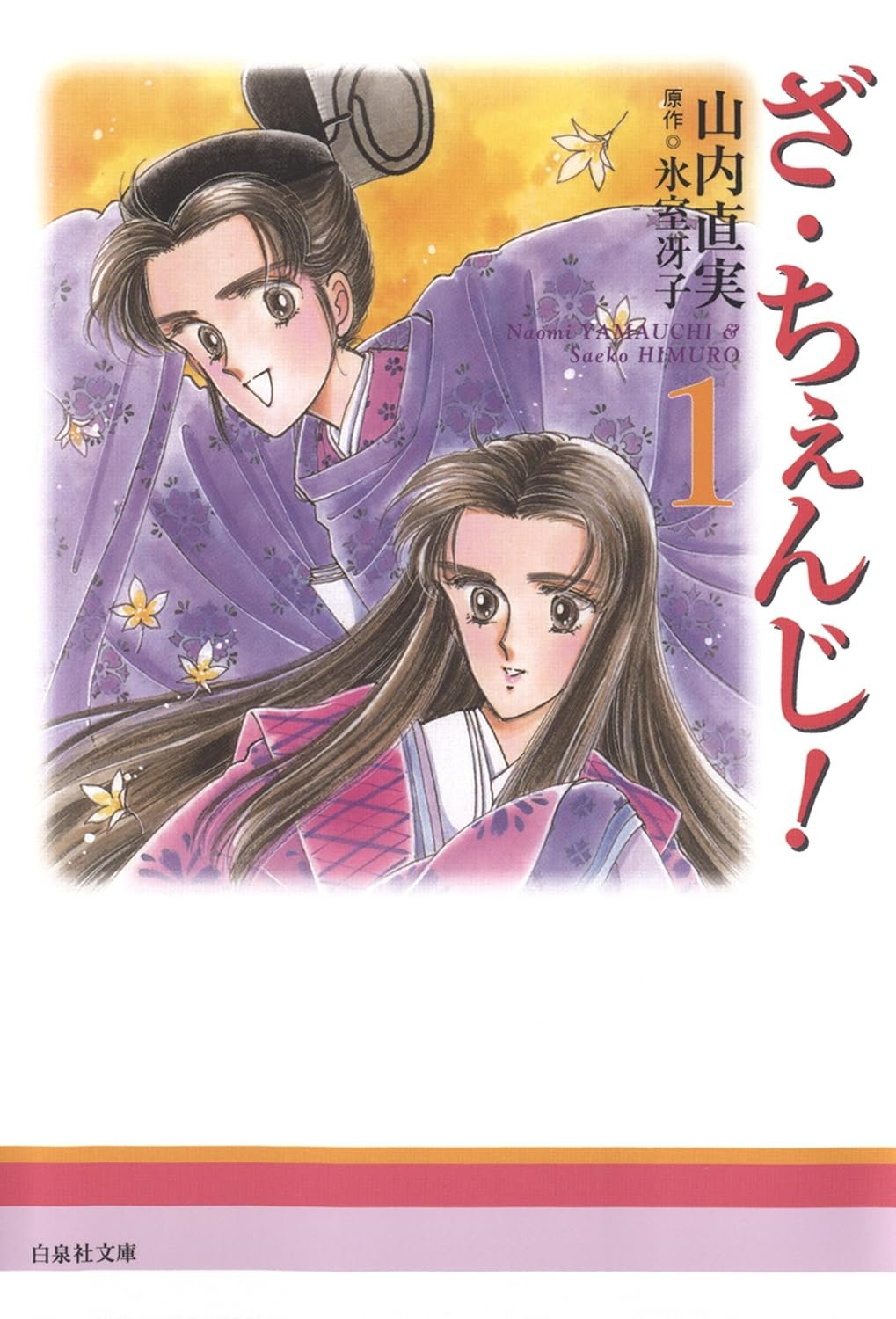
The cover of Za Chenji! volume 1.
I’ve written before about how Torikae baya diverges in minor and major ways from its source material, and this is true for Za Chenji! as well. One of the most obvious differences is that it only tells part of the story, with the fourth and final volume ending as Sara’s counterpart Kira takes over the role of naishi no kami from Suiren’s counterpart (also called Kira) and ponders what will happen next. The tone is quite different too: although the sibling in the Sara role does have moments of self-doubt and melancholy, for the most part it’s more of a romantic comedy full of hijinks and awkward misunderstandings. As an example of the latter, Sara’s counterpart doesn’t get pregnant, instead naively getting the impression that kissing makes babies. Some changes, like changing the udaijin’s fourth daughter (the chunagon’s wife) to his third daughter, seem pretty arbitrary.
There are cases where alterations to the original story in Torikae baya align with ones that already appeared in Za Chenji! For example, the Shikibu-kyo no Miya character, though named for an individual mentioned in passing in the original text, has a lot in common with a character in Za Chenji! named Hyobu-kyo no Miya, who does not appear in Torikaebaya monogatari. Meanwhile, the storm that provides Suiren with the opportunity to reveal the truth to Togu must have been influenced by a similar scene in Za Chenji!, even if Saito’s version adopts a more serious tone.
On the other hand, there are many ways in which Torikae baya clearly goes back to the source. When I was looking again recently at the earlier portions of Torikaebaya monogatari for the first time in a while, I was struck by how much of it is actually portrayed without changes in Torikae baya. There were even several points where I realised that some apparently original scenes were probably repurposed from moments that were otherwise skipped over. Importantly, Saito reinstates elements that don’t show up at all in Yamauchi and Himuro’s adaptation, like the characters of Suzakuin and Yoshino no Miya and the father’s dream about the tengu. It seems to some extent like a deliberate choice to bring this newer version closer to the source material.
But having said that, it’s not like Torikae baya reflects the narrative of Torikaebaya monogatari without any alterations or interpretations – and certainly not that any of this makes it somehow a “better” adaptation than Za Chenji! I’ve spoken before about a few motivating factors that appear to guide Saito’s decision-making in the process of adapting the tale, and we’ve already seen that her manga is not purely telling the original Heian period story but also the story she wants to tell. The same can be said for Za Chenji! too. It uses the plot of Torikaebaya monogatari basically to tell a story about a girl who wants to live the exciting, meaningful life afforded to men, but Himuro – and then Yamauchi – isn’t all that interested in exploring the complexity of the siblings’ genders. That complexity is absolutely central to Torikae baya though. Their differences compared to Torikaebaya monogatari and each other reflect those distinct angles.
Each new adaptation plays with the potential in the source material, but each one also becomes a kind of source for future versions. Sometimes, Torikae baya is different from Za Chenji! because it’s closer to the original text, but sometimes it’s different even because it does take inspiration from the earlier manga and shines a new light on it. And obviously, both of them have elements entirely specific to that one version of the story. Wouldn’t it be boring if they were all just the same?
By the way, if you want to read the Za Chenji! manga in English and see how different (or similar!) it is compared to other versions, there is actually a fan translation out there. I won’t link it here, but look it up and give it a read if you’re interested!