Reading above the lines
Last week, I was reviewing the paper I presented at the InTO MANGA conference back in January. That paper looks at how Saito deals with and takes advantage of the differences between the source and target media in adapting Torikaebaya monogatari, using various examples I’ve discussed to at least some extent on the blog. But I noticed one thing that I only bring up briefly in the paper and have barely mentioned on the blog either. So today, I’d like to set that straight and talk about furigana!
Furigana or “ruby” are the small characters that appear above or beside (depending on whether the text is horizontal or vertical) full-size kanji or sometimes letters of the alphabet, telling the reader how the word should be pronounced. Whether they appear or not usually depends on how reasonable it is to expect that the reader would know the pronunciation without assistance. Material intended for younger readers tends to feature more furigana, because they’re still learning, but on the other hand, works for adults are also more likely to include obscure terminology that require furigana because people without specialist knowledge wouldn’t know it. In manga, the use of furigana generally depends on the target demographic, and even though Flowers is aimed at a readership of mainly grown women, it stays true to its shōjo roots by having furigana on all kanji except in handwritten text.
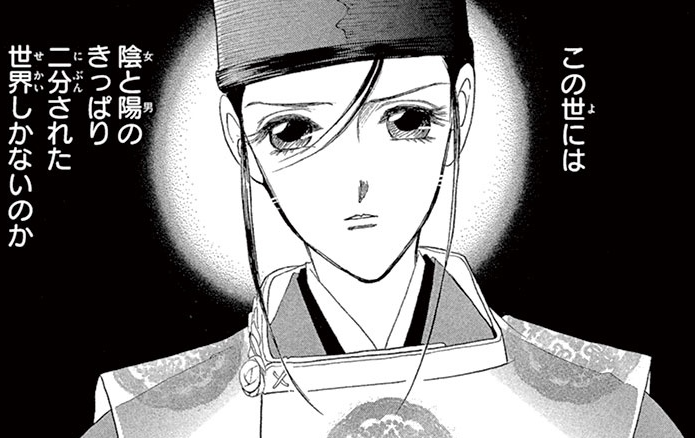
Panel from volume 1, page 133.
©Chiho Saito/Shogakukan
Another important thing about furigana in manga (also light novels, science fiction, etc) is that it’s very often used for non-standard readings. This phenomenon, called gikun (義訓), takes a few different forms, but basically it allows the writer to associate two words: maybe a rare kanji or neologism needs a phonetic explanation, or conversely a foreign or made-up word needs the semantic value of kanji to lend a hand, or maybe the writer wants to just signal some sort of double meaning. I did bring up this phenomenon once on the blog, when I mentioned the use of おとこ as furigana for both 男 and 天狗 to tie together the concepts of “man” and “tengu” in Suiren’s mind.
The main reason I haven’t said much about this before is because I’ve been more focused on techniques that strike me as unusual, but actually, there are some notable creative uses of furigana in Torikae baya. One case is similar to the previous example. In Episode 4, Sara laments that the world is so starkly divided between 陰 and 陽 – yin and yang – leaving no room for someone who is both yin and yang, and neither yin nor yang. And if you’re thinking the notions of neitherness/bothness and yin/yang point towards an additional meaning, you’d be right! When the kanji are first used in this passage, they are not glossed as いん and よう as they normally would be, and otherwise are, but instead as 女 (female) and 男 (male) respectively. The furigana allows that double meaning to take centre stage and initiate an ongoing theme.
Most often, though, Saito uses gikun readings to inject a bit of a classical vibe into dialogue without breaking the flow. In many cases, footnotes or sidenotes in the gutters are the only way to properly explain the meaning of specialist vocabulary, but there are also times when furigana is sufficient for introducing a fun archaism. For example, when Togu learns that Sara and Suiren have switched places, she uses the classical Japanese phrase 興あり glossed as おもしろい (intriguing, amusing). Elsewhere, when the ladies are fawning over Tsuwabuki in Episode 2, one remarks that she might send him a 文, an older word for a letter which is disambiguated with furigana reading ラブレター, a distinctly modern loan word from “love letter”.
There isn’t always a clear solution when it comes to translating these – often the best I can do is try to make it sound similarly archaic and add a footnote of my own to explain what was originally there. An example I actually talked about recently during a translation workshop is うつけ, which is glossed as 馬鹿者 (fool, idiot) when Sara uses it shortly after first meeting Tsuwabuki. Part of what makes this one tricky is that it then comes up semi-regularly during the series. Since attention is brought to this being an uncommon word, that makes me want to translate it consistently, but my first attempt at this (“dolt”) didn’t end up working nearly so well for some of the later uses of うつけ – including but not limited to an instance that’s immediately followed by “I’m having your baby!”
One answer might be to highlight the unusual words by just transliterating them rather than coming up with an English equivalent, but then they’d be much more unusual in English than they sound in Japanese. I’d also really prefer to avoid ending up with a “you are my nakama and nothing will fucking change that” kind of translation. As a result, I don’t quite have an answer yet, but these furigana tricks definitely open some interesting cans of worms!