Torikae baya as… yuri?
After explaining what makes Torikae baya a shōjo manga and suggesting some benefits of looking at it as a gakushū manga, I want to discuss Torikae baya in terms of genre just a little bit more. First, I should admit that while Saito Chiho’s manga career and available information about Flowers magazine definitely point towards the shōjo category and there are at least some people vouching for Torikae baya as gakushū manga, the basis for categorising it as yuri (百合) is more dubious. Basically, this idea comes from a fairly throwaway remark Saito made in a joint interview with Revolutionary Girl Utena director Ikuhara Kunihiko, saying that there might be “relatively yuri-esque” (割と百合っぽい) aspects in Torikae baya. As such, I’m not being entirely serious about defining it in this way, but let’s see where this takes us!
This might remind you of something.
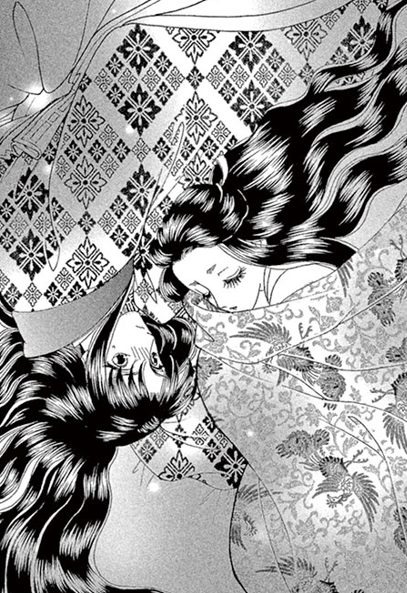
Cropped panel from volume 2, page 88. ©Chiho Saito/Shogakukan
What is yuri? I’m quite happy with this definition: it is “any anime or manga series [etc]… that shows intense emotional connection, romantic love or physical desire between women” as determined “by the *perception* of the audience.” It has its roots in early shōjo magazines, which featured serialised novels depicting “S” relationships (エス関係 – also called “Class S”), that is, very strong friendship and romantic (?) admiration between girls. Associated tropes like all-girls schools and sad endings form part of the background for yuri as a genre.
The relationship between Suiren and Togu fits this mould pretty well. Suiren admires Togu from the moment they first meet, and when Tsuwabuki tries it on with Suiren, it occurs to her that his definition of “love” matches her feelings for Togu. Their connection then develops through awkward moments and Togu’s jealousy when she believes that Suiren is to become one of the Emperor’s women. They aren’t in a school, but their workplace of the Nashitsubo is basically a girls-only environment. Whether they have the same kind of senpai/kohai dynamic of some “S” relationships is complicated a bit by the fact that, as first in line to the throne, Togu is obviously in a senior position, but Suiren is probably a few years older – but with yuri being in the eye of the beholder, isn’t that extra tension just a bit more fun for the beholder? ;) Another point that might be a coincidence is the possibility of some bilingual wordplay: although “suiren” (睡蓮) is literally something like “sleeping lotus” in Japanese, its English name is water lily, and the Japanese name for lily is, of course, yuri (百合).
Obviously, Suiren and Togu’s relationship looks a lot less like yuri once Suiren is known to the world as “General Sarasoju”. This point makes me think of another aspect of older narratives: those relationships weren’t supposed to last. Either the girls were expected to grow out of it and later find husbands, or – as became common for a time in yuri stories – it ended in disaster. If we think of Suiren/Togu as an example of an “S” relationship, then its obligatory ending comes when, just as things are getting serious, Suiren vanishes and returns in a form that makes the relationship no longer one between two girls.
One more benefit of thinking about Torikae baya in relation to yuri is that it makes us question which relationships would count. Depending on how you interpret Suiren and Sara’s respective situations, you might argue that Suiren/Togu was never a lesbian relationship. But if that were the case, then Sara’s marriage to Shi no Hime would have to count instead! Similar issues apply to other romantic situations too: if Tsuwabuki is attracted to Sara, Suiren and Shi no Hime, those can’t all be heterosexual at the same time.
Ultimately, with all the other stuff going on in the story, maybe yuri isn’t really the best way to categorise Torikae baya. But still, just considering that possibility raises questions that make it clear that no matter how you look at it, some aspect of the story (most aspects, let’s be honest!) is undeniably queer.