Saito Chiho’s Torikae baya is not the first modern version of Torikaebaya monogatari, and as previously discussed, it isn’t even the first manga version. For this project, I’m interested in Saito’s adaptation as just one noteworthy point in Torikaebaya monogatari’s extended afterlife of 800 years or so. In that time, the tale has been rewritten, translated and reimagined plenty of times, and today, I’d like to quickly run through that history and give a sense of what came before the Torikae baya manga.
The history of Torikaebaya monogatari in adaptation is as old as the tale itself. Mumyozoshi, a work of literary criticism from the beginning of the 13th century, describes two versions of the story: a weaker, earlier version with farfetched plot points like a magic mirror and the main characters rising from the dead (does that sound familiar?), and a then-recent version that fixed many of these flaws. Experts generally agree that the later version was a total reworking rather than a partly revised new edition, and that it is (more or less) the same as the extant text we know today. Not much is known for certain though, as the hand-copied manuscripts still around were all produced centuries later.
In the late 19th to early 20th century, Torikaebaya monogatari wasn’t held in very high regard under the moral standards of Japan as a modern nation-state, but printed editions were produced on a fairly regular basis, with or without annotations. From the 60s, it was taken a bit more seriously as a subject for scholarship, with people like Suzuki Hiromichi defending it against earlier accusations of moral degeneracy. New editions and translations into modern Japanese emerged too, including in the 1960 Koten nihon bungaku zenshu collection of classical literature, where a modern translation by Nakamura Shin’ichiro accompanied the text. A later standalone release of Nakamura’s translation was among Saito’s reference materials for writing the manga. Other editions worth mentioning here are a four-volume set by Kuwabara Hiroshi featuring the classical Japanese text and his modern translation, also used by Saito, and the most recent academic edition, appearing in the 2002 Shinpen nihon koten bungaku zenshu series with a translation by Ishino Keiko, which is my main point of reference for examining the original text.
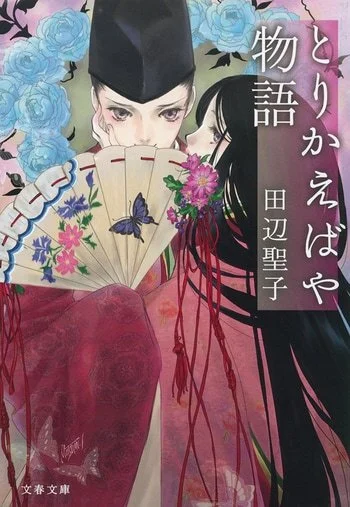
The cover of the 2015 reprint of Tanabe Seiko’s novelisation.
Torikaebaya monogatari was translated into English by Rosette F Willig for her 1978 doctoral thesis – part of the inspiration for this project! This was primarily based on Suzuki’s annotated edition. When Willig’s translation was published in 1983, one of the main changes was to treat titles like Chunagon and Naishi no Kami as if they were proper names, to avoid referring to characters only by their ever-changing court positions. That edition also applied the new title of The Changelings, a choice that received a mixed response and frustratingly meant that in the decades since, writers in English have often uncritically referred to the tale as The Changelings as if that were obviously the English title. As it happens, that title has been dropped as of this year’s new edition, which is otherwise identical apart from a bonus introduction by Gustav Heldt. Translations have also been made into German – around the same time as Willig’s translation – and into Russian, French and Spanish in the 21st century.
After republications and self-described translations of the original story, categorisation gets a bit tougher. There’s a wider spread of related works, many of which might fit under the umbrella of arenji (アレンジ – literally “arrangement”), a term that I really quite like for describing this hazier area of novelisations, intermedial adaptations and more subtly inspired works. At one end, examples like Tanabe Seiko’s popular novelisation are not so far removed from modern translations released to a wider audience, and at the other, the phrase “torikaebaya” shows up randomly in the titles of short stories and TV show episodes, and the Japanese name of an insect with unusual genitals.
But with the caveat that some of these are much closer to the original story than others, let’s see what exists beyond the more academic publications. There have been other novelisations since Tanabe’s, typically with a “making literary classics appeal to young people” slant. And of course, before hers was Za Chenji!, Himuro Saeko’s shōjo novel that was the basis for the first manga adaptation of Torikaebaya monogatari. Torikaebaya ibun by Kihara Toshie is another manga that gets talked about alongside Za Chenji! and Torikae baya, but its relationship to the source material is nowhere near as close. Kihara’s manga did get made into a Takarazuka play though, which I’m convinced is the best format for a dramatisation of Torikaebaya monogatari. On the subject of the performing arts, there was another play of some description in 1980, and a fictional kabuki adaptation aptly plays a part in Mishima Yukio’s 1957 short story Onnagata. If you want to see an animated version of Torikaebaya monogatari, the closest you can probably get is an obscure anime film called Kimi no na wa (!). I was doubtful when I first heard this, but the film’s original proposal actually made explicit reference to the original tale.
I suppose the point I want to make with all this is that Torikaebaya monogatari has more of a legacy than you might think! It’s been republished and adapted many times, and if we consider other works that have taken inspiration from it – I only mentioned a few, since they can’t all be among the highest-grossing Japanese films ever, and I didn’t even get on to more contemporary examples like Ariake no wakare – its cultural reach is really quite significant. And for that reason, it’s a bit of a shame that so little of that web of inspiration has been translated into English until now!