Following on from last time, let’s shift from the ways that Saito changes the narrative of Torikaebaya monogatari in her adaptation to parts that are interestingly faithful* to the original. I’ll be taking a look at two particular sections where, when I was re-reading the source material, I was struck by how closely events in the manga reflect the old story. Of course, they’re not one-to-one recreations (and how could they be?) but the little points of divergence are interesting in themselves.
*The idea of a “faithful” adaptation (or translation, for that matter) is a bit contentious, but let’s just go with that on this occasion. Maybe another day I can get into the dicey questions of what adaptations are and what they “should” be.
At the end of Episode 10, Tsuwabuki overhears Shi no Hime playing the koto and makes his move, before having his way with her in Episode 11. I’ve already talked about how Saito borrows poems from the equivalent scenes in Torikaebaya monogatari, but a closer look shows many more points of similarity.
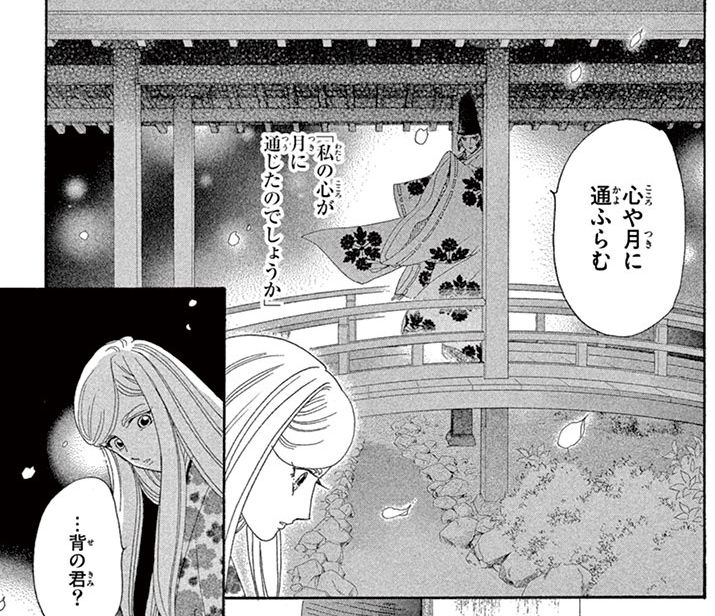
Tsuwabuki, wearing Sara’s robe, is briefly mistaken for Sara.
Panels from volume 2, page 181. ©Chiho Saito/Shogakukan
To begin with, Tsuwabuki’s counterpart the saisho no chujo is sad that he can’t have the naishi no kami (Suiren), so he decides to pay her brother the chunagon (Sara) a visit. The chunagon, though, has already left for his night duty. The scene in Torikae baya is much the same, with some distinctions: Tsuwabuki does meet Sara, who is happy to get a chance to avoid his sister-in-law Umetsubo (that particular dynamic is also not in the original story), but after the lads get drunk and fall asleep, Sara does indeed slip away for night duty, leaving Tsuwabuki in the same position as the saisho no chujo. Another difference is that while the saisho no chujo is upset about the naishi no kami after hearing her play the koto, Tsuwabuki has instead recently tried (and failed) to seduce Suiren. A comparable scene does appear in the source material, but there it lays the groundwork for the saisho no chujo’s other unwanted sexual advance. I can only assume that Saito brought this plot point forward to provide a bit more basis for Tsuwabuki’s interest in Suiren, confusion about Sara and decision to go for Shi no Hime instead.
Next, the saisho no chujo hears someone playing the koto, then goes and spots the chunagon’s wife reciting a surprisingly glum poem. When he approaches, it looks at first like the chunagon has returned home. The woman realises he is another person and cries out when he responds to her poem and pulls her behind the screens in her room. Her maid Saemon is confused, and even more so when she discovers that her mistress is in tears; unable to do anything about the situation, she waits for it to end while the other maids watch the moon and flowers.
Again, the manga version is very similar. Tsuwabuki hears the sound of the koto, then sees Shi no Hime and is surprised that she seems unhappy. While he makes his advance, the maids are watching the moon and flowers, with the slight distinction that Saemon is with them initially, then returns to the house when she hears Shi no Hime’s voice. Another detail added in Torikae baya is that Tsuwabuki appears wearing Sara’s outer robe. Considering the quite different character designs for him and Sara, this makes it a bit more believable that both Shi no Hime and Saemon mistake him for Sara at first. The moment where Tsuwabuki smells the robe and puts it on also does show up later in the original story, when the saisho no chujo is grieving after the former chunagon vanishes from the Uji villa. Since it does appear in the manga too at that point, this creates something of a parallel, foreshadowing that Tsuwabuki will again be left all alone when Sara disappears while he looks the other way.
Another chapter I want to consider is one of my favourites, Episode 23 – when Sara makes his grand exit from the Heian court. Leading up to the flower viewing party scene, Torikaebaya monogatari describes how the chunagon attends court at the beginning of the new year looking more wonderful and even dressing up his servants more lavishly than ever, but feels “like a sheep being led to the slaughter” (羊の歩みの心地して – a phrase apparently meant to evoke Ukifune). This corresponds to a moment at the end of Episode 22 of the manga, when Sara shows up at court in a nice two-page spread with his attendants, and everyone remarks on how nice he looks amid the light snow.
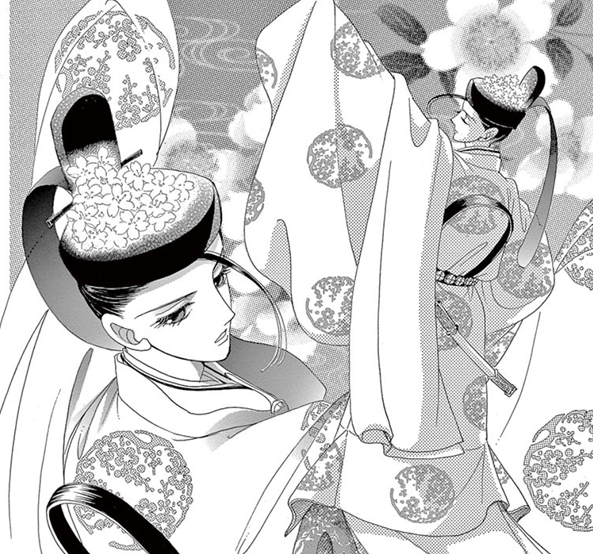
Sara accepts a gift of a robe from the Emperor.
Panel from volume 5, page 96. ©Chiho Saito/Shogakukan
In both the original and Saito’s manga, we’re told that he continues to be extra dazzling and unusually friendly until the big day arrives as the cherry trees bloom in the spring. In Torikaebaya monogatari, professors are brought in to supply themes for a Chinese poetry recital, and the chunagon’s poetry is so outstanding that onlookers believe there could be nothing better even in China. The Emperor gifts our hero his robe, which the chunagon accepts with a formal dance, causing his father to cry tears of joy and wonder how he ever doubted that the chunagon could make it as a man. Finally, the chunagon plays the flute with such emotion and beauty that the sound touches the heavens, and the Emperor is immediately stirred to announce a promotion for him.
Every single one of these things happens in Torikae baya too! Who exactly says what and some of the details do vary, but Saito follows all of this remarkably closely – though one important change in the grand scheme of things is that she has the good sense to actually make this Sara’s last day at court, whereas the chunagon’s remaining time as a court official continues to meander and eventually peter out after this.
One other adjustment I’d like to point out is the addition of a scene where Sara runs into Suiren, who senses something off about his bittersweet tone; the two are called to see Togu and Marumitsu, and both Sara and his father are moved to tears. There isn’t a scene quite like this in Torikaebaya monogatari, but it seems to me like a combination of two. In the chunagon’s actual last scene before leaving the capital, he visits his sister in the Sen’yoden (Nashitsubo) and speaks obliquely of his sadness. Much earlier, when they’re first developing their sibling bond, they meet in the Sen’yoden, their appearance and especially their clothes are described in great detail, and their father joins them and weeps when they play music together. Incidentally, this is the very point where the saisho no chujo overhears the naishi no kami playing the koto and is so captivated and forlorn that he simply must have an affair with his friend’s wife. And so it all comes full circle!
I think it’s really interesting to see not just what Saito altered but also which parts of the original story she was evidently keen to portray as described. To some extent, it’s likely that some of these more “faithful” interpretations came about when she happened to return to the source text for a closer look. On the other hand, the way that certain scenes – or echoes of them at least – crop up even when their original narrative purpose has been edited out suggests that they stuck with Saito so strongly that she couldn’t help but work them in at some point.