
Blogging about my Torikae baya manga translation project.
Thoughts from Episode 62: Back to the Daigokuden
There’s a fire in the palace! After seeing Genkaku starting the fire last time, Sara now comes running to alert the Emperor – dressed in Suiren’s spare clothes. That means that throughout the chapter, both Sara and Suiren are recognised by others as “Sarasoju”.
There’s a fire in the palace! After seeing Genkaku starting the fire last time, Sara now comes running to alert the Emperor – dressed in Suiren’s spare clothes. That means that throughout the chapter, both Sara and Suiren are recognised by others as “Sarasoju”.
While the original Sara – the one who has been known to all as “Suiren” since Episode 33 but let’s call him Sara 1 this time – gives instructions inside the palace, the other one – the one we know as Suiren but let’s call her Sara 2 – is on the way to see the unconscious Yoshino no Miya together with San no Hime. San no Hime defies the hesitant priests looking after Yoshino and takes him away by force; he shows signs of life before she transports him away to the Suzakuin on horseback.
Taking advantage of the fire, bandits dressed as tengu show up to wreak havoc. Just as Sara 1 is about to evacuate the Emperor by palanquin, the bandits attack, causing them to change plans and head for the Daigokuden instead. Meanwhile, Sara 2 is giving orders to fight the bandits off. Tsuwabuki offers to lead those efforts, allowing Sara 2 to go looking for the Emperor.
When Sara 2 reaches the top of the Daigokuden, she finds the Emperor and Sara 1 there. Finally, their secret is revealed, but the Emperor isn’t angry. After he successfully prays for rain and adjusts Sara 1’s hair and clothes to look more feminine again and avoid anyone knowing what has happened, they all leave happily. The Emperor allows Sara 1 into his own palanquin and announces that Sara 1 is to be one of his ladies from now on.
Aaaand breathe! This action-packed chapter is effectively the climax of the series, returning once more to the subject of Sara and Suiren’s “curse” and bringing major plot points to an end, leaving just a few loose ends to tie up over the remaining chapters. And fittingly, it calls back very clearly to the chapter where the “curse” was first introduced.
In Episode 3, Sara has dreams where a tengu tells him that he and Suiren are cursed, prior to an ominous eclipse. Hoping that he can break the curse by confronting the eclipse directly, he goes to top of the Daigokuden, pursued by Tsuwabuki, and meets the then-Togu (later the Emperor) who is inspired by the idea. Togu uses a Kundali crystal ball given to him by the then-Emperor (later Suzakuin) to pray for rain clouds, protecting everyone from the eclipse.
This time, Sara has the crystal ball, which has already helped him survive attacks by an entranced Yuzuru and Genkaku, and returns it to the Emperor at the Daigokuden. The Emperor relies on its power again to tackle the new calamity of the fire in the palace. Having suggested in Episode 15 that the efficacy of the crystal ball against the eclipse was dependant on the will of the heavens, he again interprets the outcome as an expression of divine judgement:
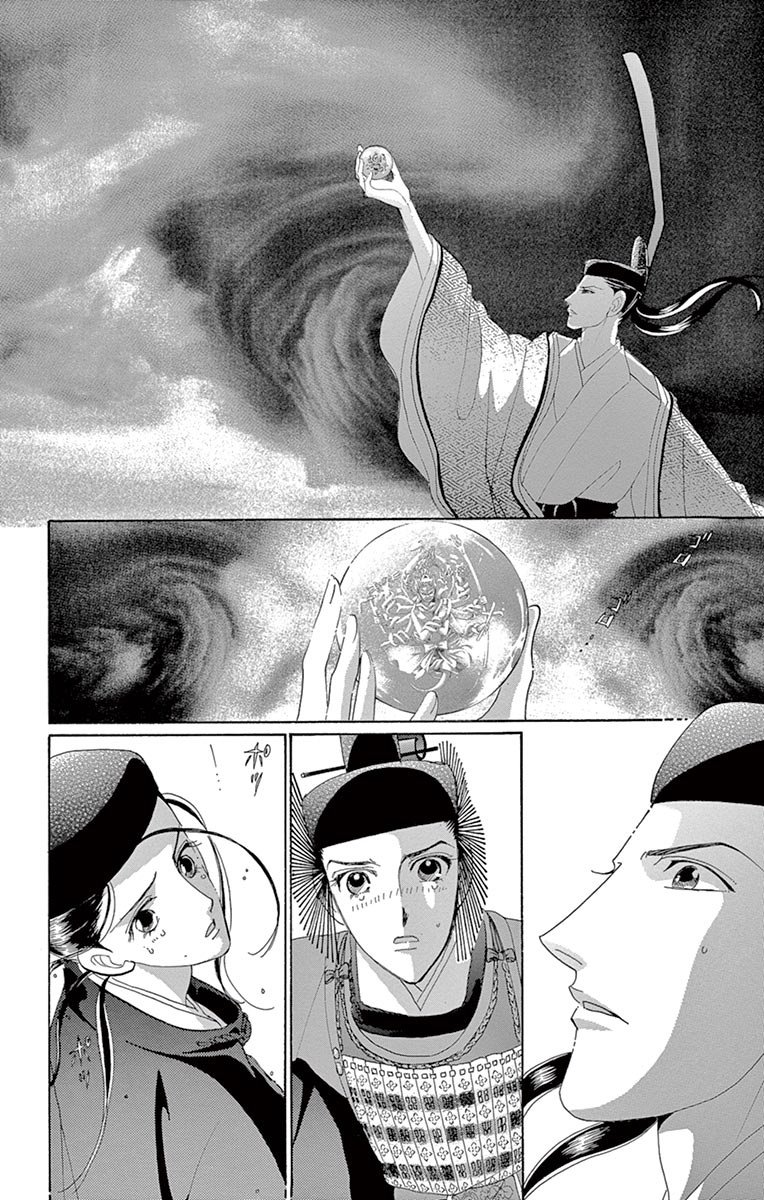
Panels from volume 13, page 72.
©Chiho Saito/Shogakukan
The EMPEROR looks down in surprise to see both siblings kneeling, with SARA reverently holding the crystal ball up to him.
SARA The crystal ball Your Highness entrusted to me…
Let me return it to you, along with my title of naishi no kami!!
SUIREN I, too…
deceived everyone and betrayed Your Highness's trust!
My actions are unforgivable…
Both are shown from the front, bowing, with SARA passionately raising his voice.
BOTH Let us atone for our sins by taking vows!
Closeups shows the EMPEROR looking at them gravely, then accepting the crystal ball. He holds it up to the light, revealing the Kundali image inside.
EMPEROR Why don't we consult… the heavens?
And once the clouds gather to begin extinguishing the flames, it becomes clear that the Emperor has no intention of delivering any kind of punishment. When the chapter ends, he even tells Sara that he believes the siblings’ curse to be broken.
So we have plenty of the same elements: the Daigokuden, Sara and the Emperor, a threat, the Kundali crystal ball, a successful prayer, the tengu’s curse. With the tengu bandits attacking the capital, there are actually repeated references to the supposed origin of the curse.
But there’s a twist: this time there is not one “Sara”, but two. This is, of course, the later important instance of the siblings dressing as each other that I mentioned previously. As in the earlier cases, there is a sense of this being a special power that the two have. In choosing to put on Sara 2’s clothes, Sara 1 thinks of this as something he has the ability to do in this moment. He also perceives the clothes not simply as “Suiren’s”, but more significantly as “the general’s” – this suggests that rather than being a specific individual, “the general” is someone that Sara 1 can become in this time of need.
This also ties in with the existing idea of the siblings as effectively one person, or two halves of a whole. Indeed, when they’re both hard at work in this chapter, an impressed group of ladies comment on how “the general” appears to be everywhere at once. I’ve described the siblings’ ability to switch places as a “superpower” before, and in this chapter, that’s genuinely how it appears to the people around them!
When the rain falls, the Emperor tells them that on the inside, they are Sara and Suiren, regardless of whether they appear as a man or a woman. What makes them unusual is also what the Emperor treasures about them, now that his suspicions have finally been confirmed. Perhaps this is the real meaning of their curse having been lifted: the secret that has tormented them all this time has been exposed, but the Emperor – and the heavens – determines that they should be cherished, not punished, for being as they are, and that great burden is now gone.
Thoughts from Episode 61: Heavy clothes to fill
For the first time in two months, today’s post concentrates on just one chapter, with the thirteenth volume being one of the eight included in my translation. Plenty has happened in the story since Episode 35, covering about a year of in-story time by my estimation. I did summarise volumes 8-12 in the last few posts, but let’s begin with a brief reminder of where we are right now.
Sara took over Suiren’s position and worked as Togu’s naishi no kami together with San no Hime. Togu, who later stepped down, is now known as Ichi no Himemiya (or Mitsuko). Sara is now the Emperor’s naishi no kami, working closely with people like the imperial archive keeper. Suiren, in turn, took over Sara’s position and now works as a general in the Imperial Guards, though she left the capital for a while after a thwarted attempt to visit Mitsuko. The Emperor has worked out that Sara is not really Suiren, but hasn’t truly confronted him. Tsuwabuki is now married to Shi no Hime, and has zero understanding of what has happened with Sara and Suiren. And finally, during the search for a new Togu, two monks have arrived to cause problems: one, Ginkaku, was banished but continued to cast curses from far away, and his disciple, Genkaku, is now ready to carry out Ginkaku’s evil plans.
For the first time in two months, today’s post concentrates on just one chapter, with the thirteenth volume being one of the eight included in my translation. Plenty has happened in the story since Episode 35, covering about a year of in-story time by my estimation. I did summarise volumes 8-12 in the last few posts, but let’s begin with a brief reminder of where we are right now.
Sara took over Suiren’s position and worked as Togu’s naishi no kami together with San no Hime. Togu, who later stepped down, is now known as Ichi no Himemiya (or Mitsuko). Sara is now the Emperor’s naishi no kami, working closely with people like the imperial archive keeper. Suiren, in turn, took over Sara’s position and now works as a general in the Imperial Guards, though she left the capital for a while after a thwarted attempt to visit Mitsuko. The Emperor has worked out that Sara is not really Suiren, but hasn’t truly confronted him. Tsuwabuki is now married to Shi no Hime, and has zero understanding of what has happened with Sara and Suiren. And finally, during the search for a new Togu, two monks have arrived to cause problems: one, Ginkaku, was banished but continued to cast curses from far away, and his disciple, Genkaku, is now ready to carry out Ginkaku’s evil plans.
Yoshino no Miya’s counter-curse against Ginkaku appears to have succeeded, but at a cost. Suiren informs the Emperor and Sara that Yoshino is in some sort of coma, and is instructed to patrol the palace. Meanwhile, Genkaku, who has been staying at Kakumitsu’s residence, sets the house on fire before catching Umetsubo and her maid as they try to escape.
Suiren gets dressed for action, speaks with Tsuwabuki, and leaves her regular uniform with Sara. She then runs into Mitsuko and advises her to return to the Suzakuin. Mitsuko acquiesces, but sends San no Hime to visit Yoshino on her behalf, and points out that although the fire has died down, there are now signs of a disturbance approaching the palace proper.
When Sara returns to the oddly quiet palace, he encounters Umetsubo’s maid. He sees Genkaku (remembering him from Kurama and immediately linking him to the snake incident from volume 12), who has taken Umetsubo and the maid there. Genkaku attempts to strangle Sara, but Sara manages to stab him and attack him with the crystal ball he received from the Emperor. Though Sara escapes, he has his kamoji of Suiren’s hair yanked off in the process and witnesses Genkaku starting a new fire. The chapter ends with somebody closely resembling Suiren running to deliver news to the Emperor.
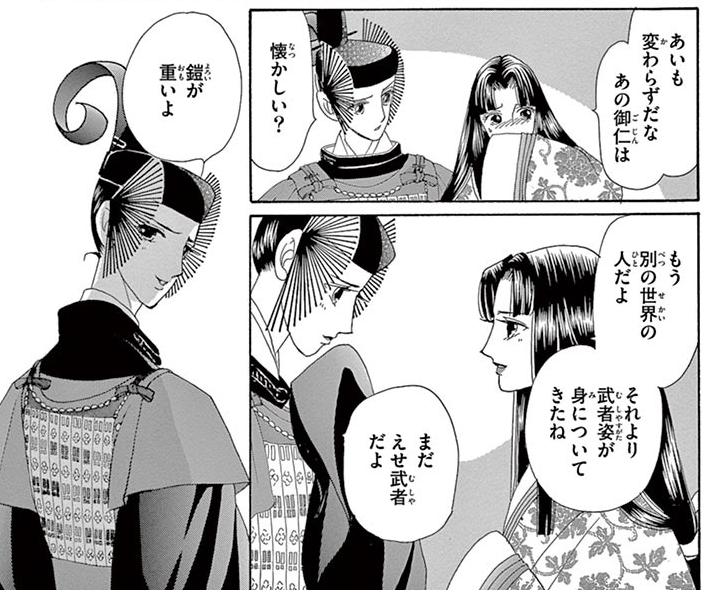
Panels from volume 13, page 18.
©Chiho Saito/Shogakukan
A lot of time has gone by since Sara and Suiren made the dramatic decision to switch places and go back to Heian-kyo. As I touched on at that time, this change isn’t presented as a return to their true natures, but as going against their usual instincts. And even this late in the story, there are still indications that they haven’t settled comfortably into their new roles.
When Tsuwabuki appears in this chapter, Sara avoids him, then remarks to Suiren about how his former colleague behaves the same way he always did. Suiren asks if he misses his time as a court gentleman and Sara suggests that he is over it by now, but when Sara responds that Suiren now looks the part of a soldier, Suiren disagrees. After all this time, Suiren still regards herself as an えせ武者 (a false soldier – “a pale imitation” in my translation). She leaves with a wry smile and says, “The armour is heavy” (鎧が重いよ).
Suiren’s comment on the weight of her new clothes reminds me of a moment from much earlier, shortly after the siblings return to the capital. In Episode 34, Sara is exhausted after a tough first day as Togu’s naishi no kami, and tells Torako, “Women’s clothes are so heavy” (女の装束は重い). Obviously, we can read both lines literally – yes, armour is likely to be heavy, and yes, the many layers of Heian court women’s dress add up – but it’s hard not to see a figurative meaning too. Wearing clothes that they don’t feel at ease wearing is a challenge for Sara and Suiren; it’s a heavy burden, and so is the responsibility attached to them.
Speaking of responsibility, there is another moment in this chapter that calls back to the time when Sara and Suiren return to Heian-kyo. To persuade Mitsuko to go somewhere safer, Suiren insists that as somebody who could still end up ruling the country if things went horribly wrong, Mitsuko’s life is not only her own. Sara’s mother Nishi says something very similar in Episode 33, admonishing him for disappearing and causing his loved ones such heartache.
I’ve mentioned before that although the topic of fate comes up a lot, the narrative of the manga strongly suggests that the siblings are free to shape their own destiny. Still, it isn’t as simple as them getting to do whatever they like at all times. They originally leave their positions in the capital when everything starts to crumble, but when they consider the power they have to help the people they care about, they make a choice to go against what feels easiest and take on new roles. The responsibility they ultimately feel may be a heavy burden to bear, but it comes along with their active choice to keep on living.
Thoughts from Episode 32: Trading places
The manga reaches a key turning point in the story now, as Sara and Suiren plan their return to the capital to fill each other’s former roles. They teach one another how to look and behave to avoid suspicion, and Yoshino no Miya helps Suiren overcome her anxiety around men.
But what Episode 32 concentrates on mostly is events in Heian-kyo. In an effort to alleviate Marumitsu’s stress, the Emperor declares that he is rescinding his request for Suiren’s hand in marriage – much to the jealous Umetsubo’s delight. Meanwhile, Kakumitsu tries to have his as-yet unseen daughter San no Hime installed as Togu’s naishi no kami, but Togu rejects him, wanting to wait until Suiren recovers from her alleged ailment.
The manga reaches a key turning point in the story now, as Sara and Suiren plan their return to the capital to fill each other’s former roles. They teach one another how to look and behave to avoid suspicion, and Yoshino no Miya helps Suiren overcome her anxiety around men.
But what Episode 32 concentrates on mostly is events in Heian-kyo. In an effort to alleviate Marumitsu’s stress, the Emperor declares that he is rescinding his request for Suiren’s hand in marriage – much to the jealous Umetsubo’s delight. Meanwhile, Kakumitsu tries to have his as-yet unseen daughter San no Hime installed as Togu’s naishi no kami, but Togu rejects him, wanting to wait until Suiren recovers from her alleged ailment. As Kakumitsu abandons decorum and complains openly about Togu, a shady bunch of vice ministers plot to get rid of her, ideally in favour of Shikibu-kyo no Miya. By the end of the chapter, they put their plan into action, with a man showing up in Togu’s bedchamber, thus exposing lax security in the Nashitsubo pavilion, stirring up gossip about Togu, and making Kakumitsu even more determined to restructure Togu’s staff.
Something we see quite a bit of at this stage in the manga, roughly between Episodes 31 and 34, is use of the verb とりかえる (to exchange, trade, substitute, etc). As that is indeed the verb used in the title of the story, you might think that isn’t so strange, but until now it’s been used sparingly. It appeared back in Episode 1, first when Marumitsu laments that things would be so much simpler if his children’s personalities were the other way around, and then a few times specifically in reference to the siblings trading outfits in order to escape the tengu bandits. That chapter ends with this scene:
SARA and SUIREN, both looking the same in their nightclothes and with their hair down, examine the clothes together.
SUIREN I never liked these boys' clothes,
but now that I know I'll never put my arms through those sleeves again,
I felt the desire to see the genpuku outfit...
SARA I feel the same way.
I wanted to properly say goodbye to my life as a girl...
...
Shall we switch clothes one last time?
Your mogi outfit,
and my genpuku outfit.
And aptly, we also say goodbye to the word とりかえる. The only time it is used again between Episode 1 and Episode 31 is when Marumitsu repeats his opening line in the new context of marriage discussions surrounding both Sara and Suiren.
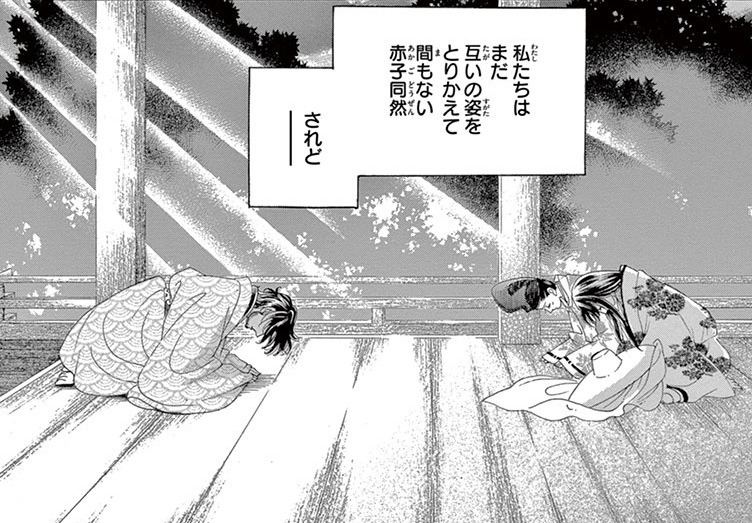
Panel from volume 7, page 74.
©Chiho Saito/Shogakukan
I find it very interesting that it takes so long for とりかえる to re-emerge, and that this is the first time Sara and Suiren talk about switching their positions or appearances, rather than just their clothes as in Episode 1. While readers might be tempted to think of the early decision to give Sara a genpuku (boys’ coming-of-age ceremony) and Suiren a mogi (girls’ coming-of-age ceremony) as the central “switch” of the title, the way the siblings describe their situation shows that to them, this is the moment where they change and take on roles that don’t suit them. And sure enough, this chapter basically gives us a montage where they learn how to live as one another, which requires them to really push back against their natural instincts.
But even though there’s basically no discussion of とりかえる for large portions of the story, there are actually several occasions where one sibling stands in for the other. They are, after all, similar enough in appearance to seem like two parts of one person. Obviously, they put on each other’s clothes to outwit the bandits in Episode 1, but then there’s also the incident where Sara suddenly has to impersonate Suiren while speaking to the Emperor from behind a blind.
Another situation where Sara dresses in women’s clothes – though not with the goal of appearing like Suiren – is in Episode 14. I didn’t say very much about it in my earlier blog post about that chapter, but to lull some greedy regional officials into a false sense of security, Sara and Tsuwabuki put on a show wearing women’s clothes. They perform a song from the legend of Yamato Takeru, impressing the spectators who seem to conveniently forget that in the legend, Yamato Takeru disguises himself as a woman to gain access to his enemies, maybe a stone’s throw away from where they’re sitting.
And there’s another important occasion much later, where the siblings’ situation is very different, but Sara has a reason to take on Suiren’s appearance again (and I would say “for the last time”, but there is a bonus chapter that suggests they’re not entirely done switching places). I won’t go into detail about it here, since we’re still nowhere near that point in the story, but it’s another moment that fits in with a pattern that these earlier scenes establish.
One aspect of these “trading places” incidents is of course to play around with the central conceit of the story, but more importantly, they present the siblings’ irregularity as something of a superpower. Yoshino addresses this directly in this chapter, telling them that very few others share “the combined knowledge and experience of both man and woman” (男と女の二倍の知識と経験). Living with a secret causes both Sara and Suiren a great deal of heartache, and Sara especially suffers a lot, but it also enables them to do things that most others can’t. And ultimately, what pushes them to switch positions and return to Heian-kyo isn’t some idea that they should “go back” to how they “should” be; it’s the realisation that they have a unique opportunity to help their loved ones, and that they can still do good in the world even after the unravelling of their lives so far.
As an aside, it’s now been a year since I started the blog! A few weeks ago I wrote about how far the project has come since then, but I just wanted to say once again, thank you for reading! Hopefully I’ll be able to keep this going even as I get closer to the end of the project!