The more things change…
In a post a few weeks ago, I wrote about how I’d been going through some of the various modern Japanese translations and adaptations of Torikaebaya monogatari, notably including the 1986-88 manga Za Chenji! That got me talking about how that and Saito’s Torikae baya relate to each other and the source material, and how closely or not they follow the details of the original story.
But because of the inclusion of another manga to compare with, I didn’t really get that much into specifics of what does and doesn’t change when going from Torikaebaya monogatari to Torikae baya – even though that’s something that has actually been on my mind quite a bit as I’ve re-explored the story! With that in mind, today’s post looks at aspects of the adjustments that Saito makes to the original Torikaebaya monogatari in adapting it, with a focus on examples that have a kind of “streamlining” effect.
What I’m interested in looking at is the approach to taking a piece of art and adapting it to a new medium – what we could call a kind of “border crossing”. I don’t mean that the borders between one medium and another are fixed or that there’s some kind of everlasting rule that everyone working within a medium has to follow, but it’s not too outrageous to say that a piece of art is recognised as belonging to a certain medium because it ticks at least most of the expected boxes.
An intermedial perspective looks at the works involved and takes into consideration the basic differences between the media in which they’re produced. There are some complicated and granular ways of defining these differences with terms like “mode” and “modality” and whatnot, but although I will go into that in more depth in the actual thesis, I don’t think it’s necessary right here right now. Let’s just say that if we take a prose text and a manga, there are elements they have in common (text! paper or a screen!) but others that obviously set them apart from each other (especially the visual dimension of manga, which follows its own set of conventions).
Two big challenges to consider in making a manga adaptation of Torikaebaya monogatari are the need to convey textual information through images, and organising the narrative into chapters of a consistent length to be published at regular intervals. An important factor here is the question of what will best keep readers entertained. Sometimes, Saito expands the story with new scenes or new angles, like when Tsuwabuki’s discovery of Sara’s secret is stretched from one scene to two chapters. Spending more time over this plot point and putting a cliffhanger in the middle ramps up the drama, but it’s also just more visually interesting when it doesn’t all take place in a single room! This sense of adding visual flair is relevant earlier in Episode 15 too, where Sara performs a saibara song. Instead of just telling us about it as in the original story, Saito includes the words of the song, along with depicting Sara’s dance.
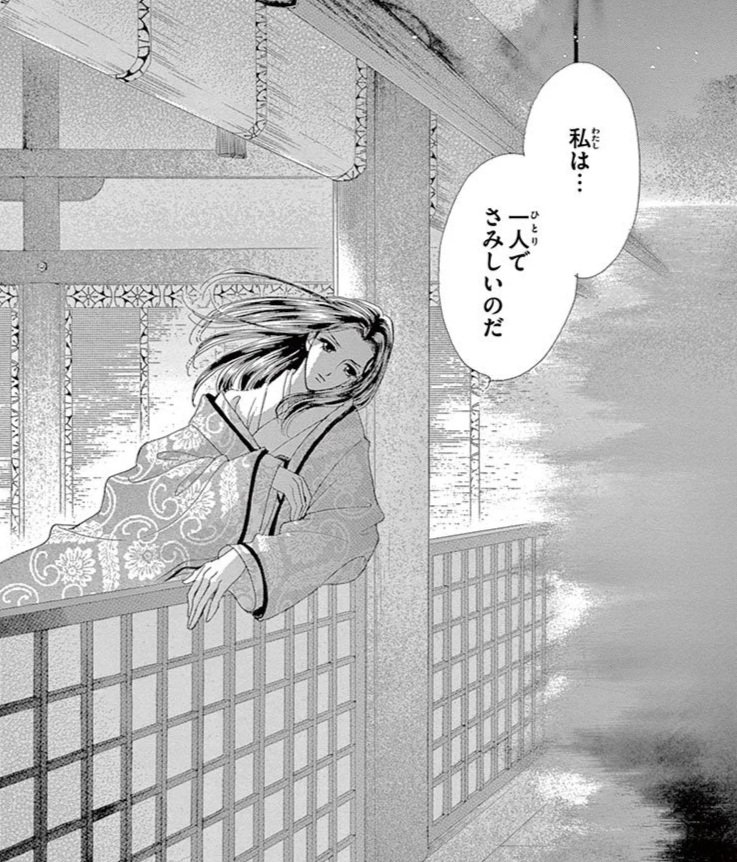
Sara leans out under rolled blinds, like his counterpart in an earlier scene.
Cropped panel from volume 6, page 79. ©Chiho Saito/Shogakukan
But the opposite also happens: simplifying events from Torikaebaya monogatari. When reading through the story again, I was reminded of just how much it goes back and forth between a limited number of locations. The chunagon (Sara’s counterpart) goes to Yoshino several times and spends quite a while there, though only three of these trips are described in detail. In Torikae baya, Sara does not visit Yoshino apart from those three times: he first goes with Togu and her entourage, then again after discovering his pregnancy, and one more time once he is reunited with Suiren. Only the last one appears to be a lengthy stay. This gives him time to go to other places instead, like when he and Tsuwabuki are sent to hassle greedy governors and when he works on the banks of the Kamogawa. This serves the same purpose as the example of the expanded section: paring down a recurring element to key moments keeps those moments narratively and visually exciting, and frees up opportunities for fun additions elsewhere.
Similarly, after the incident between the chunagon and the saisho no chujo (Tsuwabuki’s counterpart) in Torikaebaya monogatari, the chunagon goes twice to the house of his former wet nurse, both times being secluded for a while as the saisho no chujo comes to see him. He then finally goes to Uji, and the saisho no chujo is called away multiple times to check on the chunagon’s wife.
It all feels a bit repetitive, and it seems like Saito had the same impression! Torikae baya still sees Sara visit Aguri’s home twice, but the first is specifically to avoid seeing Tsuwabuki, and the second is to indirectly seek pregnancy advice. He doesn’t spend very long there, and he heads for Uji right after the flower viewing party, whereas his counterpart in the original hangs around in Heian-kyo for quite some time after that. Moments that take place between the chunagon and saisho no chujo at the wet nurse’s house are largely shifted to Uji – for example, when Sara sadly recites a poem in Uji, it seems to be combined with a scene originally set earlier – and some are omitted entirely. This approach helps eliminate some redundancy and make each visit to a different location feel like a clearly defined part of the story.
These are just a few examples of how Saito streamlines the story in her adaptation. Sometimes this approach contrasts with points where new material is added, but often these methods go hand in hand. Overall, it all helps the story fit into a medium where so much needs to be told through visuals and the narrative needs to be paced within a strict format and schedule.
Come back next time to see some interesting examples of where Saito does follow the original story pretty closely!