
Blogging about my Torikae baya manga translation project.
Summary and observations on Volume 9: Repercussions all round!
The summaries continue today, now moving to Volume 9, which largely revolves around the fallout from Suiren (now “Sara”) being caught trying to visit Togu at the end of the previous volume.
The summaries continue today, now moving to Volume 9, which largely revolves around the fallout from Suiren (now “Sara”) being caught trying to visit Togu at the end of the previous volume. Most directly, the incident results in Suiren’s banishment from the capital. The Emperor has heard what happened, and despite his sympathy for “Sara”, tells Suiren she must “die” in political terms until the time is right, much like Yoshino no Miya once did. Sara would rather take responsibility – it was his idea after all – and so after evading punishment, he voluntarily takes a break from palace life.
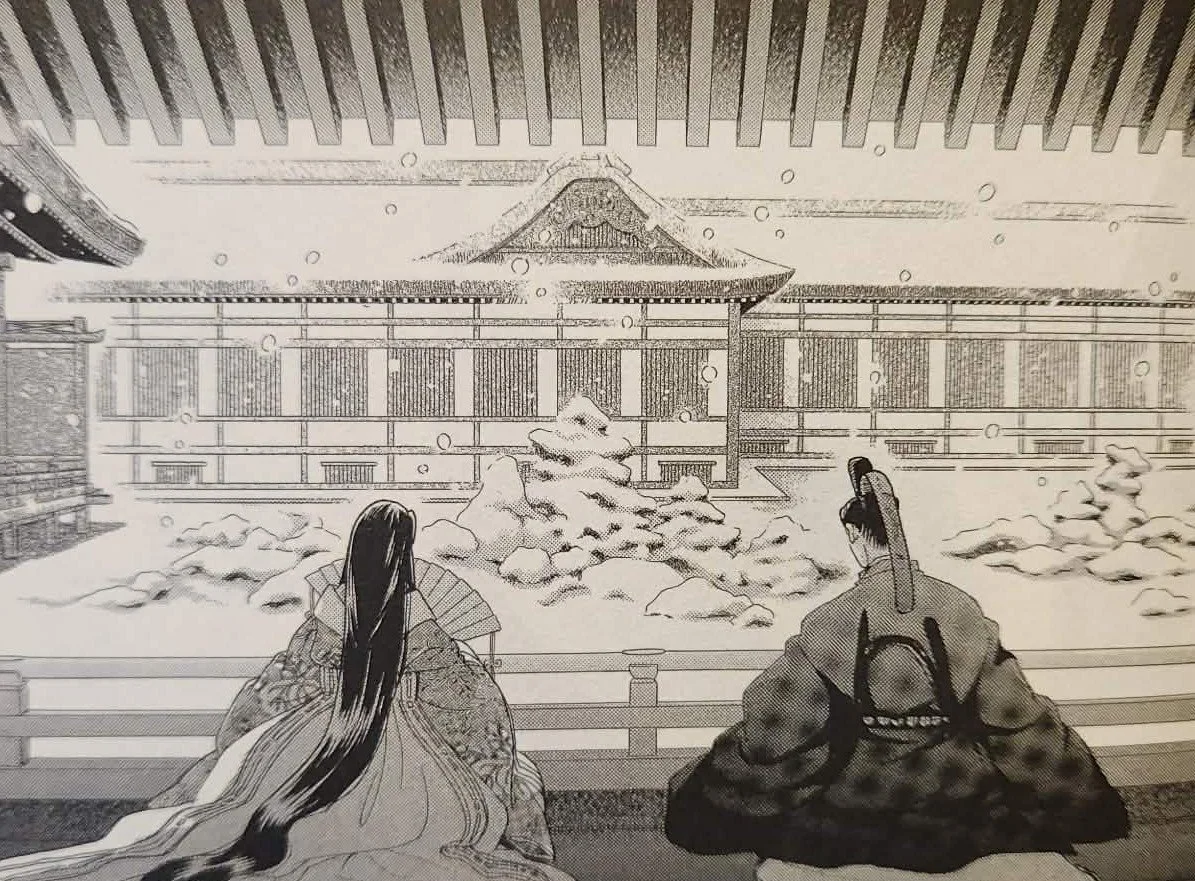
Sara (left) and Suiren (right) wait to hear the consequences of Suiren’s attempted visit to Togu.
Panel from volume 9, page 21. ©Chiho Saito/Shogakukan
The situation has an impact on other characters too. Shi no Hime was aware that her “husband” had feelings for another woman, but it’s harder to maintain their sham marriage now she knows who the woman is and her now disgraced husband isn’t even around. That means she doesn’t put up much of a fight when her father Kakumitsu decides she should go and marry the governor of Settsu instead – but when she’s on the way to Sumiyoshi, there’s a twist! Her tempestuous former lover Tsuwabuki shows up on a horse and reveals that Kakumitsu plans to keep one of her children and give the other up for adoption. Tsuwabuki finally brings her back to face Kakumitsu, thwarts the send-her-away-to-Sumiyoshi scheme, and declares his intention to marry Shi no Hime himself.
Back at court, things haven’t really settled down. Togu is still under pressure, and despite having returned to work briefly, she isn’t in the best of health either. The Emperor finally agrees with Suzakuin that something must be done, and announces plans to replace Togu. Talk soon turns to who that replacement should be, with names like Yoshino no Miya (unlikely) and even Tsuwabuki (absurd) being thrown around. In the end, Shikibu-kyo no Miya brings up a prince nobody has ever heard of called Yuzuru, and makes mysterious eye contact with a weird monk…
Meanwhile, the Emperor still isn’t over Sara. When Suzakuin suggests that he find a new wife and maybe finally have a son to be his heir, the only woman the Emperor can imagine choosing is “Suiren”. Sara’s mother Nishi is aware of this too, and suggestively gives Sara training in women’s work just in case he ever gets married. But when Sara hears about Togu, he drops everything to pray for her in Kurama, only to discover signs of a plot against the Emperor. One he gets back, he is invited back to work… but this turns out to be in a new position as the Emperor’s naishi no kami.
Some more noteworthy points:
When Shi no Hime heads off for Sumiyoshi, she gets as far as Yamasaki no Tsu, a port along the Yodogawa near the site of the ill-fated previous capital Nagaoka-kyo. Tsuwabuki is in a position to hear that she’s there because he is carrying out Sara’s old river management job, which he offered to take over all the way back in Episode 23. He then whisks Shi no Hime away to his villa in Toba, not too far away.
Sara actually meets Shi no Hime in this volume! They bump into each other at a hanami party shortly after it emerges that Shi no Hime is getting back together with Tsuwabuki. Just as the flowers are giving Sara bittersweet reminders of his former marriage, Shi no Hime says that the old days were happy “like a flower”. You may remember that while Tsuwabuki is “like an autumn storm” to Shi no Hime, Sara has often been compared to spring and flowers, so this passing comment really tugs at Sara’s heartstrings.
Keep an eye on the monks! Two characters who become important over the next few volumes appear to make early appearances in Volume 9. One shows up at the Tango no Sekku festival in Episode 44, though he hasn’t been properly introduced just yet, and I’m pretty sure the priest who serves Sara in Kurama in Episode 45 is the same one who appears in the second-last volume to play a big role.
Digression: Who’s who in Torikae baya? Part 2
I’m stepping away briefly from my summaries of volumes 8-12 to unveil a new addition to the Extras page! The new page is for a kind of character relationship chart (something I realise I first hinted at doing over a year ago…) and you can find it here.
I’m stepping away briefly from my summaries of volumes 8-12 to unveil a new addition to the Extras page! The new page is for a kind of character relationship chart (something I realise I first hinted at doing over a year ago…) and you can find it here.
Each tankobon volume of Torikae baya, beginning with the second, kicks off with a diagram of the most important characters in the story and their relationships to one another, with short introductions of each character and a plot synopsis to bring readers up to speed. These are very handy, but there are a couple of downsides: they only include certain characters at one time, thereby leaving out some of the relationships, and there are plenty of characters who are never deemed important enough to appear. And so I thought that for followers of this project, it would be nice to have a bigger version of one of these.
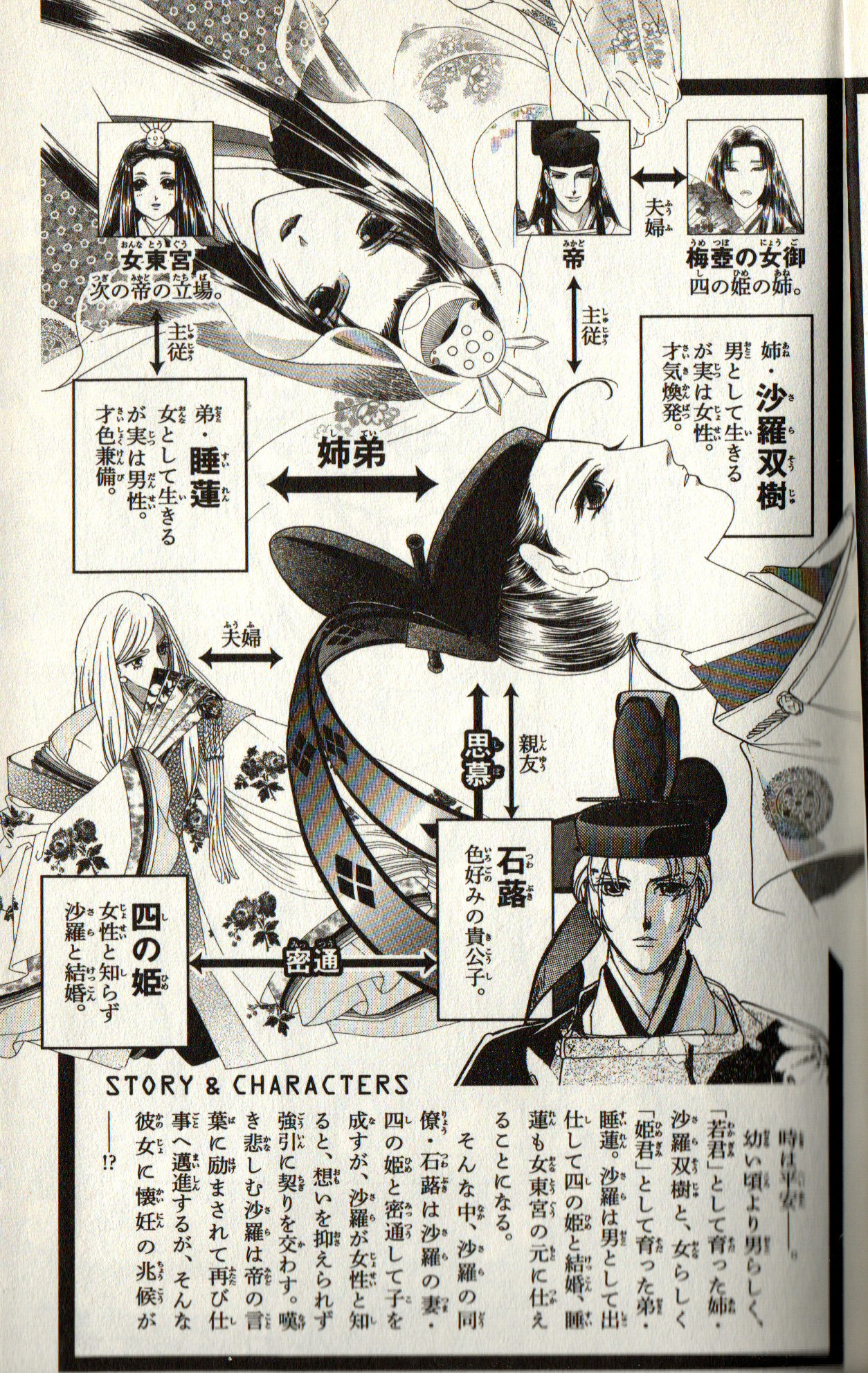
The character relationship chart included at the beginning of the fifth volume.
From volume 5, page 3. ©Chiho Saito/Shogakukan
I fantasised about showing off the true madness of Torikae baya’s web of relationships via a big, unwieldy chart in the same format as those ones, like mapping out a wild conspiracy theory. In the end, I just didn’t have the technical skills (or the patience to gain the technical skills) to assemble something like that and have it actually work, so I settled on a different format. In my chart, each character has a profile card with their name, picture and introduction noting their main relationships, and you can click on the related characters to jump to their card. It even works reasonably well on mobile!
Here, I want to just say a bit more about some aspects of the chart. First, it doesn’t include absolutely everyone. 31 characters are included at this point in time, which covers just about every recurring character referred to by a name or title. There are others I might include later, like Suiren’s male attendants. The problem with them is that only two (maybe three?) are clearly referred to by name. To make things easier to follow in the translation, I have plans to assign nicknames to nameless recurring characters – this will probably also happen with “Umetsubo’s maid” – so perhaps those guys will be included on the list once I’ve done that. On the other hand, two past emperors are mentioned in the manga, and their connections to known characters are obviously important in the story, but we never see their faces – should they be added too?
There is a system of icons for easy indication of common relationship types. Some types of relationship (for example “political supporter”) just don’t come up often enough to get an icon, so those go in the little introduction instead. Meanwhile, some relationships are one-way, which is why Sara is “🤝💖” in Tsuwabuki’s eyes and Tsuwabuki is “🤝” in Sara’s (awkward). Also, characters like Sara, who have some kind of connection to just about everyone, don’t have every single one of those relationships listed in their profile. Kakumitsu is just as closely related to Suiren as to Sara, but Kakumitsu and Suiren don’t have very much to do with each other, so I left out that link.
Similarly, I don’t get too much into the nitty gritty of how relationships change and when. The “>” shows that it doesn’t happen right when the character first appears, but what is “late” in one character’s story could be early in another’s. And even though there are some spoilers in there, I omit some of the final developments, especially if the general direction of change is already indicated.
Anyway, I hope this new addition is a useful resource! In other news, I’ve also made a few updates to the map (with a few more yet to come) and brought the timeline up to date as of the end of Volume 8. And actually, I spotted a mistake in the timeline while I was working on this: the kidnapping incident doesn’t take place six years into the story, but six years after Sara and Suiren first meet. I now estimate that they’re probably about ten years old when they go to Kurama. This might not matter an awful lot, but who knows?
Summary and observations on Volume 8: New relationship drama for Sara and Suiren
This is the first of five posts summarising the volumes of Torikae baya that cover the period after the siblings’ big switch and before the manga’s conclusion. Something to bear in mind as we go on is that although I’ll continue to refer to Sara and Suiren as the characters we know, most people at court think that each sibling is the other – making everything a bit confusing!
At the end of Volume 7, Sara was working as Togu’s naishi no kami alongside San no Hime, and getting the first inklings that he might have a thing for the Emperor. That situation and its ongoing developments take centre stage in Volume 8.
This is the first of five posts summarising the volumes of Torikae baya that cover the period after the siblings’ big switch and before the manga’s conclusion. Something to bear in mind as we go on is that although I’ll continue to refer to Sara and Suiren as the characters we know, most people at court think that each sibling is the other – making everything a bit confusing!
At the end of Volume 7, Sara was working as Togu’s naishi no kami alongside San no Hime, and getting the first inklings that he might have a thing for the Emperor. That situation and its ongoing developments take centre stage in Volume 8.
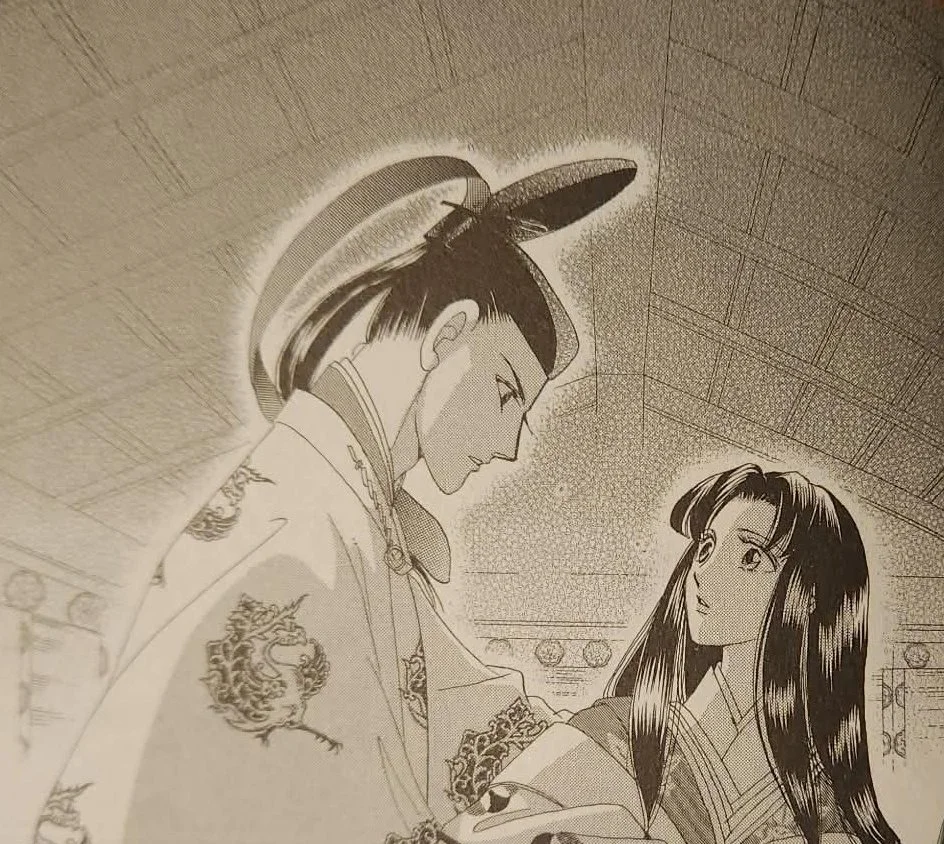
Cropped panel from volume 8, page 79.
©Chiho Saito/Shogakukan
Ahead of a party for the Tookanya festival (on the 10th day of the 10th month), Togu suggests that Sara could perform the koto for the Emperor at the event. In spite of Suiren’s best efforts to teach Sara previously, Sara isn’t much good at it, and sadly plays the flute by himself; the Emperor overhears this, remembers how Sara used to play, and turns his thoughts towards “Suiren”. His interest only increases following the party, where he catches Sara in his arms after a convenient gust of wind.
Despite this, Sara continues to deny having any romantic feelings towards the Emperor. He and San no Hime – who thinks the two naishi no kami are friendly rivals – prepare to dance to celebrate the Niinamesai ceremony, despite being older than the usual performers. Sara feigns illness to let San no Hime get the attention instead, but the Emperor is undeterred. The situation gets thornier, with Sara attempting to put him off by claiming to be unable to bear children, then avoiding him, which results in the Emperor declaring that he won’t allow any other man to marry “Suiren” – if he can’t have Sara, nobody can. To cap it off, the Emperor later sends Sara a gift of red maple leaves just after their time had passed, a gesture that reminds Sara of the unseasonally blooming cherry branch he once sent, and makes Sara realise he really does love the Emperor after all.
Meanwhile, the real Suiren just wants to be with Togu, but is in no position to make this happen. Kakumitsu convinces Suiren to meet again with Shi no Hime, who has now had enough of Tsuwabuki and his shenanigans, and is suddenly eager to have a “real” relationship with her husband. Suiren fights off her advances by admitting to having feelings for somebody inaccessible, but agrees to superficially maintain their marriage.
Of course, Togu hears about this and so that relationship becomes awkward too. And after Togu falls ill and goes to convalesce at her father’s home, Sara decides that a proper meeting between Togu and Suiren would cheer them both up. He organises an opportunity for a night-time visit at the end of the volume, but unfortunately an unwitting San no Hime once again demonstrates her security skills by catching Suiren and alerting the guards.
Some other details and stray observations:
I noted once before that Saito expressed a preference for avoiding giving explicit names or job titles to original characters, but still ended up doing it a bit anyway. At this point in the manga, there is much more original material altogether, as it departs quite significantly from the post-switch story beats of Torikaebaya monogatari. With that seems to come a greater willingness to have a bit of fun, even with the aspects that Saito felt unqualified for. I feel the use of archaic vocabulary and historical spelling rules increases in this volume, especially in chapter titles (for example Episode 36 is titled 相逢, with the furigana あひあふ and read as あいあう), and it seems like dialogue also features older conjugation rules more frequently than before.
The Niinamesai is an event connected to the rice harvest, and one where the gosechi dance is performed the next day. San no Hime is so eager to be one of the dancers because it offers a chance to catch the Emperor’s eye, and her strategy is so obvious that other women bring up Fujiwara no Takaiko, who performed the dance and later became Empress.
San no Hime’s blatant attempts to get close to the Emperor also invite remarks that she should just be his naishi no kami instead – remember that explanations about the naishi no kami’s job usually assume that she serves the Emperor rather than the crown prince!
One more point about San no Hime is that she aids in my efforts to track the timeline by saying in Episode 38 that she is 23 years old. Incidentally, she also suggests that this makes her a Christmas cake by the standards of the time.
Her sister Shi no Hime sends Tsuwabuki away with his tail between his legs early in the volume. He is, of course, the father of both of her children, and he refers to the newest child as Sakuyahime. However, when Shi no Hime meets Suiren (believing she is being reunited with Sara), she calls the child Tamakohime, and says she alone named her – another (frankly deserved) punch in the gut for Tsuwabuki!
Sara is inspired to offer Togu and Suiren a meeting together after stumbling upon Suiren’s writings and realising that they show the strength of Suiren’s feelings towards Togu. Not for the first time, it sounds like Suiren is basically writing the same story we’re reading, or something very similar.
Thoughts from Episode 35: Naishi no kami
I’m back for the final chapter before the volumes I’m skipping over! (I explain that plan a bit more here) At this point in the story, Sara and Suiren are settling into their new roles as each other, but there’s a catch: their personalities seem to have changed since before they went missing. Men at court think that “Sara” is no longer as bright and fun as he was, and suspect it is because of Shi no Hime and Tsuwabuki’s affair; meanwhile, the returning “Suiren” doesn’t seem like the modest, ladylike individual San no Hime has heard about. Now fearful of raising suspicious, both Sara and Suiren take extra care about how they come across as they deal with the drama of this chapter.
I’m back for the final chapter before the volumes I’m skipping over! (I explain that plan a bit more here) At this point in the story, Sara and Suiren are settling into their new roles as each other, but there’s a catch: their personalities seem to have changed since before they went missing. Men at court think that “Sara” is no longer as bright and fun as he was, and suspect it is because of Shi no Hime and Tsuwabuki’s affair; meanwhile, the returning “Suiren” doesn’t seem like the modest, ladylike individual San no Hime has heard about. Now fearful of raising suspicious, both Sara and Suiren take extra care about how they come across as they deal with the drama of this chapter.
And what is that drama? In Episode 32, there was an intruder in Togu’s quarters, resulting in San no Hime coming in as a new naishi no kami, and this time, they get a lead on who the intruder could be. Sara first seeks Suiren’s help, before revealing the investigation to San no Hime, and in the end, the two naishi no kami work together to catch the perpetrator.
During a party to celebrate their success, San no Hime gets lightly wasted on Fushimi’s finest* and tells her new friend Sara about her childhood and how she only came to live with her father in Heian-kyo after her mother died. She also reveals that she dreams of marrying the Emperor and finally providing him with a male heir – and though Sara is nice about it, he begins to have conflicted feelings.
Since returning to the palace, Sara has had to contend with the fact that another naishi no kami is already there. In Episode 34, his strategy for dealing with the Amatsukitsune – with assistance from Suiren and Yoshino no Miya – helped him get accepted by Togu, and this time his working relationship with San no Hime improved. At the end of it all, both Sara and San no Hime remain in post as Togu’s naishi no kami.
So what is a naishi no kami? I haven’t really said much about this, other than that the naishi no kami (尚侍) is an attendant that Willig called the “Maid of Honour” in her translation**. The naishi no kami obviously plays a big part in Torikaebaya monogatari, being the job of both main characters one after the other, and later in the manga, Saito even has Sara become the naishi no kami to somebody else. It’s an important role, and not one that Saito would’ve expected readers to know much about, so she uses the manga volume afterwords to provide some extra information.
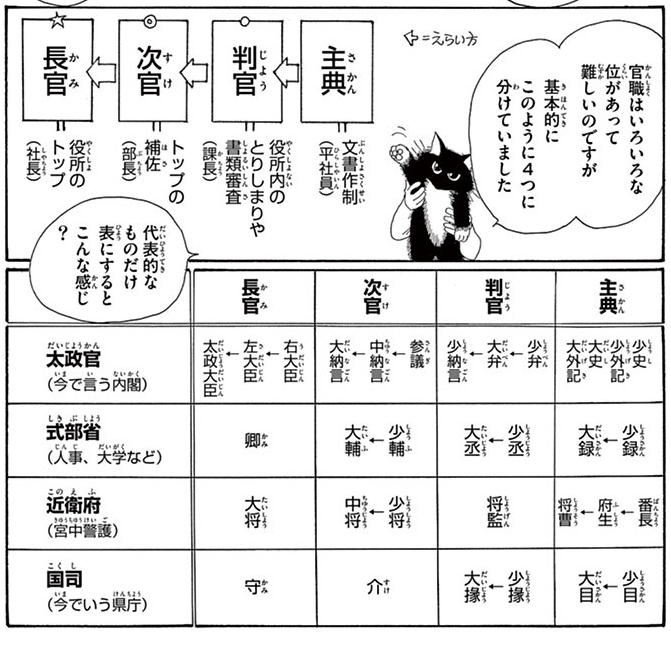
Chart from volume 4, page 184.
©Chiho Saito/Shogakukan
First, in the Volume 4 afterword, we see a chart broadly dividing court positions into different ministries and ranks. Kami (長官, but also spelt with other kanji depending on government ministry) refers to those people in the highest positions in each section. And on the next page, Saito goes on to clarify that the naishi no kami is the kami of an office called the naishi no tsukasa. They were between the junior fifth rank and junior third rank at court, and there could be up to two of them. They had responsibility for relaying the Emperor’s messages, and with time, the position became nearly as important as the Emperor’s consorts, often being a pathway for young women of influential families to become consorts themselves.
The Volume 10 afterword, coming just after Sara’s new appointment which I hinted at earlier, offers more detail about what the job entails. A bit like a senji, the naishi no kami was like a private secretary to the Emperor. She would present him with proposals from ministers, then record his decisions, and she would inform others of his requests. But she also had other responsibilities like helping him with eating and bathing, and as kami of the naishi no tsukasa, she kept the other palace ladies in check.
Much of this matches what happens in Torikae baya. Though Suiren (and then Sara) is employed as naishi no kami not to the Emperor but to his planned successor, we see a lot of these other details, and they often impact the story. For example, Suiren’s early anxieties relate to the expectations of the job and the ideas people have about it. She worries about being able to take responsibility within Togu’s staff and is embarrassed about the prospect of providing more intimate assistance. She becomes a target of Umetsubo’s jealousy, and the Emperor does eventually seek to make her one of his ladies. As Sara takes over the job and then moves to another similar post, these same kinds of challenges rear their heads again. And even that throwaway point from the Volume 4 afterword about the number of positions available turns out to be significant when he runs into the other naishi no kami San no Hime!
As Volume 7 comes to an end, everything is basically in place for the latter parts of the story. Suiren is now “Sara”, working as a court official, and Sara is now “Suiren”, established as one of Togu’s two naishi no kami. There is an ongoing movement to unseat the current Togu – taking power away from somebody ill-equipped for it in the eyes of her opponents, or relieving her of a great burden in the eyes of her allies – but still no real alternative. And finally, Sara is starting to wonder whether his admiration for the Emperor is really just respect for his former employer.
But I will not be translating volumes 8-12, at least not for this project. With that in mind, rather than doing generally one blog post per chapter, I’ll write a few posts covering the plotlines of one volume at a time, with some observations along the way. And hopefully, I’ll soon fit in a chance to put up the big character chart I’ve been threatening to make!
*I do realise that sake production in Fushimi came later, but just let me have this one!
**Interestingly (and surprisingly!) Willig’s translation was recently republished, this time without the previous title of The Changelings. The old one was out of print for quite a while, so this is a good chance to read it.
Thoughts from Episode 34: The sky is falling
The cliffhanger last time saw Sara, now ready to take over Suiren’s old position as naishi no kami, coming face to face with San no Hime (daughter of Kakumitsu and sister of Sara’s former wife Shi no Hime). It soon emerges that in the wake of the invasion of Togu’s quarters, Kakumitsu had most of her existing staff dismissed in favour of San no Hime and her attendants, leaving Togu isolated and distrustful. When Sara finally gets to see her in private, she quickly confirms that he is not the Suiren she knows, and San no Hime takes him away.
Just as Sara and Suiren are scrambling for a solution, an ominous falling star appears in the night sky. Suiren seeks advice from Yoshino no Miya, who writes back telling them that it will recur for three nights. The siblings then devise a plan.
The cliffhanger last time saw Sara, now ready to take over Suiren’s old position as naishi no kami, coming face to face with San no Hime (daughter of Kakumitsu and sister of Sara’s former wife Shi no Hime). It soon emerges that in the wake of the invasion of Togu’s quarters, Kakumitsu had most of her existing staff dismissed in favour of San no Hime and her attendants, leaving Togu isolated and distrustful. When Sara finally gets to see her in private, she quickly confirms that he is not the Suiren she knows, and San no Hime takes him away.
Just as Sara and Suiren are scrambling for a solution, an ominous falling star appears in the night sky. Suiren seeks advice from Yoshino no Miya, who writes back telling them that it will recur for three nights. The siblings then devise a plan. On the third night, Sara advises Togu to copy sutras in the Daigokuden, where priests are doing the same; Suiren appears and they convince Togu by discreetly confirming her suspicion that they have switched places. When the meteor is gone the following night – just as Yoshino predicted – this happy outcome is attributed to Togu’s efforts. As a consequence, Sara cements his position as (one of) Togu’s trusted naishi no kami, and the Emperor resolves to continue backing Togu.
Among the interesting little details in Episode 34 is the casual identification of a now-former member of Togu’s staff as “Senji no kimi” (宣旨の君). Senji here refers to a high-ranking female servant of an emperor, crown prince, regent, etc, who was something like a chief secretary. This character worked alongside Suiren throughout her time as naishi no kami, making appearances in more than ten chapters by my count – so why did it take until now for her to be referred to by rank? Well, that’s because the same thing happens in the source material! When the siblings return to court after their switch, there’s an abrupt mention of a “senji no kimi”, and then one more reference later adding that she is the daughter of Togu’s late mother’s wetnurse (that is, she was to Togu’s mother as Torako and Toramitsu are to Sara). I don’t know whether this version of Senji is that accurate to the original, but I do have a feeling that Saito discovered late on that this character existed and probably corresponded to the one she’d already included up to this point. Anyway, this all means that Suiren’s former colleague is actually one of the very few characters specifically identified in the original Torikaebaya monogatari!
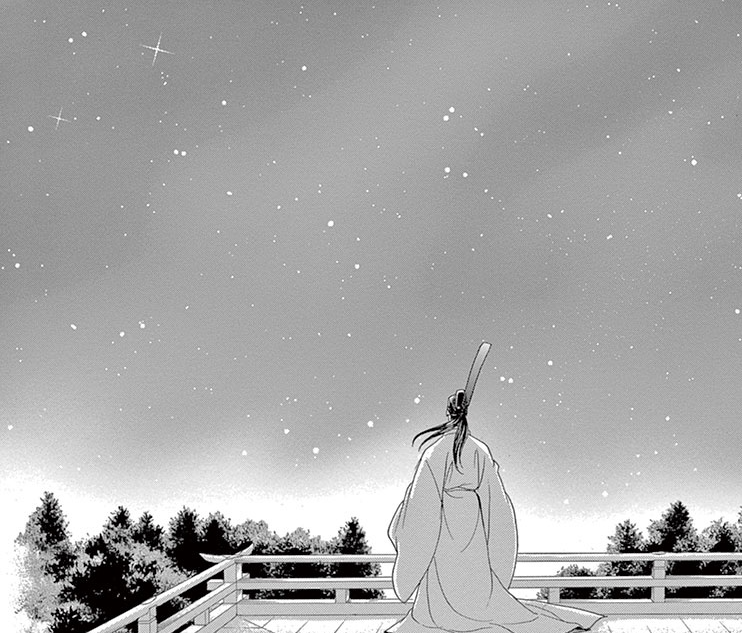
Panel from volume 7, page 146.
©Chiho Saito/Shogakukan
This chapter also returns us to the Daigokuden, an important palace building atop which Sara, Tsuwabuki and the then-Togu confronted another astronomical phenomenon all the way back in Episode 3. The now Emperor even points out the significance of warding off two bad omens in the same building, bringing memories flooding back for Sara.
But the similarities between these events don’t stop there. While the eclipse was tied to Sara’s frightening visions of a tengu threatening to devour the sun/Emperor, the falling star in Episode 34 has a name that is also connected to tengu myths: Amatsukitsune (written 天津狐 in Torikae baya), meaning “heavenly fox”. When I wrote about the eclipse the first time, I mentioned the tiangou, a Chinese mythical dog said to eat the sun. The earliest appearance of the word 天狗 (which we read as “tengu”, at least now) in Japan is in the Nihon shoki, an important history book of the 8th century CE, where it refers to an ominous star crossing the sky from east to west, its naming clearly influenced by those earlier Chinese legends.
With time, what was once imagined as a dog far up in the sky became a birdlike entity a bit closer to earth. But more importantly, glosses used to guide readers in how to understand the Classical Chinese of the Nihon shoki in the local language give us the pronunciation “amatsukitsune”. That means that the meteor that appears in this chapter of Torikae baya is a specific phenomenon recorded in the earliest Japanese histories, which is closely tied to the developing legends of the tengu. And considering Yoshino’s apparent connection to the tengu in the story, it might not just be his scientific knowledge that allows him to give such convenient advice about the Amatsukitsune.
We’re now very close to the point where my translation skips ahead to the final volume, but I’m afraid I’ll have to make you wait a bit longer! I’m taking a break next week, so my post about Episode 35 will probably come in two weeks’ time. See you then! 👋
Thoughts from Episode 33: Life is but a dream
Episode 33 begins with the image of a tengu, appearing in Marumitsu’s dreams as a voice informs him that his children’s karmic debts have been repaid and they will return shortly. He then wakes up to learn that it’s true! Sara and Suiren are back to pick up each other’s lives where they left off, and their parents are overjoyed.
The news of their return soon reaches others: Kakumitsu, who is persuaded to take Shi no Hime and her children back in, and Tsuwabuki, who is too shocked about “Sara” coming back to even think about Shi no Hime. Tsuwabuki makes his way to the palace on the day Suiren arrives to take over Sara’s old job, approaching Suiren with his typical degree of discretion and earning himself a kick in the head. Later, the Emperor receives Suiren and expresses his relief that “Sara” is back at court.
Episode 33 begins with the image of a tengu, appearing in Marumitsu’s dreams as a voice informs him that his children’s karmic debts have been repaid and they will return shortly. He then wakes up to learn that it’s true! Sara and Suiren are back to pick up each other’s lives where they left off, and their parents are overjoyed.
The news of their return soon reaches others: Kakumitsu, who is persuaded to take Shi no Hime and her children back in, and Tsuwabuki, who is too shocked about “Sara” coming back to even think about Shi no Hime. Tsuwabuki makes his way to the palace on the day Suiren arrives to take over Sara’s old job, approaching Suiren with his typical degree of discretion and earning himself a kick in the head. Later, the Emperor receives Suiren and expresses his relief that “Sara” is back at court.
Finally, the real Sara shows up at the Nashitsubo pavilion with Torako and other attendants to begin work as the naishi no kami… only to meet another naishi no kami: Kakumitsu’s daughter San no Hime.
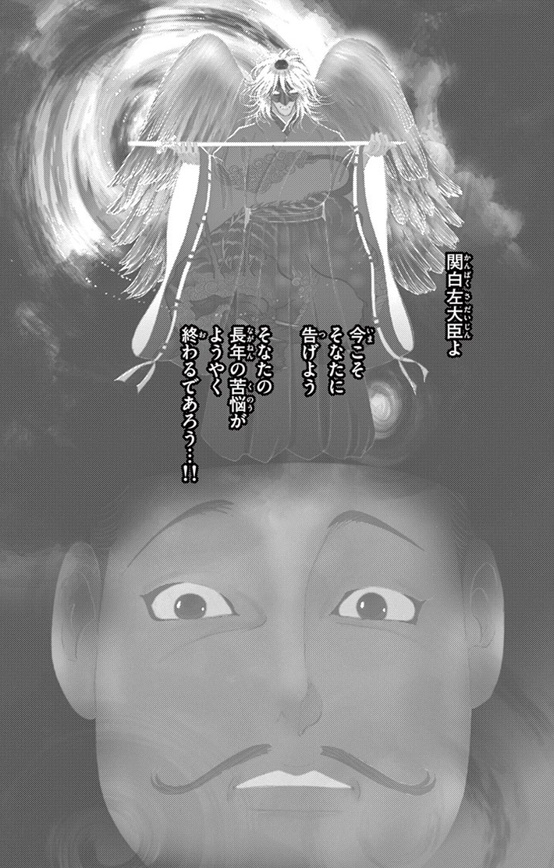
Marumitsu dreams of the tengu.
From volume 7, page 77. ©Chiho Saito/Shogakukan
And so, the big switch that Sara and Suiren prepared for last time is now complete. Marumitsu’s dream at the start of this chapter is, of course, equivalent to a key scene in the Heian period tale – a scene that I never tire of pointing out as the only time a tengu is mentioned in the source material. As such, I devoted quite a bit of time to working out how this scene is adapted and how to put that into English. Broadly speaking, it stays quite close to the original scene, though the visual focus is on the tengu, whereas the original suggests that Marumitsu only sees a priest who tells him about the tengu. Of the different versions, Saito’s wording is probably closest to Kuwabara Hiroshi’s modern Japanese translation, but with the notable distinction of omitting any specific mentions of the man’s children and their genders. Therefore, where other versions clearly state “[the tengu] changed the boy into a girl, the girl into a boy” and “the man will be a man and the woman a woman” (both from Willig’s translation), the manga avoids saying quite what the punishment was and quite what the remedy is. In fact, Marumitsu doesn’t seem certain either – the dream voice tells him “all things should soon settle rightly into their right places” and he then wakes up wondering what “rightly” (しかるべき) was supposed to mean.
Even apart from this big moment, references to dreams loom pretty large in Torikaebaya monogatari. Willig characterises the tale as a giko monogatari, a genre that is openly derivative of existing courtly literature (particularly The Tale of Genji) and notes “dreams” as one of the genre’s typical themes. One of the main ways this comes across in the original text is the many moments where an incident is described as “like a dream” (or some similar variation). The “dreamlike” description is applied frequently but not exclusively to dubiously consensual sex scenes, which I imagine has some connection to the figuratively and literally murky reality of courtship among the Heian nobility. I could swear I’ve read about this phenomenon occurring in other Heian literature too, but I couldn’t come up with a source on it today. Torikae baya, being in a visual medium, doesn’t reflect this tendency so much, but there is a moment early in Tsuwabuki’s affair with Shi no Hime when he wonders sadly if their night together was just a “sweet dream” never to reoccur.
Dreams are also associated with Yoshino no Miya in both the source material and the manga, with dream interpretation being one of his many areas of mystical knowledge. When the chunagon first leaves for Yoshino in the original story, he tells people he needs to take a break on the advice of a dream interpreter. This is apparently meant to put them off his scent, which I must say seems a bit counterintuitive, but at least it shows that people were taking dream interpretation very seriously! Anyway, it makes sense that Yoshino is an expert on these matters, as he serves an important role in the story as somebody with knowledge of the past and future and of the siblings’ secret. This is especially important in the manga, where he’s also closely associated with the tengu. Incidentally, Willig suggests in passing that he is connected to Marumitsu’s dream in the original story too, but so far I’ve found nothing to back this up.
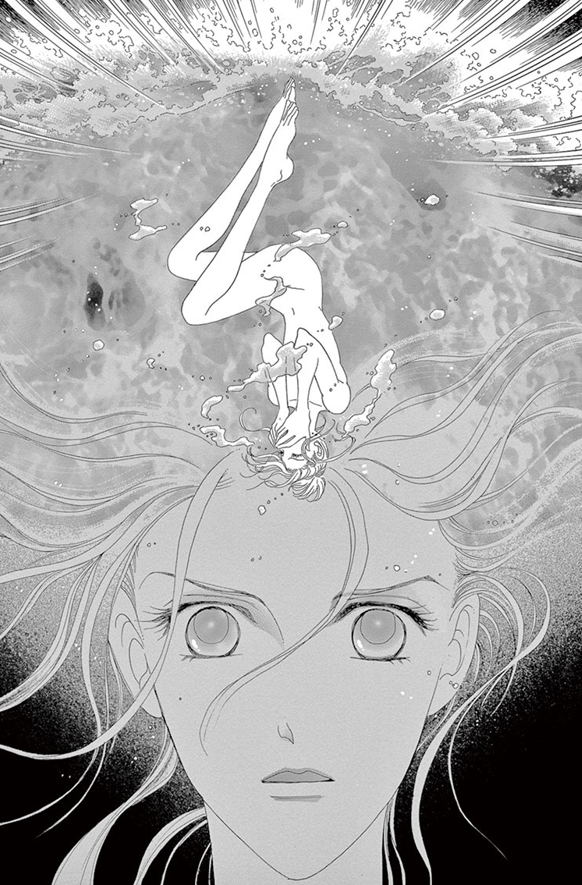
Sara dreams of drowning.
From volume 4, page 57. ©Chiho Saito/Shogakukan
Anyway, in the Torikae baya manga, the most common references to dreams are just dreams themselves! In Episode 3, Sara dreams about the “tengu” that kidnapped him and Suiren as children, and indicates that isn’t the first time. This dream shakes up the narrative of the story by revealing the idea of the tengu’s curse much earlier and treating it as something that weighs on the siblings’ minds, and because it is also a premonition of the eclipse incident, it gives Sara an early emotional connection to the future Emperor. And when things go wrong later, he and Suiren both suffer from nightmares: after his night with Tsuwabuki, Sara dreams that he is drowning (foreshadowing his suicide attempt in Uji), and following Sara’s disappearance, Suiren is plagued with confused thoughts about where he has gone and why. Similar moments occur later in the series too, including ones that call back to earlier dreams.
Altogether, I find that all these dreams – the ones experienced by the characters and the passing allusions to dreaming – serve two main purposes. In the overall narrative, they help to tie things together, giving the reader hints of what is to come and providing some explanation for events. But maybe more importantly, they contribute to a sense of ambiguity. The characters and the reader can’t always tell what is real, and distinctions aren’t always clear-cut. And as Togu suggests when she gazes out on the aptly named Yume no Wada and can’t help but quote the Man’yoshu, dreams and reality may not be so far apart.
Thoughts from Episode 32: Trading places
The manga reaches a key turning point in the story now, as Sara and Suiren plan their return to the capital to fill each other’s former roles. They teach one another how to look and behave to avoid suspicion, and Yoshino no Miya helps Suiren overcome her anxiety around men.
But what Episode 32 concentrates on mostly is events in Heian-kyo. In an effort to alleviate Marumitsu’s stress, the Emperor declares that he is rescinding his request for Suiren’s hand in marriage – much to the jealous Umetsubo’s delight. Meanwhile, Kakumitsu tries to have his as-yet unseen daughter San no Hime installed as Togu’s naishi no kami, but Togu rejects him, wanting to wait until Suiren recovers from her alleged ailment.
The manga reaches a key turning point in the story now, as Sara and Suiren plan their return to the capital to fill each other’s former roles. They teach one another how to look and behave to avoid suspicion, and Yoshino no Miya helps Suiren overcome her anxiety around men.
But what Episode 32 concentrates on mostly is events in Heian-kyo. In an effort to alleviate Marumitsu’s stress, the Emperor declares that he is rescinding his request for Suiren’s hand in marriage – much to the jealous Umetsubo’s delight. Meanwhile, Kakumitsu tries to have his as-yet unseen daughter San no Hime installed as Togu’s naishi no kami, but Togu rejects him, wanting to wait until Suiren recovers from her alleged ailment. As Kakumitsu abandons decorum and complains openly about Togu, a shady bunch of vice ministers plot to get rid of her, ideally in favour of Shikibu-kyo no Miya. By the end of the chapter, they put their plan into action, with a man showing up in Togu’s bedchamber, thus exposing lax security in the Nashitsubo pavilion, stirring up gossip about Togu, and making Kakumitsu even more determined to restructure Togu’s staff.
Something we see quite a bit of at this stage in the manga, roughly between Episodes 31 and 34, is use of the verb とりかえる (to exchange, trade, substitute, etc). As that is indeed the verb used in the title of the story, you might think that isn’t so strange, but until now it’s been used sparingly. It appeared back in Episode 1, first when Marumitsu laments that things would be so much simpler if his children’s personalities were the other way around, and then a few times specifically in reference to the siblings trading outfits in order to escape the tengu bandits. That chapter ends with this scene:
SARA and SUIREN, both looking the same in their nightclothes and with their hair down, examine the clothes together.
SUIREN I never liked these boys' clothes,
but now that I know I'll never put my arms through those sleeves again,
I felt the desire to see the genpuku outfit...
SARA I feel the same way.
I wanted to properly say goodbye to my life as a girl...
...
Shall we switch clothes one last time?
Your mogi outfit,
and my genpuku outfit.
And aptly, we also say goodbye to the word とりかえる. The only time it is used again between Episode 1 and Episode 31 is when Marumitsu repeats his opening line in the new context of marriage discussions surrounding both Sara and Suiren.
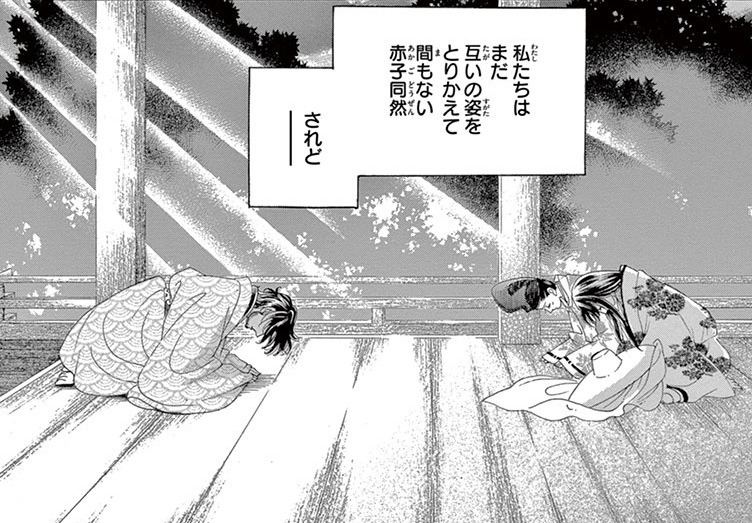
Panel from volume 7, page 74.
©Chiho Saito/Shogakukan
I find it very interesting that it takes so long for とりかえる to re-emerge, and that this is the first time Sara and Suiren talk about switching their positions or appearances, rather than just their clothes as in Episode 1. While readers might be tempted to think of the early decision to give Sara a genpuku (boys’ coming-of-age ceremony) and Suiren a mogi (girls’ coming-of-age ceremony) as the central “switch” of the title, the way the siblings describe their situation shows that to them, this is the moment where they change and take on roles that don’t suit them. And sure enough, this chapter basically gives us a montage where they learn how to live as one another, which requires them to really push back against their natural instincts.
But even though there’s basically no discussion of とりかえる for large portions of the story, there are actually several occasions where one sibling stands in for the other. They are, after all, similar enough in appearance to seem like two parts of one person. Obviously, they put on each other’s clothes to outwit the bandits in Episode 1, but then there’s also the incident where Sara suddenly has to impersonate Suiren while speaking to the Emperor from behind a blind.
Another situation where Sara dresses in women’s clothes – though not with the goal of appearing like Suiren – is in Episode 14. I didn’t say very much about it in my earlier blog post about that chapter, but to lull some greedy regional officials into a false sense of security, Sara and Tsuwabuki put on a show wearing women’s clothes. They perform a song from the legend of Yamato Takeru, impressing the spectators who seem to conveniently forget that in the legend, Yamato Takeru disguises himself as a woman to gain access to his enemies, maybe a stone’s throw away from where they’re sitting.
And there’s another important occasion much later, where the siblings’ situation is very different, but Sara has a reason to take on Suiren’s appearance again (and I would say “for the last time”, but there is a bonus chapter that suggests they’re not entirely done switching places). I won’t go into detail about it here, since we’re still nowhere near that point in the story, but it’s another moment that fits in with a pattern that these earlier scenes establish.
One aspect of these “trading places” incidents is of course to play around with the central conceit of the story, but more importantly, they present the siblings’ irregularity as something of a superpower. Yoshino addresses this directly in this chapter, telling them that very few others share “the combined knowledge and experience of both man and woman” (男と女の二倍の知識と経験). Living with a secret causes both Sara and Suiren a great deal of heartache, and Sara especially suffers a lot, but it also enables them to do things that most others can’t. And ultimately, what pushes them to switch positions and return to Heian-kyo isn’t some idea that they should “go back” to how they “should” be; it’s the realisation that they have a unique opportunity to help their loved ones, and that they can still do good in the world even after the unravelling of their lives so far.
As an aside, it’s now been a year since I started the blog! A few weeks ago I wrote about how far the project has come since then, but I just wanted to say once again, thank you for reading! Hopefully I’ll be able to keep this going even as I get closer to the end of the project!
Thoughts from Episode 31: Return to Yoshino
After spending quite a bit of time on the previous chapter (two posts over three weeks), let’s finally move on to Episode 31, the beginning of volume 7! Sara and Suiren have been reunited, Sara instructs Aguri – who imagines she’s seeing two of the same person – to let Tsuwabuki think Sara has vanished into thin air while the siblings head for Yoshino. There, they tell Yoshino no Miya of their intention to take up religious vows, and lament together about how they have ended up in this situation.
After spending quite a bit of time on the previous chapter (two posts over three weeks), let’s finally move on to Episode 31, the beginning of volume 7! Sara and Suiren have been reunited, Sara instructs Aguri – who imagines she’s seeing two of the same person – to let Tsuwabuki think Sara has vanished into thin air while the siblings head for Yoshino. There, they tell Yoshino no Miya of their intention to take up religious vows, and lament together about how they have ended up in this situation.
One day, the Emperor appears. Sara and Suiren eavesdrop as he seeks Yoshino’s advice regarding troubles at court and asks him to return to political life in Heian-kyo. Yoshino turns down the request and informs the Emperor that the real reason he was previously banished from the capital was because he coveted the former Emperor’s consort. Eventually, the current Emperor reluctantly accepts Yoshino’s refusal and goes on his way.
Sara and Suiren, having heard about the difficulties in the capital – including their father being literally worried sick about them and Togu being left without supporters – question whether they are doing the right thing in abandoning the secular world. At last, they decide to switch places (立場をとりかえ) and return to Heian-kyo.
This chapter is titled “The Secret of Yoshino” (吉野の秘め事), and as such, I’d like to get a bit more into Yoshino no Miya and his backstory. I did give him a little introduction earlier, but Episode 31 reveals details that were previously murky.
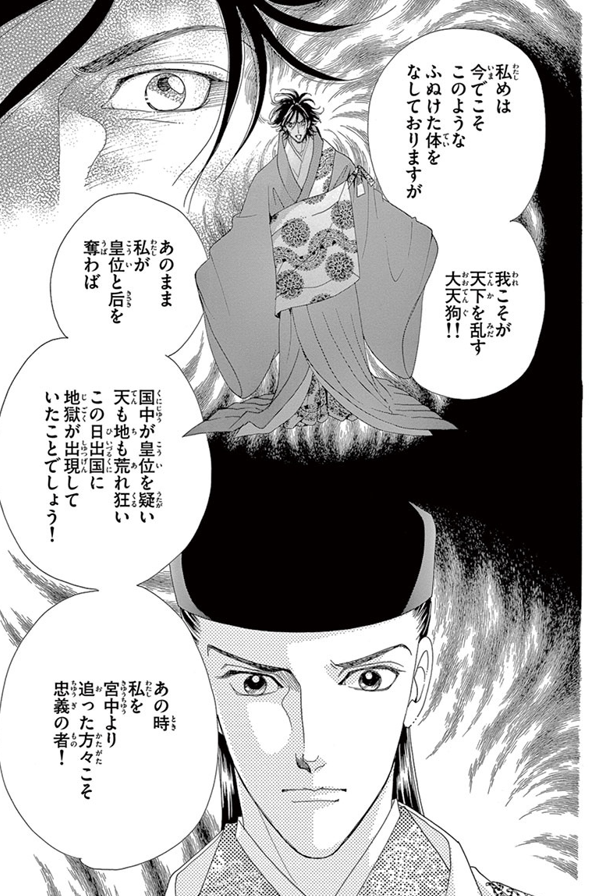
Page from volume 7, page 31.
©Chiho Saito/Shogakukan
So who is he? He refers to Suzakuin (the former Emperor) as his cousin, and therefore he is also a cousin to the current Emperor, who is Suzakuin’s younger brother. At some point in the past, he travelled to China and gained knowledge in esoteric fields such as physiognomy. That presumably occurred before a period ten-plus years prior to the current events, when he was involved in a scandal which resulted in his expulsion from the world of politics. He then secluded himself on the remote Yoshinoyama, where he prays for the safety and prosperity of the people in the capital, especially the imperial family, and especially especially Togu.
In this chapter, we learn the nature of that earlier scandal. Not only was he involved in a succession dispute with Suzakuin, but he lost that dispute – and we can deduce that that probably resulted in Suzakuin ascending the throne soon afterwards. Even worse, he desired Suzakuin’s late wife, and may well be the illegitimate father of the current Togu. When the current Emperor directly questions him about this in Episode 31, he denies that his relationship with Suzakuin’s wife reached that point, but the implication is that the stories are true. Of course, this would make his particular attachment to Togu make a lot of sense!
It’s also interesting when we compare his character to his counterpart in the original Torikaebaya monogatari. There, Yoshino no Miya has two beautiful daughters, whose mother was Yoshino’s Chinese wife who tragically died, leading him to take them back to Japan with him. He feels a responsibility to remain hidden away on Yoshinoyama, but wishes that his daughters could leave and live a more normal life; he gets his wish when Sara’s counterpart takes an interest in the elder daughter and Suiren’s counterpart later marries her in his stead. In the manga, Suzakuin’s late wife is the equivalent of Yoshino’s late wife, and Togu – as Suiren’s only love interest and Yoshino’s implied illegitimate daughter – turns out to be a composite character of the original Togu and Yoshino’s daughters.
And while revealing these dramatic details in Episode 31, Yoshino says one other interesting thing. As he insists that it was only right for him to driven away from the capital, he refers to himself as “the great tengu that sows chaos across the land” (天下を乱す大天狗). Now, a “tengu” can also figuratively mean an arrogant person, which would be a plausible interpretation in this context, but it isn’t the first time he’s been associated with tengu. On his very first appearance, his skills, his knowledge and his clothing led Sara and Suiren to mistake him for a tengu, and since then, he has made remarks about turning his back on a dark past. For him to call himself a “tengu” now – just before the only part of the original story where the tengu is mentioned – comes across as more than just a figure of speech. It suggests that while Togu takes on aspects of Yoshino’s daughters from Torikaebaya monogatari, the tengu’s story also becomes part of Yoshino’s story in this version of the tale.
More thoughts from Episode 30: A sarasoju by any other name
I’m back! There was no blog post last week because at the time I’d normally write it, I was in Torino, at the InTO MANGA: Critical Paths in Manga Studies conference. It was a privilege to be on a panel and get to talk about part of my project alongside such clever people! In my presentation, I focused on something I touched on a bit in this post from last August, using Episodes 15 and 16 as an example of how Saito expands on smaller plot points, adds cliffhangers, etc in service of telling the story of Torikaebaya monogatari the way she wants to tell it. And apart from that, I had a lot of fun throughout the conference, and I was really struck by the variety of subject matter – people had so much to say about manga from all kinds of angles!
Now that I’ve returned, I actually want to stick with Episode 30 just a wee bit longer, as it offers a good jumping-off point for another topic I wanted to return to. A couple of months ago, I wrote about the significance of the word 散る (chiru – to fall, to scatter, to die nobly) in relation to Sara’s departure from the court and in relation to his name. So just as I foretold back then, today I’ll say some more about the meaning of sarasoju!
I’m back! There was no blog post last week because at the time I’d normally write it, I was in Torino, at the InTO MANGA: Critical Paths in Manga Studies conference. It was a privilege to be on a panel and get to talk about part of my project alongside such clever people! In my presentation, I focused on something I touched on a bit in this post from last August, using Episodes 15 and 16 as an example of how Saito expands on smaller plot points, adds cliffhangers, etc in service of telling the story of Torikaebaya monogatari the way she wants to tell it. And apart from that, I had a lot of fun throughout the conference, and I was really struck by the variety of subject matter – people had so much to say about manga from all kinds of angles!
Now that I’ve returned, I actually want to stick with Episode 30 just a wee bit longer, as it offers a good jumping-off point for another topic I wanted to return to. A couple of months ago, I wrote about the significance of the word 散る (chiru – to fall, to scatter, to die nobly) in relation to Sara’s departure from the court and in relation to his name. So just as I foretold back then, today I’ll say some more about the meaning of sarasoju!
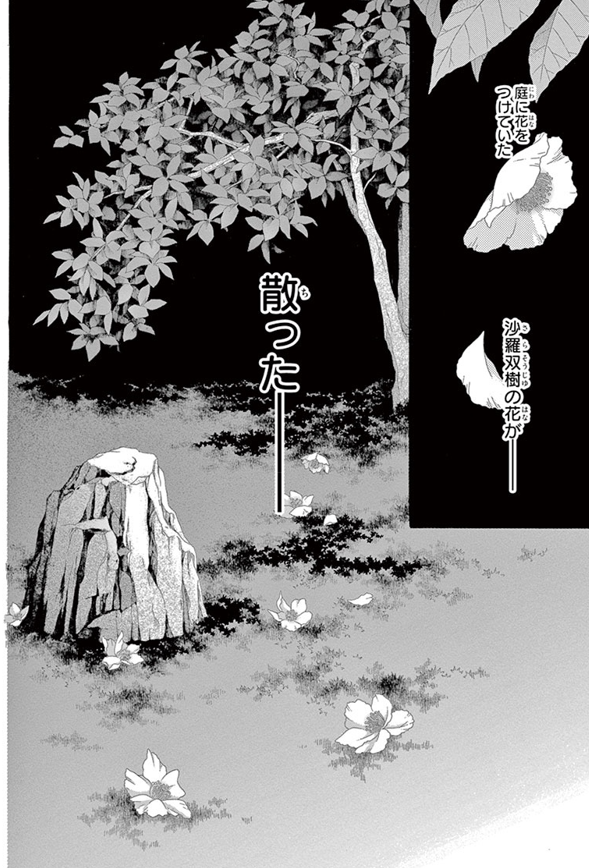
Page from volume 6, page 154.
©Chiho Saito/Shogakukan
Episode 30 opens with flowers falling from a tree. Before Tsuwabuki comes rushing to Uji to learn of Sara’s miscarriage, Sara narrates:
庭に花をつけていた
沙羅双樹の花が――
散った――
Sara uses the word 散る again, referring specifically to the flowers of the 沙羅双樹 (sarasoju) tree. The images and words parallel the opening of Episode 23 – the one in which Sara leaves the capital – where we see a blooming cherry tree in the court and Sara tells us he will disappear (also 散る). Both of these moments use seasonal flowers as a metaphor for death or departure.
Later in this chapter, the word 散る comes up once more. Before going to see Shi no Hime and help with her childbirth, Tsuwabuki vows to cherish Sara always, but Sara knows better, and thinks:
言葉だけが...
私たちの間を
舞い散るばかり
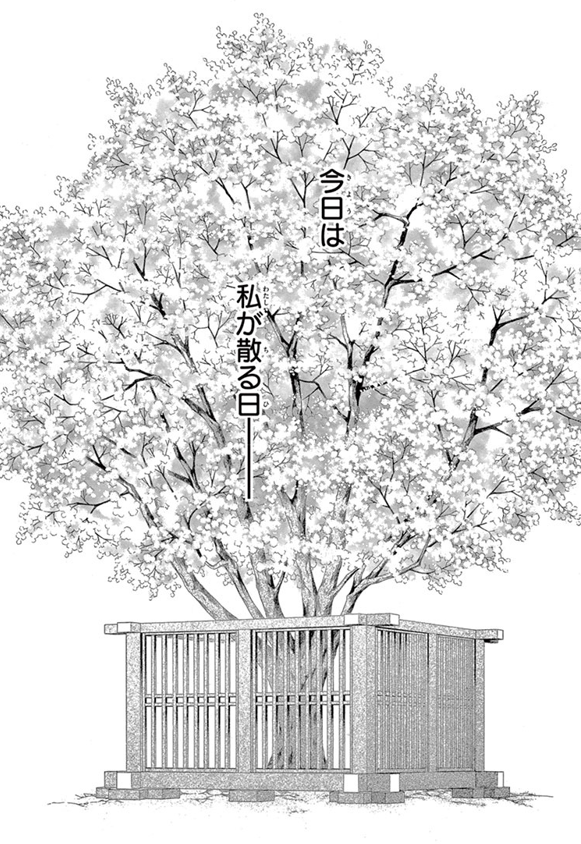
Page from volume 5, page 80.
©Chiho Saito/Shogakukan
This time, he’s saying that Tsuwabuki’s words are falling between the two of them. The word used for “fall” is 舞い散る (maichiru), a variation on 散る meaning to fall down softly, as if dancing, particularly when talking about flowers, petals, etc. This time, of course, the subject is words rather than flowers – but “word” (言葉) itself contains 葉 (leaf)! So with that in mind, I see this as a clear evocation of the same imagery as all the previous uses of 散る, suggesting something fleeting, inconsequential. In an effort to preserve this link, I chose to foreground the botanical theme in my translation:
Mere words…
flutter down like leaves
between you and me.
And now finally, what’s so significant about sarasoju? I mentioned way back that Sara is named after a tree that was growing nearby when he was born. Sarasoju is the Japanese name for the Indian sal tree. The “soju” part (双樹 – two trees) specifically references the story that the Buddha died under a pair of sal trees which then spontaneously bloomed out of season. The tree’s short-lived flowers thus represent impermanence, and their most famous appearance in Japanese literature is the opening lines of the Tale of the Heike, which use the sal flower as a reminder that all good things must come to an end.
Not the most cheerful thing to be named after, and the then-Emperor thinks so too when Sara enters court service early in Torikae baya. He relates the story of the Buddha’s passing and says, “It's an odd name for a vivacious young lad like you.” Sara is familiar with the story, and with the fact that the flowers are known for blooming in the morning and falling by the evening. But as eloquent as ever, he concludes:
Gracefully living one's life to the full for only one day.
I believe that is a beautiful way to live.
I am proud to bear such a name.
Apart from showing that Sara is suave and discerning enough to deserve an instantaneous promotion, this foreshadows the life Sara ends up having in Heian-kyo: bright, but sadly brief. 🥲
“Sarasoju” trees and fallen flowers at Torin’in in Kyoto.
By the way, the flowers that fall in the garden of Tsuwabuki’s Uji villa are actually not sal flowers – or at least, they’re not the same flowers that appear in Buddhist teachings. That’s because in Japan, sarasoju also refers to a different tree. Japan doesn’t have the right climate for real sal trees to grow, but rather than give up on the idea, temples opted to use an unrelated but visually somewhat similar briefly-blooming tree in its place. And so the term is used both for the original tree found in India and for the natsutsubaki or “summer camelia” (incidentally not really a camelia either).
I can’t quite get my head around what role that last element would play in this big nesting doll of metaphors, but at least I got to see the flowers myself when I was in Japan! I went to Torin’in, a temple in Kyoto that has the trees in its garden, and although they were already shrivelling up on the ground by the time I saw them, it was nice to get a real feel for how quickly they come and go, and maybe get a bit better at spotting them when they keep showing up in Torikae baya…
Thoughts from Episode 30: Two for the price of one
At the end of the previous chapter, Sara was having a medical incident, and at just the same time, Suiren came to the conclusion Sara couldn’t be found in Uji. In Episode 30, Tsuwabuki rushes back to his villa to learn that Sara’s baby was stillborn. Tsuwabuki is shocked, but Sara insists that he return to Shi no Hime, who is ready to give birth herself.
Having unknowingly caught sight of Sara last time, Suiren is worked up over the fact that she can’t stop thinking about the mystery woman. After worrying about being drawn to somebody other than Togu, it finally occurs to her that Sara too might’ve changed his appearance.
At the end of the previous chapter, Sara was having a medical incident, and at just the same time, Suiren came to the conclusion Sara couldn’t be found in Uji. In Episode 30, Tsuwabuki rushes back to his villa to learn that Sara’s baby was stillborn. Tsuwabuki is shocked, but Sara insists that he return to Shi no Hime, who is ready to give birth herself.
Having unknowingly caught sight of Sara last time, Suiren is worked up over the fact that she can’t stop thinking about the mystery woman. After worrying about being drawn to somebody other than Togu, it finally occurs to her that Sara too might’ve changed his appearance. She takes her attendants to Uji again, and some rumours lead them to the villa. While Aguri, Torako and Toramitsu head out for ingredients to make Sara’s favourite foods to cheer him up, Suiren enters the villa, alarming the maids who think they’ve seen a ghost. Finding that Sara is already gone, she hurries outside. She finds Sara wading out into the Ujigawa, calls out to him, and they embrace happily.
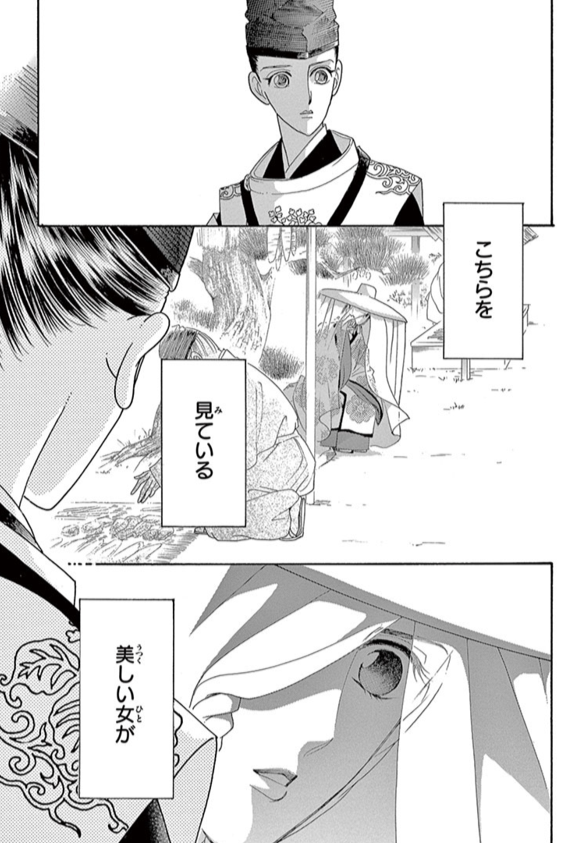
Suiren and Sara spot each other in Episode 29.
Page from volume 6, page 149. ©Chiho Saito/Shogakukan
And so, as Volume 6 comes to a close, Sara and Suiren have found each other again, with much having happened since their last contact. The chapter title reflects this: 魂合う (tama au) means something like “becoming one” or “understanding one another” in a soulmate sort of way. This is of course a bit tricky to translate into English given that their mysterious connection isn’t a romantic one, so what did I do about it? Wanting it to be similarly short and snappy, I decided to associate it with how the siblings describe their connection. There’s a scene in the previous chapter, when Suiren is fearing what might’ve happened to Sara, and she says:
I've felt like I’m in a trance, seeking out a lost half of myself…
And I don't know what will become of me if I can't find my other half…
So when it came to translating the title of Episode 30, I went with “Two Halves”, diverging from the original line to instead call back to Suiren’s line in a way that (hopefully!) will give readers the same sense of the siblings’ connection that 魂合う is supposed to express.
And on that note, I want to say a bit more today about that connection, as it’s a major focus of this chapter. After worrying that she’s attracted to the mystery woman in Uji, there are a couple of steps before Suiren realises that she saw Sara. First, it occurs to her that what caught her attention was the woman’s resemblance to herself; she then imagines that she witnessed another version of herself, from the past.
How could the same person be in two places at once? The maids at the villa offer one answer: they question whether the person visiting the house is a yurei (ユーレイ, a spirit of the dead, “ghost” in my translation) or an ikiryo (生霊, something more akin to an astral projection, tentatively “doppelganger” in my translation). The latter was a popular idea in the Heian period, even famously appearing in The Tale of Genji, and obviously doesn’t require the apparition to be of someone who is deceased.
The idea of Sara and Suiren as the same person aligns with the argument that Torikaebaya monogatari basically has one main character “played” by two individuals. The manga gives each sibling more time to shine, so we know they’re separate people, but as far as the people who know them are concerned, they might as well be one and the same. We’ve seen this in the way that Tsuwabuki looks at one and imagines the other, and the incident where Sara impersonates Suiren in a conversation with the Emperor.
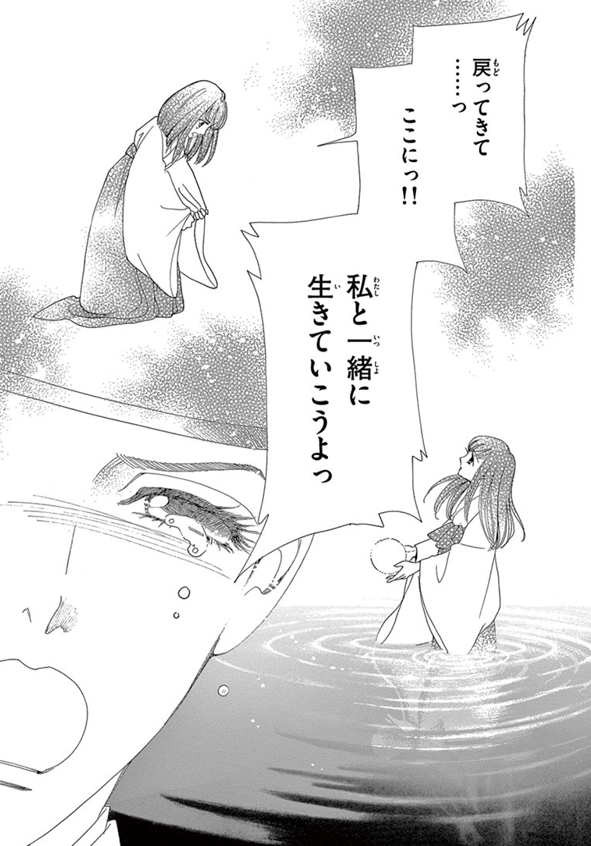

Suiren shouts out to Sara and pictures them as children in Episode 30.
Page from volume 6, page 187. ©Chiho Saito/Shogakukan
I’m also interested in the sense of Sara and Suiren as two equal parts of a whole as it relates to yin and yang. This concept was relevant to religion and philosophy of the Heian period, as seen earlier in the manga when the divination experts from the on’yoryo show up to give advice about the eclipse. The manga even prominently shows a taijitu (aka a “yin-yang symbol”) in Episode 27, when Sara is thinking about Tsuwabuki’s flighty, divided-loyalties nature. I find it really quite funny that the most explicit reference to yin and yang is a bit of a superficial application of the concept, given that it’s actually very fitting for Sara and Suiren.
Like yin and yang, Sara and Suiren are opposites with an interdependent relationship. They live in separate spheres and harbour secrets that are mirror images of each other, and when Sara disappears, Suiren feels the need to go in search of him. Notably, yin and yang are associated with the female and male principles respectively – so how does this show in Sara and Suiren? Well, Sara exhibits many of the qualities associated with yang: he’s bright and energetic, and he’s regularly compared to sunlight. Suiren, meanwhile, is more quiet and passive, and has the personal name Tsukimitsu, meaning “moonlight”. But it isn’t totally straightforward! Despite his cheery demeanour, Sara isn’t seen to be quite as outgoing as a young man should be, especially with the ladies. Meanwhile, Suiren worries in this chapter that some kind of masculine unfaithfulness has awoken in her.
In the context of yin and yang, this apparent contradiction still makes sense. As the taijitu demonstrates with the smaller circles in each half, the interconnectedness of the two means that each contains the other. Sara and Suiren are unusual compared with the other people around them, but the fact that they each have facets of the other gives them this special bond, and we’ve seen many times – since Episode 1, in fact! – that it also makes them able to achieve things that others might not.
It might come as a surprise that this deep connection between the siblings is something that isn’t actually present in Torikaebaya monogatari! In the Heian period version, they don’t know each other very well and interact quite rarely until the time comes for them to trade places, hence the idea that they basically take turns playing the “lead” role. But there’s obviously something interesting about the dynamic of these characters following a similar but opposite path, and so it’s one of many things that the manga explores to a degree that the source material never did.